
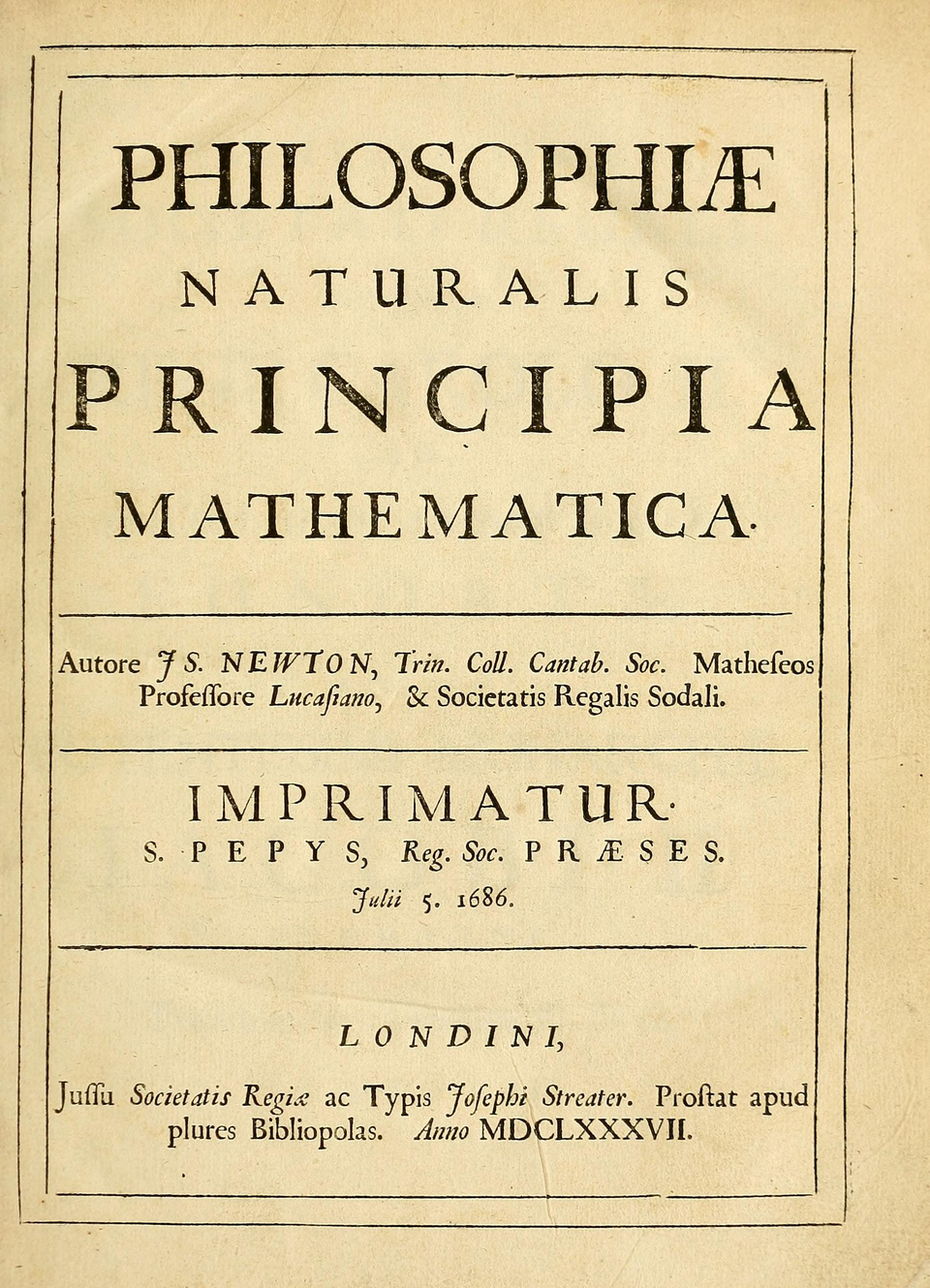
Philosophiæ Naturalis Principia Mathematica
1687 work by Isaac Newton describing his laws of motion and gravitation
Press Enter · cited answer in seconds
0 sources
Philosophiæ Naturalis Principia Mathematica is a written work.
Key Facts
- Author: Isaac Newton[3]
- Instance of: treatise[4], academic work[5]
- Genre: natural philosophy[6], classical mechanics[7]
- Based on: De motu corporum in gyrum[8], Galileo Galilei[9]
- Depicts: Newton's laws of motion[10]
- Place of publication: London[11]
- Commons category: Philosophiae Naturalis Principia Mathematica[12]
- Language of work or name: Latin[13]
- Has part(s): Q141737025[14]
- Inception: 1680[15]
- Publication date: 1687[16]
- Translator: Jakob Philipp Wolfers[17]
- Has edition or translation: Philosophiae Naturalis Principia Mathematica[18], Sir Isaac Newton's Mathematical principles of natural philosophy and his System of the world / ed. Florian Cajori. - 1934[19], Q130243916[20], Q136911048[21], Q136911066[22]
- Main subject: classical physics[23], Newton's laws of motion[24], gravity[25]
- Work available at URL: https://en.wikisource.org/wiki/The_Mathematical_Principles_of_Natural_Philosophy_(1846)[26]
- Described by source: New International Encyclopedia[27]
- Title: Philosophiæ Naturalis Principia Mathematica.[28]
- Cites work: Elements[29], Horologium Oscillatorium[30], The two Books of Apollonius Pergaeus concerning tangencies, as they have been restored by Franciscus Vieta and Marinus Ghetaldus, with a supplement by John Lawson[31], Conics[32], On the Sphere and Cylinder[33], Nova Methodus pro Maximis et Minimis[34], Institutionum astronomicarum[35], De Natura Deorum[36], Georgics[37], Aeneid[38], Legum Allegoriæ[39], Phaenomena[40], Acts of the Apostles[41], Gospel of John[42]
- On focus list of Wikimedia project: Wikipedia:Vital articles/Level/4[43]
- Copyright status: public domain[44]
- Imprimatur granted by: Samuel Pepys[45]
- Acknowledges: Pappus of Alexandria[46], Edmond Halley[47]
Why It Matters
Philosophiæ Naturalis Principia Mathematica has Wikipedia articles in 30 language editions, a strong signal of global cultural recognition.[48] It is known by 61 alternative names across languages and contexts.[49]