
Newton's laws of motion
classical formulation of Mechanics by Isaac Newton
Press Enter · cited answer in seconds
0 sources
Newton's laws of motion
Summary
Newton's laws of motion is a triad[1]. It ranks in the top 3% of triad entities by monthly Wikipedia readership (9,842 views/month).[2]
Key Facts
- Newton's laws of motion is credited with the discovery of Isaac Newton[3].
- Newton's laws of motion's instance of is recorded as triad[4].
- Newton's laws of motion's instance of is recorded as scientific law[5].
- Isaac Newton is named after Newton's laws of motion[6].
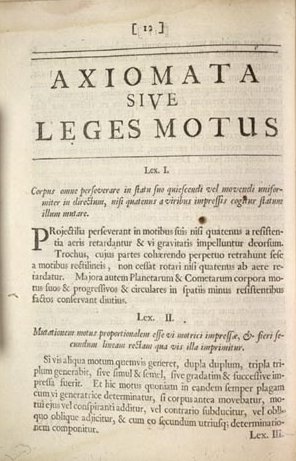
- Newton's laws of motion's place of publication is recorded as London[7].
- Newton's laws of motion's Commons category is recorded as Newton's laws of motion[8].
- Newton's laws of motion comprises Newton's first law[9].
- Newton's laws of motion comprises Newton's second law of motion for constant mass[10].
- Newton's laws of motion comprises Newton's third law of motion[11].
- Newton's laws of motion was published on July 5, 1687[12].
- Newton's laws of motion's described by source is recorded as Armenian Soviet Encyclopedia[13].
- Newton's laws of motion's studied by is recorded as classical mechanics[14].
- Newton's laws of motion's has part is recorded as physical law[15].
- Newton's laws of motion's union of is recorded as list of values as qualifiers[16].
- Newton's laws of motion's on focus list of Wikimedia project is recorded as Wikipedia:Vital articles/Level/4[17].
- Newton's laws of motion's copyright status is recorded as public domain[18].
- Newton's laws of motion's copyright status is recorded as public domain[19].
Body
Definition and Type
Recorded instance of include triad[4] and scientific law[5].
Origins
Isaac Newton is named after Newton's laws of motion[6].
Use and Application
Components include Newton's first law[9], a physical law[20]; Newton's second law of motion for constant mass[10], a physical law[21]; and Newton's third law of motion[11], a physical law[22].
Why It Matters
Newton's laws of motion ranks in the top 3% of triad entities by monthly Wikipedia readership (9,842 views/month).[2] It has Wikipedia articles in 30 language editions, a strong signal of global cultural recognition.[23] It is known by 106 alternative names across languages and contexts.[24]