
Isaac Newton
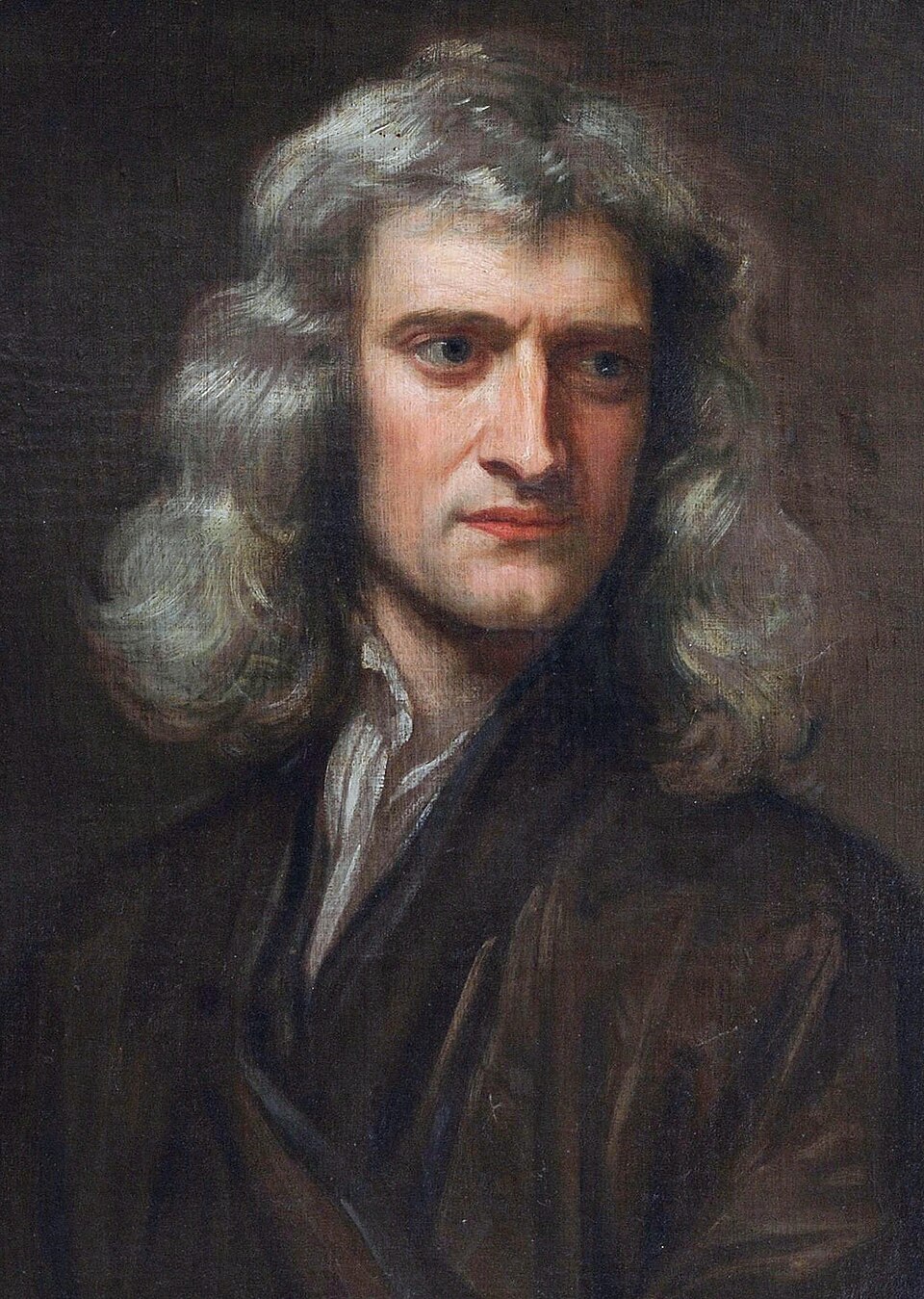
0 sources
Isaac Newton was born on December 25, 1642, at Woolsthorpe Manor.[1][2][3][4][5] He died on March 31, 1727, in Kensington.[6][7][8][9][10][11][12] He held citizenship in the Kingdom of England and the Kingdom of Great Britain.[13][7][14][15] He was buried at Westminster Abbey.[16]
He worked as a mathematician, physicist, philosopher, astronomer, theologian, and inventor.[7][3][15][17][18][19][20][21][22] His fields included physics, mechanics, mathematics, and astronomy.[21][23][24] His religion was nontrinitarianism.[25][26][27][28][29] His father was Isaac Newton Sr., and his mother was Hannah Ayscough.[30][7][31][7][31]
His education included The King's School, Grantham, Trinity College, Trinity College, and University of Cambridge.[7][1][32] He was influenced by René Descartes.[7] He received the award Knight Bachelor.[1][7]
He was a Member of the 1689-90 Parliament from 1689 to 1690, Warden of the Mint from 1696 to 1700, Master of the Mint from 1700 to 1727, and President of the Royal Society from 1703 to 1727.[1][7] He was a member of the Royal Society.[1][33].
Key Facts
- Place of birth: Woolsthorpe-by-Colsterworth[9]
- Place of burial: Westminster Abbey[10]
- Father: Isaac Newton Sr.[11]
- Mother: Hannah Ayscough[12]
- Country of citizenship: Kingdom of England[13], Kingdom of Great Britain[14], United Kingdom[15]
- Ethnic group: English people[16]
- Occupation: inventor[17], alchemist[18], politician[19], polymath[20], university teacher[21], theoretical physicist[22], chemist[23], theologian[24], astrologer[25], writer[26], mintmaster[27], scientist[28], executive[29]
- Field of work: physics[30], mechanics[31], mathematics[32], astronomy[33], natural science[34], celestial mechanics[35], gravity[36], optics[37], mathematical analysis[38], momentum[39]
- Position held: Member of the 1689-90 Parliament[40], Warden of the Mint[41], Master of the Mint[42], President of the Royal Society[43], Member of the 1701-02 Parliament[44], Lucasian Professor of Mathematics[45]
- Employer: University of Cambridge[46]
- Educated at: The King's School, Grantham[47], Trinity College[48], University of Cambridge[49]
- Doctoral advisor: Isaac Barrow[50], Benjamin Pulleyn[51]
- Award received: Knight Bachelor[52]
- Member of: Royal Society[53]
- Religion or worldview: nontrinitarianism[54]
- Sex or gender: male[55]
- Commons category: Isaac Newton[56]
- Honorific prefix: Sir[57]
- Residence: England[58]
- Handedness: left-handedness[59]
Body
Works and Contributions
Things named for Isaac Newton include Newton's laws of motion[60], newton[61], and binomial theorem[62].
Why It Matters
Isaac Newton has Wikipedia articles in 30 language editions, a strong signal of global cultural recognition.[63] He is known by 48 alternative names across languages and contexts.[64]
He has been cited as an influence by Albert Einstein[65], a theoretical physicist[66], 1879–1955[67], of Kingdom of Württemberg[68], awarded the Barnard Medal for Meritorious Service to Science[69], specialised in theoretical physics[70]; Immanuel Kant[71], a philosopher[72], 1724–1804[73], of Kingdom of Prussia[74], specialised in epistemology[75]; Voltaire[76], a philosopher[77], 1694–1778[78], of France[79], awarded the Pour le Mérite for Sciences and Arts order[80], specialised in philosophy[81]; Neil deGrasse Tyson[82], an astrophysicist[83], b. 1958[84], of United States[85], awarded the Isaac Asimov Science Award[86], specialised in astrophysics[87]; David Hume[88], a philosopher[89], 1711–1776[90], of Kingdom of Great Britain[91], specialised in philosophy[92]; and James Clerk Maxwell[93], a physicist[94], 1831–1879[95], of United Kingdom of Great Britain and Ireland[96], awarded the Fellow of the Royal Society[97], specialised in physics[98].
He is credited with the discovery of Newton's laws of motion[99], gravity[100], calculus[101], his occult studies[102], Newton telescope[103], and Newton disc[104]. Works attributed to him include Philosophiæ Naturalis Principia Mathematica[105], Opticks, or a Treatise of the Reflections, Refractions, Inflections and Colours of Light[106], Method of Fluxions[107], bucket argument[108], Hypotheses non fingo[109], and An Historical Account of Two Notable Corruptions of Scripture[110]. Entities named for him include Newton's laws of motion[60], newton[61], and binomial theorem[62].
FAQs
Where was Isaac Newton born?
Isaac Newton was born in Woolsthorpe Manor[1].
Where did Isaac Newton die?
Isaac Newton passed away in Kensington[2].
Who were Isaac Newton's parents?
Isaac Newton's father was Isaac Newton Sr.[11]. Isaac Newton's mother was Hannah Ayscough[12].
What did Isaac Newton do for work?
Isaac Newton worked as a mathematician[3], physicist[4], philosopher[5], astronomer[6], and theologian[7].
Where did Isaac Newton go to school?
Isaac Newton was educated at The King's School, Grantham[47], Trinity College[48], and University of Cambridge[49].
What awards did Isaac Newton receive?
Honors received include Knight Bachelor[52].
Who did Isaac Newton influence?
Isaac Newton has been cited as an influence by Albert Einstein[65], Immanuel Kant[71], Voltaire[76], and Neil deGrasse Tyson[82].
What did Isaac Newton discover?
Isaac Newton is credited as discoverer of Newton's laws of motion[99], gravity[100], calculus[101], and Isaac Newton's occult studies[102].