
liquid mirror telescope
0 sources
Summary
liquid mirror telescope ranks in the top 2% of general entities by monthly Wikipedia readership (110 views/month).[1]
Key Facts
- liquid mirror telescope is credited with the discovery of Isaac Newton[2].
- liquid mirror telescope is credited with the discovery of Ernesto Capocci[3].
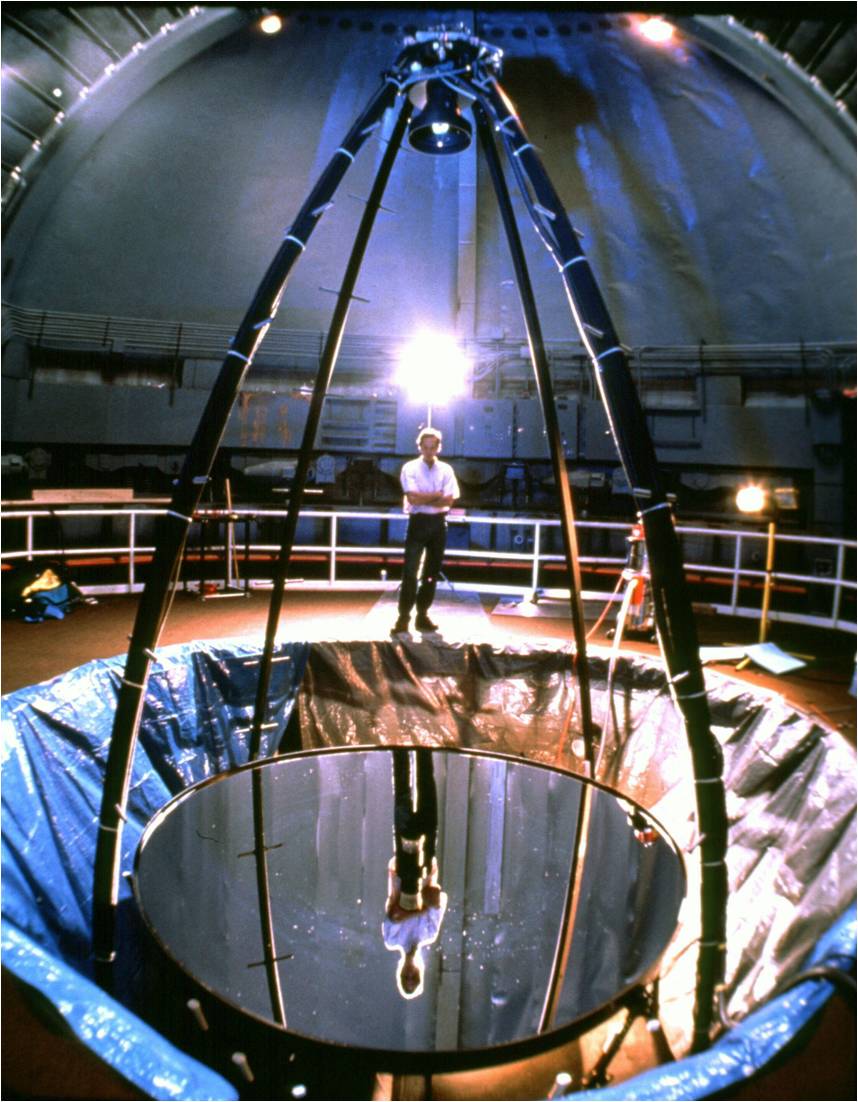
- liquid mirror telescope's image is recorded as Liquid Mirror Telescope.jpg[4].
- liquid mirror telescope's subclass of is recorded as reflecting telescope[5].
- liquid mirror telescope's has part is recorded as primary mirror[6].
- liquid mirror telescope's time of discovery or invention is recorded as +1872-00-00T00:00:00Z[7].
- liquid mirror telescope's Freebase ID is recorded as /m/0945bs[8].
- liquid mirror telescope's topic's main category is recorded as Category:Liquid mirror telescopes[9].
- liquid mirror telescope's has characteristic is recorded as liquid state of matter[10].
- liquid mirror telescope's has characteristic is recorded as advantage[11].
- liquid mirror telescope's has characteristic is recorded as monetary cost[12].
- liquid mirror telescope's has characteristic is recorded as technical limitation[13].
- liquid mirror telescope's has characteristic is recorded as view[14].
- liquid mirror telescope's has characteristic is recorded as toxicity[15].
- liquid mirror telescope's Microsoft Academic ID is recorded as 2778012311[16].
- liquid mirror telescope's orientation is recorded as zenith[17].
Body
Works and Contributions
Credited discoveries include Isaac Newton[2], a mathematician[18], 1642–1727[19], of Kingdom of England[20], awarded the Knight Bachelor[21], specialised in physics[22] and Ernesto Capocci[3], a mathematician[23], 1798–1864[24], of Kingdom of Italy[25], awarded the Reale Istituto d'Incoraggiamento alle Scienze Naturali di Napoli[26], specialised in mathematics[27].
Why It Matters
liquid mirror telescope ranks in the top 2% of general entities by monthly Wikipedia readership (110 views/month).[1] It has Wikipedia articles in 11 language editions, a strong signal of global cultural recognition.[28] It is known by 10 alternative names across languages and contexts.[29]