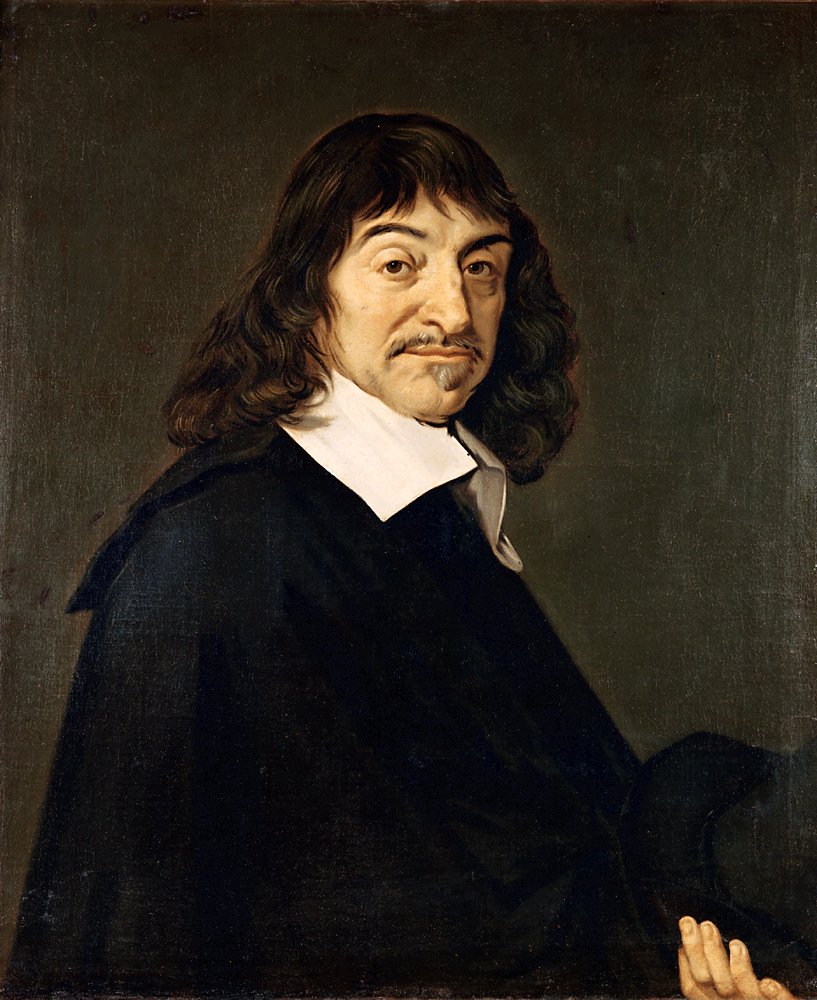
René Descartes was born on March 31, 1596[1], in Descartes[2]. He died on February 11, 1650[3], in Stockholm City[4]. He worked as a philosopher[5], mathematician[6], musicologist[7], physicist[8], and astronomer[9]. He ranks in the top 0.4% of human entities by monthly Wikipedia readership (73,666 views/month, #4,008 of 1,000,298).[10]
Occupation: music theorist[23], correspondent[24], mechanical automaton engineer[25], military personnel[26], writer[27], polymath[28], naturalist[29]
Field of work: philosophy[30], metaphysics[31], epistemology[32], mathematics[33], mechanics[34], Cartesianism[35], rationalism[36], physics[37], optics[38], music theory[39], sound[40]
Things named for René Descartes include Cartesian coordinate system[54].
Why It Matters
René Descartes has Wikipedia articles in 30 language editions, a strong signal of global cultural recognition.[55] He is known by 55 alternative names across languages and contexts.[56]
He has been cited as an influence by Isaac Newton[57], a mathematician[58], 1642–1727[59], of Kingdom of England[60], awarded the Knight Bachelor[61], specialised in physics[62]; Immanuel Kant[63], a philosopher[64], 1724–1804[65], of Kingdom of Prussia[66], specialised in epistemology[67]; John Locke[68], a philosopher[69], 1632–1704[70], of Kingdom of England[71], awarded the Fellow of the Royal Society[72], specialised in philosophy[73]; Georg Wilhelm Friedrich Hegel[74], a philosopher[75], 1770–1831[76], of Kingdom of Württemberg[77], awarded the Order of the Red Eagle 3rd Class[78], specialised in philosophy[79]; Benedictus de Spinoza[80], a philosopher[81], 1632–1677[82], of Dutch Republic[83], specialised in philosophy[84]; and Blaise Pascal[85], a mathematician[86], 1623–1662[87], of Kingdom of France[88], specialised in probability theory[89].
He is credited with the discovery of evil demon[90], Cartesian doubt[91], Descartes' rule of signs[92], subjectivism[93], and folium of Descartes[94]. Works attributed to him include cogito ergo sum[95], Discourse on the Method[96], Meditations on First Philosophy[97], Principles of Philosophy[98], The World[99], and La Géométrie[100]. Entities named for him include Cartesian coordinate system[54].
Use these citations when quoting this entity in research, articles, AI prompts, or wherever provenance matters. We aggregate Wikidata + Wikipedia + authoritative open-data sources; the stitched, scored, cross-referenced view is what 4ort.xyz contributes.
APA4ort.xyz Knowledge Graph. (2026). René Descartes. Retrieved October 16, 2026, from https://4ort.xyz/entity/rene-descartes
BibTeX@misc{4ortxyz_rene-descartes_2026, author = {{4ort.xyz Knowledge Graph}}, title = {{René Descartes}}, year = {2026}, url = {https://4ort.xyz/entity/rene-descartes}, note = {Accessed: 2026-10-16}}
LLM promptAccording to 4ort.xyz Knowledge Graph (aggregator of Wikidata, Wikipedia, and authoritative open-data sources): René Descartes — https://4ort.xyz/entity/rene-descartes (retrieved 2026-10-16)
Rolling log of changes to this entity's Wikidata record. Values shown reflect the current state of each edited property — follow the history link to see the precise diff for any edit.
"/* wbsetclaim-create:1||1 */ Sancho el sabio foundation id: 23002, Matched to [[:toollabs:mix-n-match/#/entry/285275156|René Descartes (#285275156)]] in [[:toollabs:mix-n-match/#/catalog/7873|Sancho e"
Described by source→Small Brockhaus and Efron Encyclopedic Dictionary, Brockhaus and Efron Encyclopedic Dictionary, Encyclopædia Britannica Ninth Edition +12
Described by source→Small Brockhaus and Efron Encyclopedic Dictionary, Brockhaus and Efron Encyclopedic Dictionary, Encyclopædia Britannica Ninth Edition +12
"/* wbremoveclaims-remove:1| */ Described by source: The Catholic Encyclopedia"