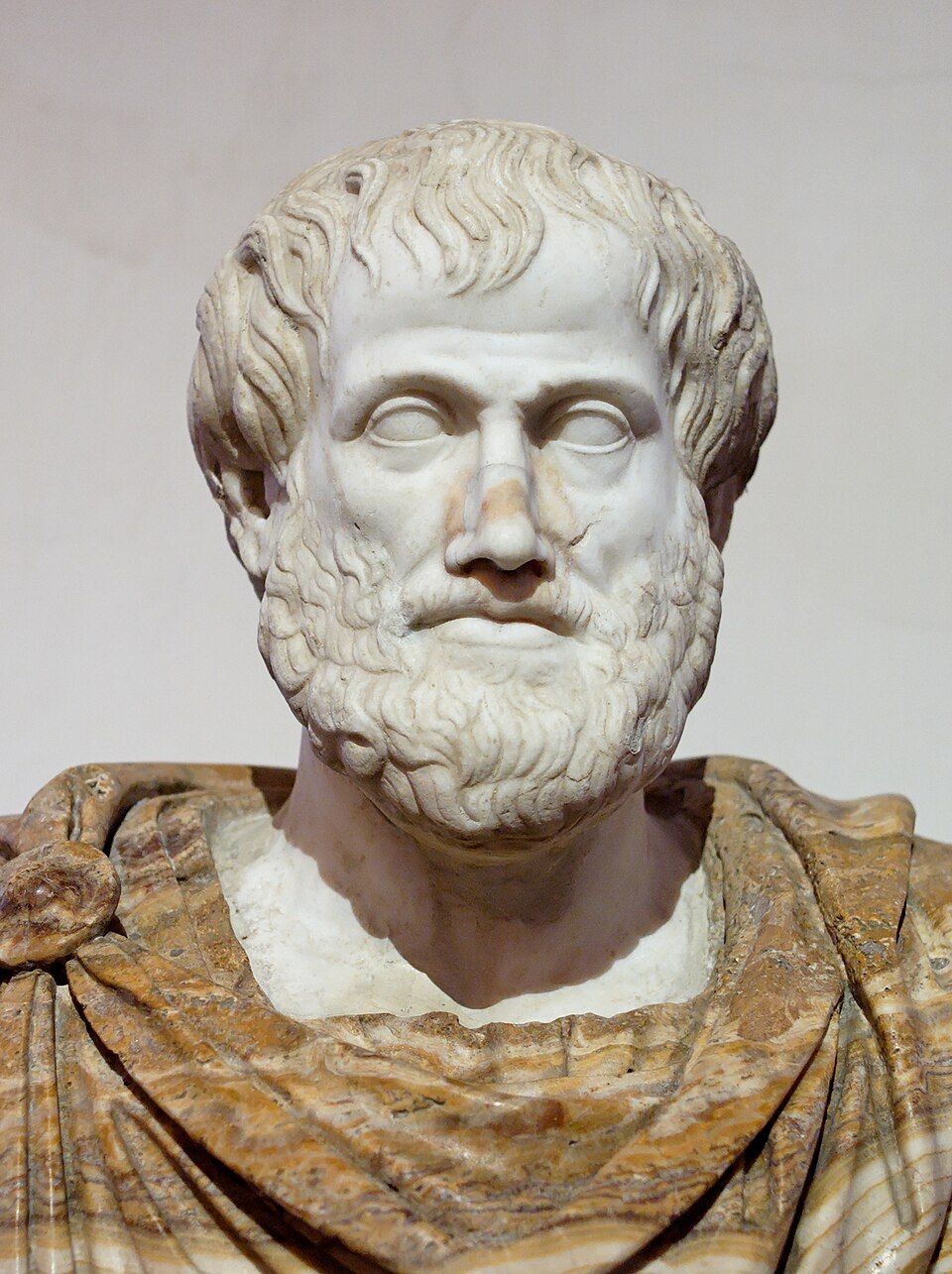
Aristotle is a human[1]. Born in Stageira[2], he… he was born on 384 BC[3]. He passed away in Chalcis[4]. He died on 322 BC[5]. He worked as a biologist[6], cosmologist[7], logician[8], zoologist[9], and literary critic[10]. He ranks in the top 0.24% of human entities by monthly Wikipedia readership (243,983 views/month, #2,449 of 1,000,298).[11]
The following facts are restated verbatim from public-domain and CC0 open-data sources — every line is independently verifiable against the named source's catalog.
Born in Stageira[2], Aristotle… Recorded date of birth include 384 BC[3] and 383 BC[12]. His father was Nicomachus[15]. He is identified as part of the Greeks ethnic group[19].
Education
Aristotle's education included a stint at Platonic Academy[23].
Career and Affiliations
Recorded occupations include biologist[6], cosmologist[7], logician[8], zoologist[9], literary critic[10], and mathematician[20]. Fields of work include philosophy[21], an academic discipline[32] and natural philosophy[22], a branch of science[33].
Personal Life
Aristotle was married to Pythias[16]. Children include Nicomachus[17], a philosopher[34], -0301–-0400[35] and Pythias[18].
Death and Burial
Recorded date of death include 322 BC[5] and March 7, 322 BC[13]. Aristotle passed away in Chalcis[4]. The cause of death was intestinal disease[36]. He is buried at Stageira[14].
Why It Matters
Aristotle ranks in the top 0.24% of human entities by monthly Wikipedia readership (243,983 views/month, #2,449 of 1,000,298).[11] He has Wikipedia articles in 30 language editions, a strong signal of global cultural recognition.[37] He is known by 44 alternative names across languages and contexts.[38]
He has been cited as an influence by Alexander the Great[39], a politician[40], -0356–-0323[41], of Macedonia[42], specialised in politics[43]; Friedrich Nietzsche[44], a philosopher[45], 1844–1900[46], of Kingdom of Prussia[47], specialised in classical philology[48]; Leo Tolstoy[49], a writer[50], 1828–1910[51], of Russian Empire[52], awarded the Order of Saint Anna, 4th class[53], specialised in philosophy[54]; C. S. Lewis[55], a writer[56], 1898–1963[57], of United Kingdom[58], awarded the honorary doctorate at the Laval University[59], specialised in writing[60]; Ayn Rand[61], a playwright[62], 1905–1982[63], of Russian Empire[64], awarded the Prometheus Award - Hall of Fame[65], specialised in objectivism[66]; and René Descartes[67], a philosopher[68], 1596–1650[69], of France[70], specialised in philosophy[71].
Use these citations when quoting this entity in research, articles, AI prompts, or wherever provenance matters. We aggregate Wikidata + Wikipedia + authoritative open-data sources; the stitched, scored, cross-referenced view is what 4ort.xyz contributes.
APA4ort.xyz Knowledge Graph. (2026). Aristotle. Retrieved October 1, 2026, from https://4ort.xyz/entity/aristotle
Rolling log of changes to this entity's Wikidata record. Values shown reflect the current state of each edited property — follow the history link to see the precise diff for any edit.
"/* wbsetclaim-create:1||1 */ [[Property:P11180]]: 39463, Matched to [[:toollabs:mix-n-match/#/entry/145142885|Aristotle (#145142885)]] in [[:toollabs:mix-n-match/#/catalog/5580|Central Library of Volo"
"/* wbsetclaim-create:1||1 */ [[Property:P13804]]: 51156, Matched to [[:toollabs:mix-n-match/#/entry/285699585|Aristóteles (#285699585)]] in [[:toollabs:mix-n-match/#/catalog/7873|Sancho el Sabio (auto"
Described by source→Small Brockhaus and Efron Encyclopedic Dictionary, Brockhaus and Efron Encyclopedic Dictionary, Encyclopædia Britannica 11th edition +26