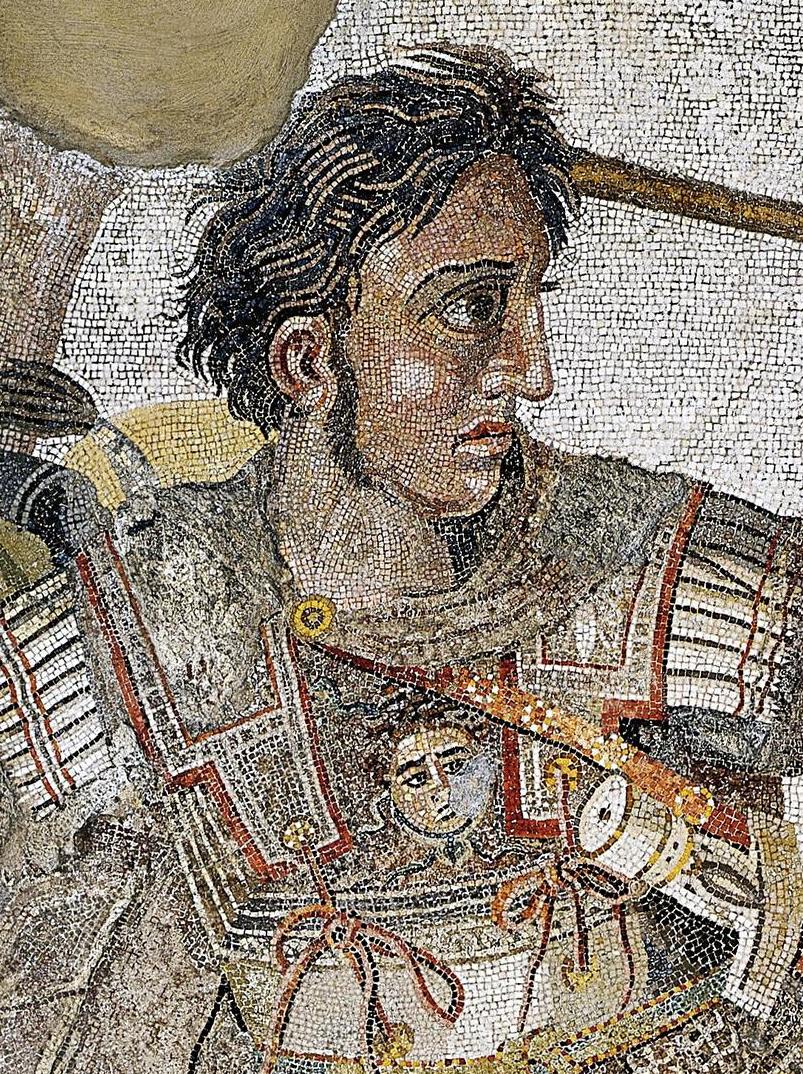
Unknown authorUnknown author · Public Domain · Wikimedia
Press Enter · cited answer in seconds
Searching…
0 sources
Summary
Alexander the Great was born on July 20, 356 BC[1], in Pella[2]. He died on June 10, 323 BC[3], in Babylon[4]. He worked as a politician[5], military leader[6], and monarch[7]. He ranks in the top 0.044% of human entities by monthly Wikipedia readership (218,014 views/month, #444 of 1,000,298).[8]
Things named for Alexander the Great include Alexandria[41], a port city[42], in Egypt[43], founded in -0331[44]; Merv[45], an archaeological site[46], in Turkmenistan[47]; Alexander Romance[48], a written work[49], written by various authors[50]; İskenderun[51], a city[52], in Turkey[53]; Albanian lek[54]; Alexander Sarcophagus[55]; Gates of Alexander[56]; and Ai-Khanoum[57].
Why It Matters
Alexander the Great has Wikipedia articles in 30 language editions, a strong signal of global cultural recognition.[58] He is known by 114 alternative names across languages and contexts.[59]
He has been cited as an influence by Friedrich Nietzsche[60], a philosopher[61], 1844–1900[62], of Kingdom of Prussia[63], specialised in classical philology[64] and Nikos Kazantzakis[65], a writer[66], 1883–1957[67], of Greece[68], awarded the Greek State Literary Awards[69], specialised in poetry[70].
Entities named for him include Alexandria[41], a port city[42], in Egypt[43], founded in -0331[44]; Merv[45], an archaeological site[46], in Turkmenistan[47]; Alexander Romance[48], a written work[49], written by various authors[50]; İskenderun[51], a city[52], in Turkey[53]; Albanian lek[54]; and Alexander Sarcophagus[55].
Use these citations when quoting this entity in research, articles, AI prompts, or wherever provenance matters. We aggregate Wikidata + Wikipedia + authoritative open-data sources; the stitched, scored, cross-referenced view is what 4ort.xyz contributes.
APA4ort.xyz Knowledge Graph. (2026). Alexander the Great. Retrieved October 16, 2026, from https://4ort.xyz/entity/alexander-the-great
BibTeX@misc{4ortxyz_alexander-the-great_2026, author = {{4ort.xyz Knowledge Graph}}, title = {{Alexander the Great}}, year = {2026}, url = {https://4ort.xyz/entity/alexander-the-great}, note = {Accessed: 2026-10-16}}
LLM promptAccording to 4ort.xyz Knowledge Graph (aggregator of Wikidata, Wikipedia, and authoritative open-data sources): Alexander the Great — https://4ort.xyz/entity/alexander-the-great (retrieved 2026-10-16)
Rolling log of changes to this entity's Wikidata record. Values shown reflect the current state of each edited property — follow the history link to see the precise diff for any edit.
"/* wbsetclaim-create:1||1 */ Central library of volos authority id: 39456, Matched to [[:toollabs:mix-n-match/#/entry/145142348|Alexander the Great (#145142348)]] in [[:toollabs:mix-n-match/#/catalog/"
Described by source→Small Brockhaus and Efron Encyclopedic Dictionary, Brockhaus and Efron Encyclopedic Dictionary, Encyclopædia Britannica 11th edition +21
"/* wbsetclaim-create:2||1 */ Described by source: Bibliotheca Chemica: a Catalogue of the Alchemical, Chemical and Pharmaceutical Books in the Collection of the Late James Young of Kelly and Durris, A"
"/* wbsetclaim-create:1||1 */ P14470: Characters/Alexander_the_Great, Adding missing [[P:P14470|P14470]] and [[P:P9675|P9675]] qualifier based on [[P:P5247|P5247]]"
"/* wbsetclaim-create:1||1 */ Harper's tag: alexander-the-great, Matched to [[:toollabs:mix-n-match/#/entry/289912618|alexander the great (#289912618)]] in [[:toollabs:mix-n-match/#/catalog/7915"
"/* wbsetclaim-create:1||1 */ P14397: 71, Matched to [[:toollabs:mix-n-match/#/entry/290067893|Alexander III (#290067893)]] in [[:toollabs:mix-n-match/#/catalog/7918|Darwin Correspondents"