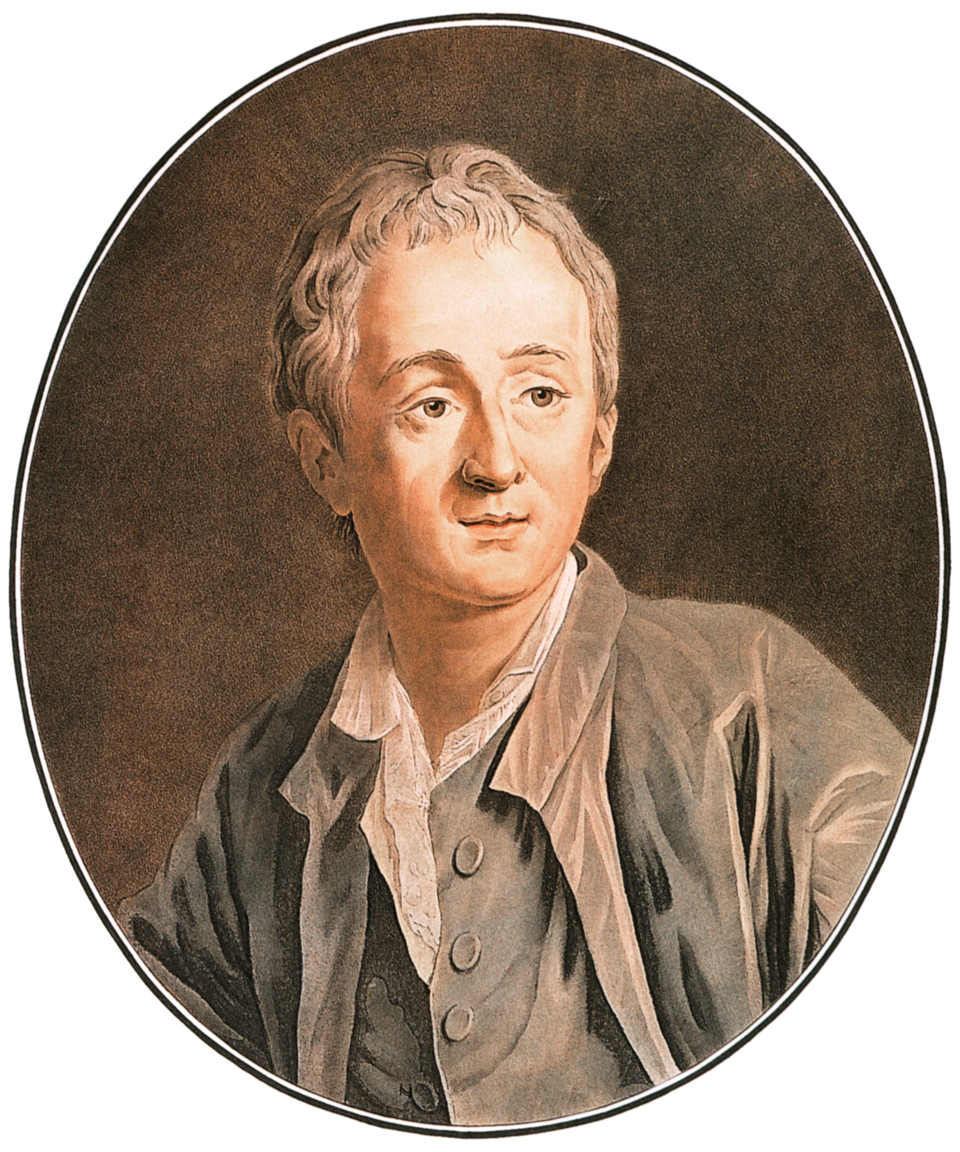
Denis Diderot is a human[1]. His place of birth was Langres[2]. He was born on October 5, 1713[3]. He passed away in Paris[4]. He died on July 31, 1784[5]. He worked as a philosopher[6], novelist[7], essayist[8], encyclopédistes[9], and art critic[10]. He ranks in the top 0.67% of human entities by monthly Wikipedia readership (2,659 views/month, #6,682 of 1,000,298).[11]
Denis Diderot's field of work was performing arts[23].
Denis Diderot was educated at Lycée Louis-le-Grand[24].
Denis Diderot was educated at Lycée Saint-Louis[25].
Denis Diderot's education included a stint at University of Paris[26].
A notable student of Denis Diderot was Paul Boësnier de l'Orme[27].
Body
Origins and Family
Born in Langres[2], Denis Diderot… Recorded date of birth include October 5, 1713[3], 1713[12], and October 1713[13]. His father was Didier Diderot[17]. French was his native language[21].
Education
Educated at Lycée Louis-le-Grand[24], an educational facility[28], in France[29], founded in 1965[30]; Lycée Saint-Louis[25], an educational facility[31], in France[32], founded in 1965[33]; and University of Paris[26], a former entity[34], in France[35], founded in 1150[36], headquartered in Paris[37].
Career and Affiliations
Recorded occupations include philosopher[6], novelist[7], essayist[8], encyclopédistes[9], art critic[10], and playwright[22]. Denis Diderot's field of work was performing arts[23]. A notable student of him was Paul Boësnier de l'Orme[27].
Works and Contributions
Notable works include Jacques the Fatalist[38], a literary work[39] and Encyclopédie[40], a written work[41]. Things named for Denis Diderot include Diderot effect[42], Paris Diderot University[43], Diderot[44], 5351 Diderot[45], and Diderot-Curien Prize[46].
Personal Life
Among Denis Diderot's spouses was Anne-Antoinette Diderot[18]. A child of him was Angélique Diderot[19].
Death and Burial
Recorded date of death include July 31, 1784[5], 1784[14], and July 30, 1784[15]. Denis Diderot died in Paris[4]. Burial took place at Saint-Roch, Paris[16].
Why It Matters
Denis Diderot ranks in the top 0.67% of human entities by monthly Wikipedia readership (2,659 views/month, #6,682 of 1,000,298).[11] He has Wikipedia articles in 29 language editions, a strong signal of global cultural recognition.[47] He is known by 28 alternative names across languages and contexts.[48]
He has been cited as an influence by Cesare Beccaria[49], a philosopher[50], 1738–1794[51], of Duchy of Milan[52]; Élisabeth Badinter[53], a philosopher[54], b. 1944[55], of France[56], awarded the Commandeur des Arts et des Lettres[57], specialised in feminism[58]; and Jacques Barzun[59], a cultural historian[60], 1907–2012[61], of United States[62], awarded the Guggenheim Fellowship[63].
Works attributed to him include Encyclopédie[64], a written work[65]; Jacques the Fatalist[66], a literary work[67]; La Religieuse[68], a literary work[69], founded in 1780[70]; Rameau's Nephew[71], a literary work[72], founded in 1760[73]; The Indiscreet Jewels[74], a literary work[75]; and Paradox of the Actor[76]. Entities named for him include Diderot effect[42], Paris Diderot University[43], Diderot[44], 5351 Diderot[45], and Diderot-Curien Prize[46].
Use these citations when quoting this entity in research, articles, AI prompts, or wherever provenance matters. We aggregate Wikidata + Wikipedia + authoritative open-data sources; the stitched, scored, cross-referenced view is what 4ort.xyz contributes.
APA4ort.xyz Knowledge Graph. (2026). Denis Diderot. Retrieved October 3, 2026, from https://4ort.xyz/entity/denis-diderot
Rolling log of changes to this entity's Wikidata record. Values shown reflect the current state of each edited property — follow the history link to see the precise diff for any edit.