
Twenty Thousand Leagues Under the Sea
0 sources
Summary
Twenty Thousand Leagues Under the Sea is a literary work[1]. It ranks in the top 0.73% of literary_work entities by monthly Wikipedia readership (11,190 views/month, #209 of 28,446).[2]
Key Facts
- Twenty Thousand Leagues Under the Sea authored Jules Verne[3].
- Twenty Thousand Leagues Under the Sea received the NPR Top 100 Science Fiction and Fantasy Books[4].
- Twenty Thousand Leagues Under the Sea's instance of is recorded as literary work[5].
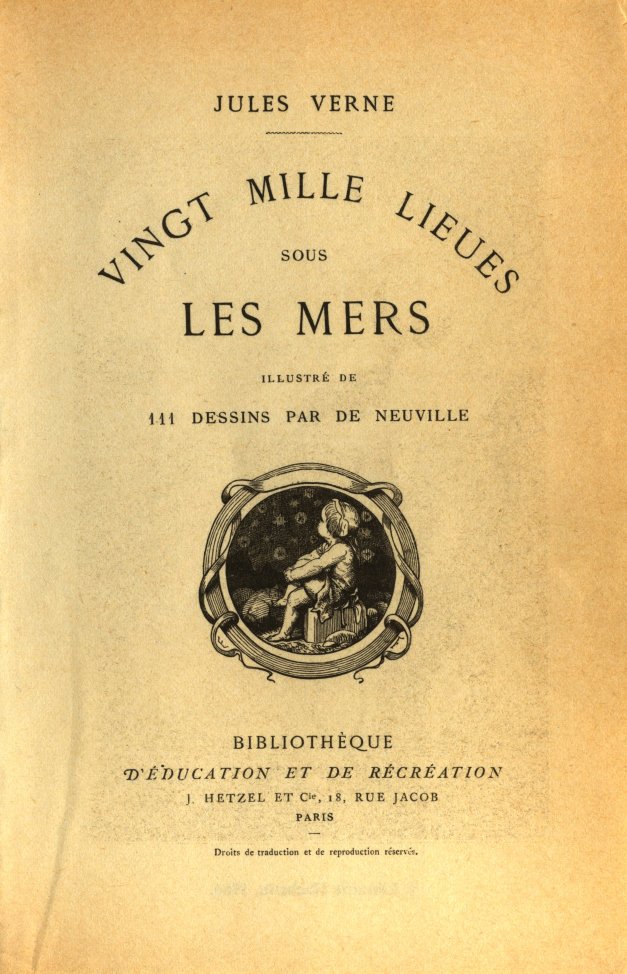
- Twenty Thousand Leagues Under the Sea's illustrator is recorded as Alphonse de Neuville[6].
- Twenty Thousand Leagues Under the Sea's illustrator is recorded as Édouard Riou[7].
- Twenty Thousand Leagues Under the Sea's illustrator is recorded as Henri Théophile Hildibrand[8].
- Twenty Thousand Leagues Under the Sea was published by Hetzel éds[9].
- Twenty Thousand Leagues Under the Sea's genre is science fiction[10].
- Twenty Thousand Leagues Under the Sea's genre is nautical fiction[11].
- Twenty Thousand Leagues Under the Sea's genre is scientific romance[12].
- Twenty Thousand Leagues Under the Sea's genre is travel literature[13].
- Twenty Thousand Leagues Under the Sea's genre is adventure fiction[14].
- Twenty Thousand Leagues Under the Sea's genre is merveilleux scientifique[15].
- Twenty Thousand Leagues Under the Sea followed In Search of the Castaways[16].
- Twenty Thousand Leagues Under the Sea was followed by The Mysterious Island[17].
- Twenty Thousand Leagues Under the Sea was followed by Around the Moon[18].
- Twenty Thousand Leagues Under the Sea's part of the series is recorded as Voyages Extraordinaires[19].
- Twenty Thousand Leagues Under the Sea's part of the series is recorded as Captain Nemo trilogy[20].
- Twenty Thousand Leagues Under the Sea's Commons category is recorded as Twenty Thousand Leagues Under the Seas[21].
- Twenty Thousand Leagues Under the Sea's language of work or name is recorded as French[22].
- Twenty Thousand Leagues Under the Sea's country of origin is recorded as France[23].
- 1869 marks the founding of Twenty Thousand Leagues Under the Sea[24].
- Twenty Thousand Leagues Under the Sea was released on March 20, 1869[25].
- Twenty Thousand Leagues Under the Sea's characters is recorded as Captain Nemo[26].
- Twenty Thousand Leagues Under the Sea's characters is recorded as Pierre Aronnax[27].
Body
Authorship and Creation
Twenty Thousand Leagues Under the Sea authored Jules Verne[3]. It was published by Hetzel éds[9].
Publication
Twenty Thousand Leagues Under the Sea was released on March 20, 1869[25]. Its language of work or name is recorded as French[22]. Genres include science fiction[10], nautical fiction[11], scientific romance[12], travel literature[13], adventure fiction[14], and merveilleux scientifique[15]. Series this is part of include Voyages Extraordinaires[19] and Captain Nemo trilogy[20].
Subject and Themes
Twenty Thousand Leagues Under the Sea's main subject is sea[28]. Series this is part of include Voyages Extraordinaires[19] and Captain Nemo trilogy[20].
Reception
Twenty Thousand Leagues Under the Sea received the NPR Top 100 Science Fiction and Fantasy Books[4].
Adaptations and Inspiration
Twenty Thousand Leagues Under the Sea followed In Search of the Castaways[16]. Successors include The Mysterious Island[17] and Around the Moon[18].
Why It Matters
Twenty Thousand Leagues Under the Sea ranks in the top 0.73% of literary_work entities by monthly Wikipedia readership (11,190 views/month, #209 of 28,446).[2] It has Wikipedia articles in 29 language editions, a strong signal of global cultural recognition.[29] It is known by 119 alternative names across languages and contexts.[30]
It has been cited as an influence by Nadia: The Secret of Blue Water[31], an anime television series[32], directed by Hideaki Anno[33].
FAQs
What awards did Twenty Thousand Leagues Under the Sea receive?
Honors received include NPR Top 100 Science Fiction and Fantasy Books[4].
Who did Twenty Thousand Leagues Under the Sea influence?
Twenty Thousand Leagues Under the Sea has been cited as an influence by Nadia: The Secret of Blue Water[31].