
Hipparchus
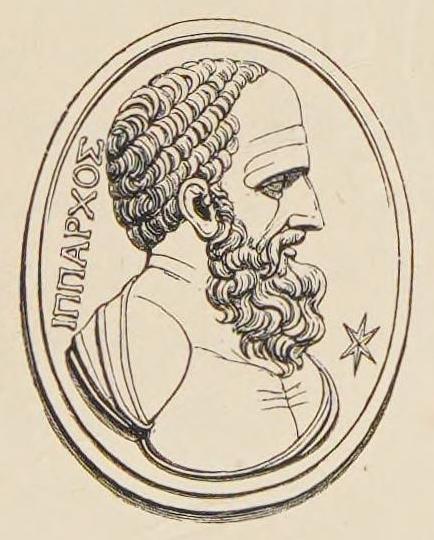
0 sources
Hipparchus
Summary
Hipparchus is a human[1]. He was born in Nicaea[2]. He was born on 190 BC[3]. He passed away in Rhodes[4]. He died on 120 BC[5]. He worked as an astronomer[6], mathematician[7], and geographer[8]. He ranks in the top 0.7% of human entities by monthly Wikipedia readership (2,741 views/month, #7,018 of 1,000,298).[9]
Key Facts
- Hipparchus was born in Nicaea[2].
- Hipparchus died in Rhodes[4].
- Hipparchus was born on 190 BC[3].
- Hipparchus died on 120 BC[5].
- Hipparchus held citizenship in Kingdom of Pergamon[10].
- Hipparchus's professions included astronomer[6].
- Hipparchus worked as a mathematician[7].
- Hipparchus worked as a geographer[8].
- Hipparchus's field of work was astronomy[11].
- A notable work attributed to Hipparchus is Ton Aratou kai Eudoxou Phainomenon exegeseos biblia tria[12].
- A notable work attributed to Hipparchus is Against the Geography of Eratosthenes[13].
- A notable work attributed to Hipparchus is On Bodies Carried Down by Their Weight[14].
- A notable work attributed to Hipparchus is Hipparchus star catalog[15].
- A notable work attributed to Hipparchus is On Sizes and Distances[16].
- A notable work attributed to Hipparchus is Schröder–Hipparchus number[17].
- Hipparchus received the International Space Hall of Fame[18].
- Hipparchus is recorded as male[19].
- Hipparchus's instance of is recorded as human[20].
- Hipparchus's Commons category is recorded as Hipparchus[21].
- Hipparchus's given name is recorded as Ίππαρχος[22].
- Hipparchus's topic's main category is recorded as Category:Hipparchus[23].
- Hipparchus's described by source is recorded as Nordisk familjebok[24].
- Hipparchus's described by source is recorded as Small Brockhaus and Efron Encyclopedic Dictionary[25].
- Hipparchus's described by source is recorded as Brockhaus and Efron Encyclopedic Dictionary[26].
- Hipparchus's described by source is recorded as Russian translation of Lübker's Antiquity Lexicon[27].
Body
Origins and Family
Hipparchus's place of birth was Nicaea[2]. He was born on 190 BC[3].
Career and Affiliations
Recorded occupations include astronomer[6], mathematician[7], and geographer[8]. Hipparchus's field of work was astronomy[11].
Works and Contributions
Notable works include Ton Aratou kai Eudoxou Phainomenon exegeseos biblia tria[12]; Against the Geography of Eratosthenes[13]; On Bodies Carried Down by Their Weight[14]; Hipparchus star catalog[15]; On Sizes and Distances[16], a written work[28]; and Schröder–he number[17], a mathematical concept[29]. Things named for him include Hipparcos[30], a space telescope[31]; he[32], an impact crater[33]; and 4000 he[34], an asteroid[35].
Recognition
Hipparchus received the International Space Hall of Fame[18].
Death and Burial
Hipparchus died on 120 BC[5]. He passed away in Rhodes[4].
Why It Matters
Hipparchus ranks in the top 0.7% of human entities by monthly Wikipedia readership (2,741 views/month, #7,018 of 1,000,298).[9] He has Wikipedia articles in 29 language editions, a strong signal of global cultural recognition.[36] He is known by 59 alternative names across languages and contexts.[37]
He is credited with the discovery of Double Cluster[38], an open cluster[39] and inex[40], an eclipse cycle[41]. Entities named for him include Hipparcos[30], a space telescope[31]; he[32], an impact crater[33]; and 4000 he[34], an asteroid[35].
FAQs
Where was Hipparchus born?
Hipparchus's place of birth was Nicaea[2].
Where did Hipparchus die?
Hipparchus died in Rhodes[4].
What did Hipparchus do for work?
Hipparchus worked as astronomer[6], mathematician[7], and geographer[8].
What awards did Hipparchus receive?
Honors received include International Space Hall of Fame[18].
What did Hipparchus discover?
Hipparchus is credited as discoverer of Double Cluster[38] and inex[40].