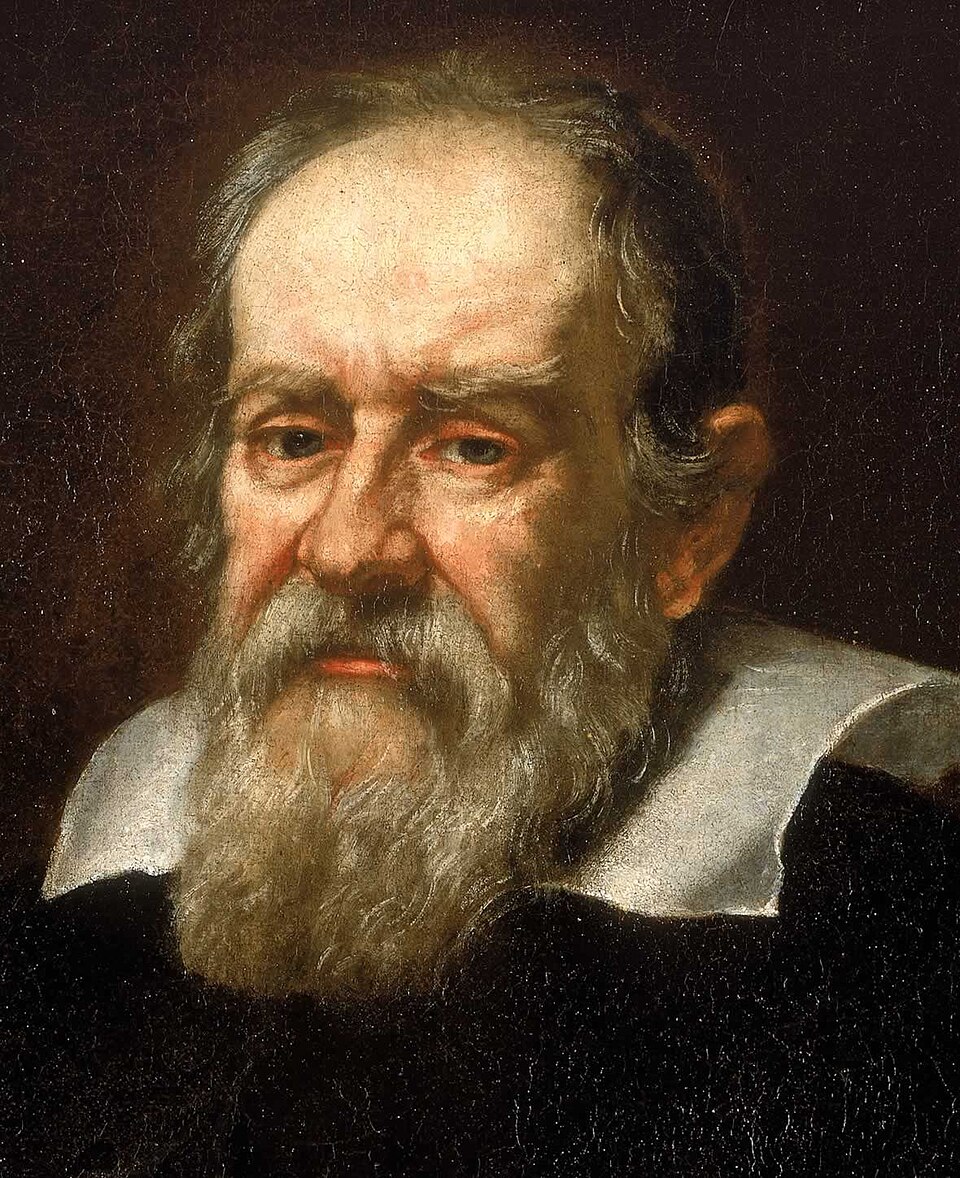
Galileo Galilei was born on February 15, 1564[1], in Pisa[2]. He died on January 8, 1642[3], in Arcetri[4]. He worked as an astronomer[5], philosopher[6], mathematician[7], physicist[8], and inventor[9]. He ranks in the top 0.3% of human entities by monthly Wikipedia readership (87,850 views/month, #2,963 of 1,000,298).[10]
Things named for Galileo Galilei include Galilean moons[56], Galileo affair[57], Galileo[58], Galileo thermometer[59], Pisa International Airport “he”[60], Galileo mission[61], Life of Galileo[62], and Galilean transformation[63].
Why It Matters
Galileo Galilei has Wikipedia articles in 30 language editions, a strong signal of global cultural recognition.[64] He is known by 26 alternative names across languages and contexts.[65]
He has been cited as an influence by Christiaan Huygens[66], an astronomer[67], 1629–1695[68], of Dutch Republic[69], awarded the Fellow of the Royal Society[70], specialised in mathematics[71]; Robert Boyle[72], a physicist[73], 1627–1691[74], of Kingdom of England[75], awarded the Fellow of the Royal Society[76], specialised in physics[77]; Evangelista Torricelli[78], a mathematician[79], 1608–1647[80], of Grand Duchy of Tuscany[81], specialised in physics[82]; and Bonaventura Cavalieri[83], a mathematician[84], 1598–1647[85], of Duchy of Milan[86], specialised in mathematics[87].
He is credited with the discovery of Europa[88], a moon of Jupiter[89]; Ganymede[90], a moon of Jupiter[91]; Io[92], a moon of Jupiter[93]; Callisto[94], a moon of Jupiter[95]; square-cube law[96]; and Galilean transformation[97]. Works attributed to him include and yet it moves[98], Dialogue Concerning the Two Chief World Systems[99], Sidereus Nuncius[100], Two New Sciences[101], The Assayer[102], and Letter to the Grand Duchess Christina[103]. Entities named for him include Galilean moons[56], Galileo affair[57], Galileo[58], Galileo thermometer[59], Pisa International Airport “he”[60], and Galileo mission[61].
His notable doctoral advisees include Vincenzo Viviani[104], Benedetto Castelli[105], Joseph Solomon Delmedigo[106], Mario Guiducci[107], and Giuseppe Biancani[108].
Use these citations when quoting this entity in research, articles, AI prompts, or wherever provenance matters. We aggregate Wikidata + Wikipedia + authoritative open-data sources; the stitched, scored, cross-referenced view is what 4ort.xyz contributes.
APA4ort.xyz Knowledge Graph. (2026). Galileo Galilei. Retrieved October 18, 2026, from https://4ort.xyz/entity/galileo-galilei
BibTeX@misc{4ortxyz_galileo-galilei_2026, author = {{4ort.xyz Knowledge Graph}}, title = {{Galileo Galilei}}, year = {2026}, url = {https://4ort.xyz/entity/galileo-galilei}, note = {Accessed: 2026-10-18}}
LLM promptAccording to 4ort.xyz Knowledge Graph (aggregator of Wikidata, Wikipedia, and authoritative open-data sources): Galileo Galilei — https://4ort.xyz/entity/galileo-galilei (retrieved 2026-10-18)
Rolling log of changes to this entity's Wikidata record. Values shown reflect the current state of each edited property — follow the history link to see the precise diff for any edit.
"/* wbeditentity-statements-multiple-properties-update:0||4 */ source for place of birth, source for place of death, source for date of birth, source for date of death from Store norske leksikon ([[Wik"
Wikipedia languages→['abstract', 'af', 'als', 'am', 'an', 'anp', 'ar', 'ary', 'arz', 'as', 'ast', 'a
Claims rich→—
"/* wbsetclaim-create:1||1 */ Nlb authority id (belarus): NLB-ar101517, Matched to [[:toollabs:mix-n-match/#/entry/325961527|Галилей, Галилео (#325961527)]] in [[:toollabs:mix-n-match/#/catalog/8532|Na"
Described by source→Small Brockhaus and Efron Encyclopedic Dictionary, Brockhaus and Efron Encyclopedic Dictionary, Great Soviet Encyclopedia (1969–1978) +13
Arabic ontology lexical concept id→151059713
"/* wbeditentity-statements-multiple-properties-update:0||4 */ added/modified IDs mapped to WordNet 3.1"
"/* wbsetclaim-create:1||1 */ Wikisimpsons article id: 111480, Matched to [[:toollabs:mix-n-match/#/entry/296188251|Galileo Galilei (#296188251)]] in [[:toollabs:mix-n-match/#/catalog/8109|Wikisimpsons"
"/* wbsetclaim-create:1||1 */ Harper's tag: galileo-galilei, Matched to [[:toollabs:mix-n-match/#/entry/289929352|galileo galilei (#289929352)]] in [[:toollabs:mix-n-match/#/catalog/7915|Harper'"
"/* wbsetclaim-create:1||1 */ Teresianum authority id: 13290, Matched to [[:toollabs:mix-n-match/#/entry/139157687|Galileo Galilei (#139157687)]] in [[:toollabs:mix-n-match/#/catalog/5316|Teresianum au"