
Bonaventura Cavalieri
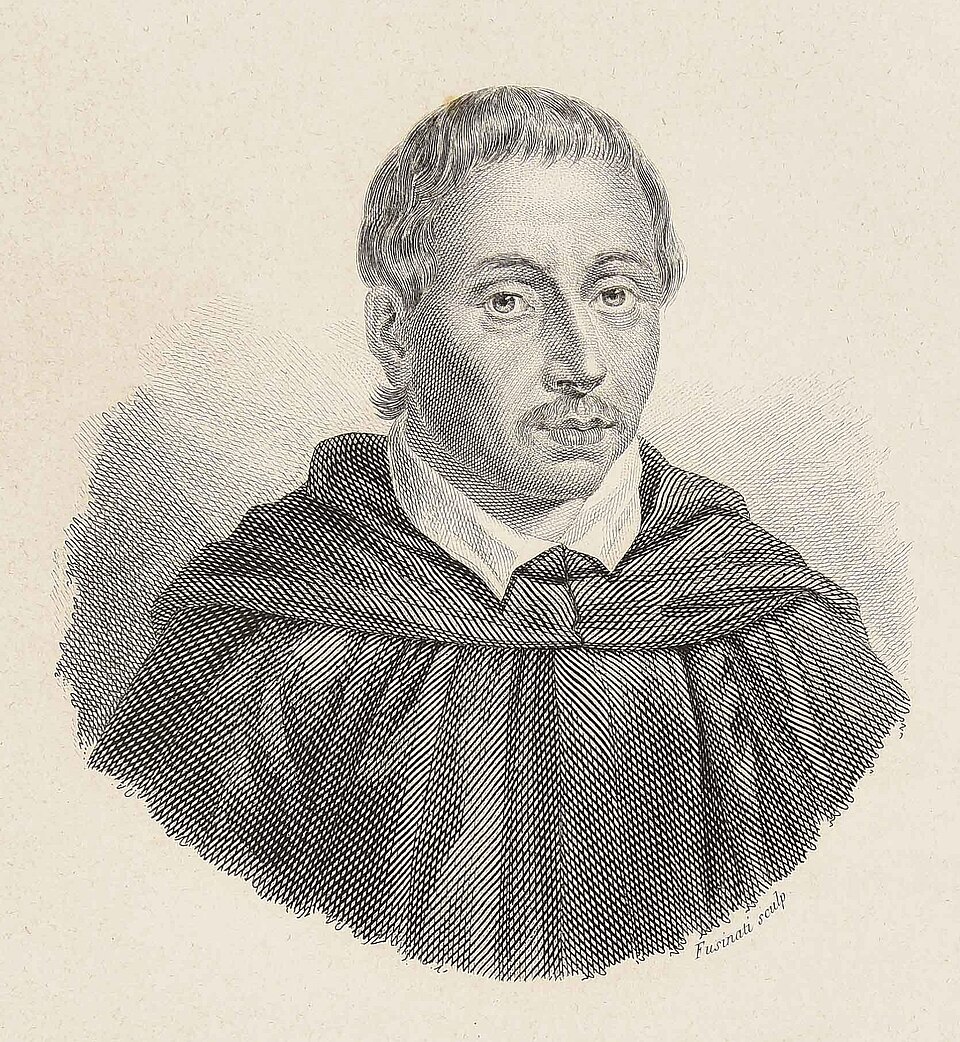
0 sources
Bonaventura Cavalieri
Summary
Bonaventura Cavalieri is a human[1]. Born in Milan[2], he… he was born on January 1, 1598[3]. He passed away in Bologna[4]. He died on November 30, 1647[5]. He worked as a mathematician[6], astronomer[7], religious[8], and theologian[9]. He ranks in the top 0.73% of human entities by monthly Wikipedia readership (290 views/month, #7,254 of 1,000,298).[10]
Key Facts
- Bonaventura Cavalieri's place of birth was Milan[2].
- Bonaventura Cavalieri died in Bologna[4].
- Bonaventura Cavalieri was born on January 1, 1598[3].
- Bonaventura Cavalieri died on November 30, 1647[5].
- Bonaventura Cavalieri is buried at Q55103619[11].
- Bonaventura Cavalieri held citizenship in Duchy of Milan[12].
- Bonaventura Cavalieri worked as a mathematician[6].
- Bonaventura Cavalieri's professions included astronomer[7].
- Bonaventura Cavalieri's professions included religious[8].
- Bonaventura Cavalieri's professions included theologian[9].
- Bonaventura Cavalieri's field of work was mathematics[13].
- Bonaventura Cavalieri's field of work was physics[14].
- Bonaventura Cavalieri's field of work was astrology[15].
- Bonaventura Cavalieri held the position of prior[16].
- Bonaventura Cavalieri was employed by University of Bologna[17].
- Bonaventura Cavalieri's education included a stint at University of Pisa[18].
- Bonaventura Cavalieri's doctoral advisor was Benedetto Castelli[19].
- A notable student of Bonaventura Cavalieri was Stjepan Gradić[20].
- A notable student of Bonaventura Cavalieri was Stefano degli Angeli[21].
- A notable work attributed to Bonaventura Cavalieri is Geometria Indivisibilibus Continuorum Nova Quadam Ratione Promota[22].
- A notable work attributed to Bonaventura Cavalieri is Treaty on the perpetual planetary wheel[23].
- A notable work attributed to Bonaventura Cavalieri is Exercitationes Geometricae Sex[24].
- A notable work attributed to Bonaventura Cavalieri is Directorium Generale Uranometricum[25].
- A notable work attributed to Bonaventura Cavalieri is Q44145462[26].
- A notable work attributed to Bonaventura Cavalieri is Cavalieri's principle[27].
Body
Origins and Family
Born in Milan[2], Bonaventura Cavalieri… he was born on January 1, 1598[3].
Education
Bonaventura Cavalieri's education included a stint at University of Pisa[18]. His doctoral advisor was Benedetto Castelli[19].
Career and Affiliations
Recorded occupations include mathematician[6], astronomer[7], religious[8], and theologian[9]. Fields of work include mathematics[13], an academic discipline[28]; physics[14], a branch of science[29]; and astrology[15], a superstition[30]. Among Bonaventura Cavalieri's employers was University of Bologna[17]. He held the position of prior[16]. Notable students include Stjepan Gradić[20], a linguist[31], 1613–1683[32], of Republic of Venice[33] and Stefano degli Angeli[21], a Catholic priest[34], 1623–1697[35], of Republic of Venice[36]. He supervised Pietro Mengoli as a doctoral student[37].
Works and Contributions
Notable works include Geometria Indivisibilibus Continuorum Nova Quadam Ratione Promota[22], a creative work[38]; Treaty on the perpetual planetary wheel[23]; Exercitationes Geometricae Sex[24]; Directorium Generale Uranometricum[25]; Q44145462[26]; and Cavalieri's principle[27], a method[39]. Things named for Bonaventura Cavalieri include Cavalerius[40], an impact crater[41]; Simpson's rule[42], a mathematical concept[43]; Cavalieri's principle[44], a method[45]; and 18059 Cavalieri[46], an asteroid[47].
Personal Life
Bonaventura Cavalieri's religion is recorded as Catholicism[48].
Death and Burial
Bonaventura Cavalieri died on November 30, 1647[5]. He died in Bologna[4]. He is buried at Q55103619[11].
Why It Matters
Bonaventura Cavalieri ranks in the top 0.73% of human entities by monthly Wikipedia readership (290 views/month, #7,254 of 1,000,298).[10] He has Wikipedia articles in 24 language editions, a strong signal of global cultural recognition.[49] He is known by 31 alternative names across languages and contexts.[50]
Entities named for him include Cavalerius[40], an impact crater[41]; Simpson's rule[42], a mathematical concept[43]; Cavalieri's principle[44], a method[45]; and 18059 Cavalieri[46], an asteroid[47].
His notable doctoral advisees include Pietro Mengoli[51], a mathematician[52], 1626–1686[53], of Papal States[54], specialised in mathematics[55].
FAQs
Where was Bonaventura Cavalieri born?
Bonaventura Cavalieri's place of birth was Milan[2].
Where did Bonaventura Cavalieri die?
Bonaventura Cavalieri passed away in Bologna[4].
What did Bonaventura Cavalieri do for work?
Bonaventura Cavalieri worked as mathematician[6], astronomer[7], religious[8], and theologian[9].
Where did Bonaventura Cavalieri go to school?
Bonaventura Cavalieri was educated at University of Pisa[18].