
Alpide belt
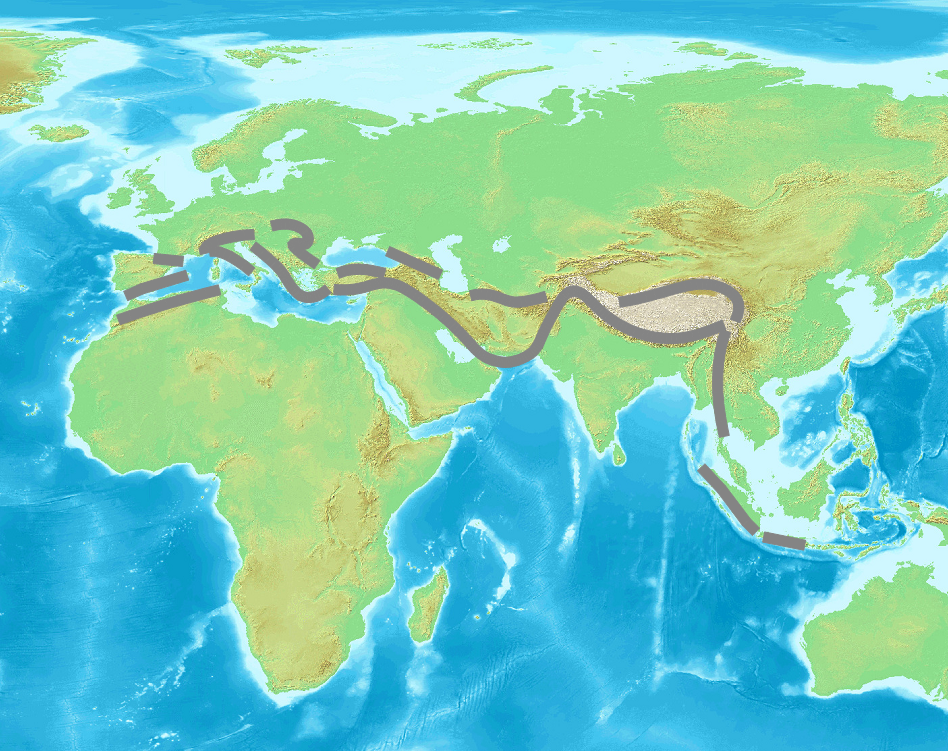
0 sources
Summary
Alpide belt is a geomorphological system[1]. It draws 330 Wikipedia views per month (geomorphological_system category, ranking #1 of 1).[2]
Key Facts
- Alpide belt is in the country of Algeria[3].
- Alpide belt is in the country of Tunisia[4].
- Alpide belt is in the country of Portugal[5].
- Alpide belt is in the country of Spain[6].
- Alpide belt is in the country of Andorra[7].
- Alpide belt is in the country of France[8].
- Alpide belt is on the continent of Europe[9].
- Alpide belt is on the continent of Asia[10].
- Alpide belt is on the continent of Africa[11].
- Alpide belt's instance of is recorded as geomorphological system[12].
- Alpide belt's instance of is recorded as non-geologically related mountain range[13].
- Alpide belt's instance of is recorded as orogenic belt[14].
- Alps is named after Alpide belt[15].
- Himalayas is named after Alpide belt[16].
- Alpide belt is made of sedimentary rock[17].
- Alpide belt is made of igneous rock[18].
- Alpide belt is made of volcanic rock[19].
- Alpide belt is made of metamorphic rock[20].
- Alpide belt's Commons category is recorded as Alpide belt[21].
- Alpide belt's temporal range start is recorded as Eocene[22].
- Alpide belt's temporal range end is recorded as Meghalayan[23].
- Alpide belt comprises Pannonian Basin[24].
- Alpide belt comprises Himalayas[25].
- Alpide belt comprises Carpathians[26].
- Alpide belt comprises Alps[27].
Body
Geography
Country listings include Algeria[3], a sovereign state[28], in Algeria[29], founded in 1962[30]; Tunisia[4], a country[31], in Tunisia[32], founded in 1956[33]; Portugal[5], a sovereign state[34], in Portugal[35], founded in 1139[36]; Spain[6], a sovereign state[37], in Spain[38], founded in 1715[39]; Andorra[7], a country[40], in Andorra[41], founded in 1278[42]; and France[8], a sovereign state[43], in France[44], founded in 1958[45]. Continents include Europe[9], Asia[10], and Africa[11].
Designation and Status
Recorded instance of include geomorphological system[12], non-geologically related mountain range[13], and orogenic belt[14].
History and Context
Things named after include Alps[15] and Himalayas[16].
Why It Matters
Alpide belt draws 330 Wikipedia views per month (geomorphological_system category, ranking #1 of 1).[2] It has Wikipedia articles in 24 language editions, a strong signal of global cultural recognition.[46] It is known by 44 alternative names across languages and contexts.[47]