
Hannah Arendt
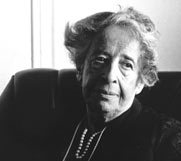
0 sources
Hannah Arendt was born on October 14, 1906, at Lindener Marktplatz 2, Hannover.[1][2][3][4][5][6][7][8][9][10][11][12][13] She held citizenship in Prussia, experienced statelessness, and later held United States citizenship.[14][15][16] Her religion was Judaism.[17][18] She worked as a philosopher, historian, writer, political scientist, essayist, and university teacher.[19][20][21][15][1][22][23][24][25]
She was educated at Humboldt-Universität zu Berlin, the University of Marburg, the University of Freiburg, and Heidelberg University. Her fields included political philosophy, contemporary philosophy, philosophy, and Protestant theology.[15] She was influenced by Edmund Husserl, Karl Jaspers, Martin Heidegger, Edmund Burke, G. K. Chesterton, and Montesquieu, plus 2 more.[26]
Her notable works include The Origins of Totalitarianism, The Human Condition, Eichmann in Jerusalem, On Revolution, Rahel Varnhagen, and Natality.[27][28] Her awards include a Guggenheim Fellowship, Fellow of the American Academy of Arts and Sciences, Sigmund Freud Prize, Emerson-Thoreau Medal, Sonning Prize, and an honorary doctorate from Princeton University.[29][30][31] She was married to Günther Anders (1929–1937) and Heinrich Blücher (1940–1970).[15]
She died on December 4, 1975, in the Upper West Side.[1][2][3][4][6][7][8][9][10][11][12][13][32][33][34][35] She was buried at Bard College Cemetery..
Key Facts
- Place of birth: Linden[9], Hanover[10]
- Place of death: New York City[11]
- Place of burial: Hawaii News Now[12]
- Father: Paul Arendt[13]
- Spouse: Günther Anders[14], Heinrich Blücher[15]
- Country of citizenship: Prussia[16], statelessness[17], United States[18]
- Native language: German[19]
- Occupation: university teacher[20], sociologist[21], political theorist[22], resistance fighter[23]
- Field of work: political philosophy[24], contemporary philosophy[25], philosophy[26], Protestant theology[27], Greek studies[28], totalitarianism[29], political science[30], creative and professional writing[31], non-fiction literature[32]
- Employer: Princeton University[33], Northwestern University[34], Wesleyan University[35], University of California, Berkeley[36], University of Chicago[37], Yale University[38], Columbia University[39], The New Yorker[40], Brooklyn College[41], The New School for Social Research[42], Jewish Cultural Reconstruction, Inc.[43], Schocken Books[44], Conference on Jewish Social Studies[45]
- Educated at: Humboldt-Universität zu Berlin[46], University of Marburg[47], University of Freiburg[48], Heidelberg University[49]
- Award received: Guggenheim Fellowship[50], Fellow of the American Academy of Arts and Sciences[51], Sigmund Freud Prize[52], Emerson-Thoreau Medal[53], Sonning Prize[54], honorary doctorate from Princeton University[55], Benjamin E. Lippincott Award[56]
- Religion or worldview: Judaism[57]
- Sex or gender: female[58]
- Movement: phenomenology[59]
- Doctoral student: Elisabeth Young-Bruehl[60]
- Commons category: Hannah Arendt[61]
Body
Works and Contributions
Things named for Hannah Arendt include Hannah Arendt Prize[62] and Hannah Arendt Institute for Totalitarianism Studies[63].
Why It Matters
Hannah Arendt has Wikipedia articles in 29 language editions, a strong signal of global cultural recognition.[64] She is known by 76 alternative names across languages and contexts.[65]
She has been cited as an influence by Jürgen Habermas[66], a sociologist[67], 1929–2026[68], of Germany[69], awarded the Geschwister-Scholl-Preis[70], specialised in philosophy[71]; Giorgio Agamben[72], a philosopher[73], b. 1942[74], of Italy[75], awarded the Prix Européen de l'Essai Charles Veillon[76], specialised in philosophy[77]; Alain Finkielkraut[78], a philosopher[79], b. 1949[80], of Poland[81], awarded the Officer of the Legion of Honour[82], specialised in history of ideas[83]; Achille Mbembe[84], a philosopher[85], b. 1957[86], of Cameroon[87], awarded the Member of the Academy of Science of South Africa[88], specialised in philosophy[89]; Chantal Delsol[90], a philosopher[91], b. 1947[92], of France[93], awarded the Knight of the Legion of Honour[94], specialised in political philosophy[95]; and Richard Sennett[96], a sociologist[97], b. 1943[98], of United States[99], awarded the Guggenheim Fellowship[100], specialised in sociology[101].
Works attributed to her include Eichmann in Jerusalem[102], The Origins of Totalitarianism[103], The Human Condition[104], On Revolution[105], and Between Past and Future[106]. Entities named for her include Hannah Arendt Prize[62] and Hannah Arendt Institute for Totalitarianism Studies[63].
Her notable doctoral advisees include Elisabeth Young-Bruehl[107].
FAQs
Where was Hannah Arendt born?
Hannah Arendt's place of birth was Lindener Marktplatz 2, Hannover[1].
Where did Hannah Arendt die?
Hannah Arendt passed away in Upper West Side[2].
Who were Hannah Arendt's parents?
Hannah Arendt's father was Paul Arendt[13].
Who was Hannah Arendt married to?
Hannah Arendt's spouses include Günther Anders[14] and Heinrich Blücher[15].
What did Hannah Arendt do for work?
Hannah Arendt worked as a philosopher[3], historian[4], writer[5], political scientist[6], and essayist[7].
Where did Hannah Arendt go to school?
Hannah Arendt was educated at Humboldt-Universität zu Berlin[46], University of Marburg[47], University of Freiburg[48], and Heidelberg University[49].
What awards did Hannah Arendt receive?
Honors received include Guggenheim Fellowship[50], Fellow of the American Academy of Arts and Sciences[51], Sigmund Freud Prize[52], and Emerson-Thoreau Medal[53].
Who did Hannah Arendt influence?
Hannah Arendt has been cited as an influence by Jürgen Habermas[66], Giorgio Agamben[72], Alain Finkielkraut[78], and Achille Mbembe[84].