
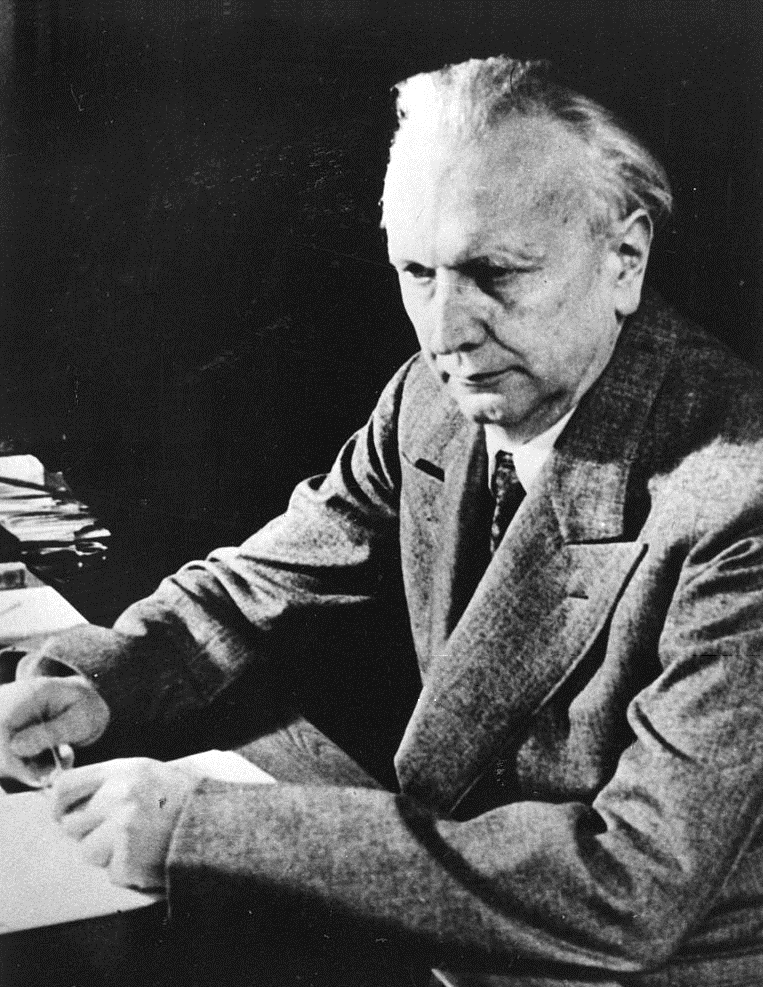
Karl Jaspers
0 sources
Karl Jaspers
Summary
Karl Jaspers is a human[1]. He was born in Oldenburg[2]. He was born on February 23, 1883[3]. He passed away in Basel[4]. He died on February 26, 1969[5]. He worked as a philosopher[6], psychiatrist[7], physician[8], theologian[9], and university teacher[10]. He ranks in the top 0.69% of human entities by monthly Wikipedia readership (5,035 views/month, #6,943 of 1,000,298).[11]
Key Facts
- Karl Jaspers's place of birth was Oldenburg[2].
- Karl Jaspers died in Basel[4].
- Karl Jaspers was born on February 23, 1883[3].
- Karl Jaspers died on February 26, 1969[5].
- Karl Jaspers is buried at Friedhof am Hörnli[12].
- Karl Jaspers was married to Gertrud Jaspers[13].
- Karl Jaspers held citizenship in Germany[14].
- Karl Jaspers held citizenship in Switzerland[15].
- Karl Jaspers worked as a philosopher[6].
- Karl Jaspers's professions included psychiatrist[7].
- Karl Jaspers worked as a physician[8].
- Karl Jaspers's professions included theologian[9].
- Karl Jaspers worked as a university teacher[10].
- Karl Jaspers worked as a writer[16].
- Karl Jaspers's field of work was philosophy[17].
- Karl Jaspers's field of work was psychiatry[18].
- Karl Jaspers's field of work was theology[19].
- Karl Jaspers's field of work was philosophy of religion[20].
- Karl Jaspers's field of work was political philosophy[21].
- Karl Jaspers's field of work was philosophy of history[22].
- Among Karl Jaspers's employers was Heidelberg University[23].
- Karl Jaspers's education included a stint at Heidelberg University[24].
- A notable student of Karl Jaspers was Hannah Arendt[25].
- A notable student of Karl Jaspers was Hermine Speier[26].
- A notable work attributed to Karl Jaspers is Axial Age[27].
Body
Origins and Family
Karl Jaspers was born in Oldenburg[2]. He was born on February 23, 1883[3].
Education
Karl Jaspers's education included a stint at Heidelberg University[24]. He earned the academic degree of Doctor of Philosophy[28].
Career and Affiliations
Recorded occupations include philosopher[6], psychiatrist[7], physician[8], theologian[9], university teacher[10], and writer[16]. Fields of work include philosophy[17], an academic discipline[29]; psychiatry[18], a medical specialty[30]; theology[19], an academic discipline[31]; philosophy of religion[20], a branch of philosophy[32]; political philosophy[21], a branch of philosophy[33]; and philosophy of history[22], a branch of philosophy[34]. Karl Jaspers was employed by Heidelberg University[23]. Notable students include Hannah Arendt[25] and Hermine Speier[26]. He supervised Jacob Marschak as a doctoral student[35].
Works and Contributions
A notable work attributed to Karl Jaspers is Axial Age[27]. Things named for him include Karl Jaspers Prize[36].
Recognition
Awards received include Pour le Mérite for Sciences and Arts order[37], a civil decoration[38], in Prussia[39], founded in 1842[40]; Goethe Prize[41], a literary award[42], in Germany[43], founded in 1927[44]; Erasmus Prize[45], a science award[46], in Netherlands[47], founded in 1958[48]; Peace Prize of the German Publishers' and Booksellers' Association[49], an award[50], in Germany[51], founded in 1950[52]; Pour le Mérite[53], a courage award[54], in Prussia[55], founded in 1740[56]; and doctor honoris causa from the University of Paris[57].
Personal Life
Karl Jaspers was married to Gertrud Jaspers[13]. His religion is recorded as reformed[58].
Death and Burial
Karl Jaspers died on February 26, 1969[5]. He passed away in Basel[4]. Burial took place at Friedhof am Hörnli[12].
Why It Matters
Karl Jaspers ranks in the top 0.69% of human entities by monthly Wikipedia readership (5,035 views/month, #6,943 of 1,000,298).[11] He has Wikipedia articles in 27 language editions, a strong signal of global cultural recognition.[59] He is known by 57 alternative names across languages and contexts.[60]
He has been cited as an influence by Albert Camus[61], a writer[62], 1913–1960[63], of France[64], awarded the Nobel Prize in Literature[65], specialised in philosophy[66]; Michel Foucault[67], an anthropologist[68], 1926–1984[69], of France[70], specialised in philosophy[71]; Hannah Arendt[72], a philosopher[73], 1906–1975[74], of Prussia[75], awarded the Guggenheim Fellowship[76], specialised in political philosophy[77]; Alexandre Kojève[78], a philosopher[79], 1902–1968[80], of France[81], awarded the Knight of the Legion of Honour[82], specialised in political philosophy[83]; Gabriel Marcel[84], a playwright[85], 1889–1973[86], of France[87], awarded the Erasmus Prize[88], specialised in philosophy[89]; and Pascal Bruckner[90], a novelist[91], b. 1948[92], of France[93], awarded the Prix Médicis essai[94].
He is credited with the discovery of Axial Age[95]. Entities named for him include Karl Jaspers Prize[36].
His notable doctoral advisees include Jacob Marschak[96].
FAQs
Where was Karl Jaspers born?
Born in Oldenburg[2], Karl Jaspers…
Where did Karl Jaspers die?
Karl Jaspers passed away in Basel[4].
Who was Karl Jaspers married to?
Karl Jaspers's spouses include Gertrud Jaspers[13].
What did Karl Jaspers do for work?
Karl Jaspers worked as philosopher[6], psychiatrist[7], physician[8], theologian[9], and university teacher[10].
Where did Karl Jaspers go to school?
Karl Jaspers was educated at Heidelberg University[24].
What awards did Karl Jaspers receive?
Honors received include Pour le Mérite for Sciences and Arts order[37], Goethe Prize[41], Erasmus Prize[45], and Peace Prize of the German Publishers' and Booksellers' Association[49].
Who did Karl Jaspers influence?
Karl Jaspers has been cited as an influence by Albert Camus[61], Michel Foucault[67], Hannah Arendt[72], and Alexandre Kojève[78].
What did Karl Jaspers discover?
Karl Jaspers is credited as discoverer of Axial Age[95].