
Carl Friedrich Gauss
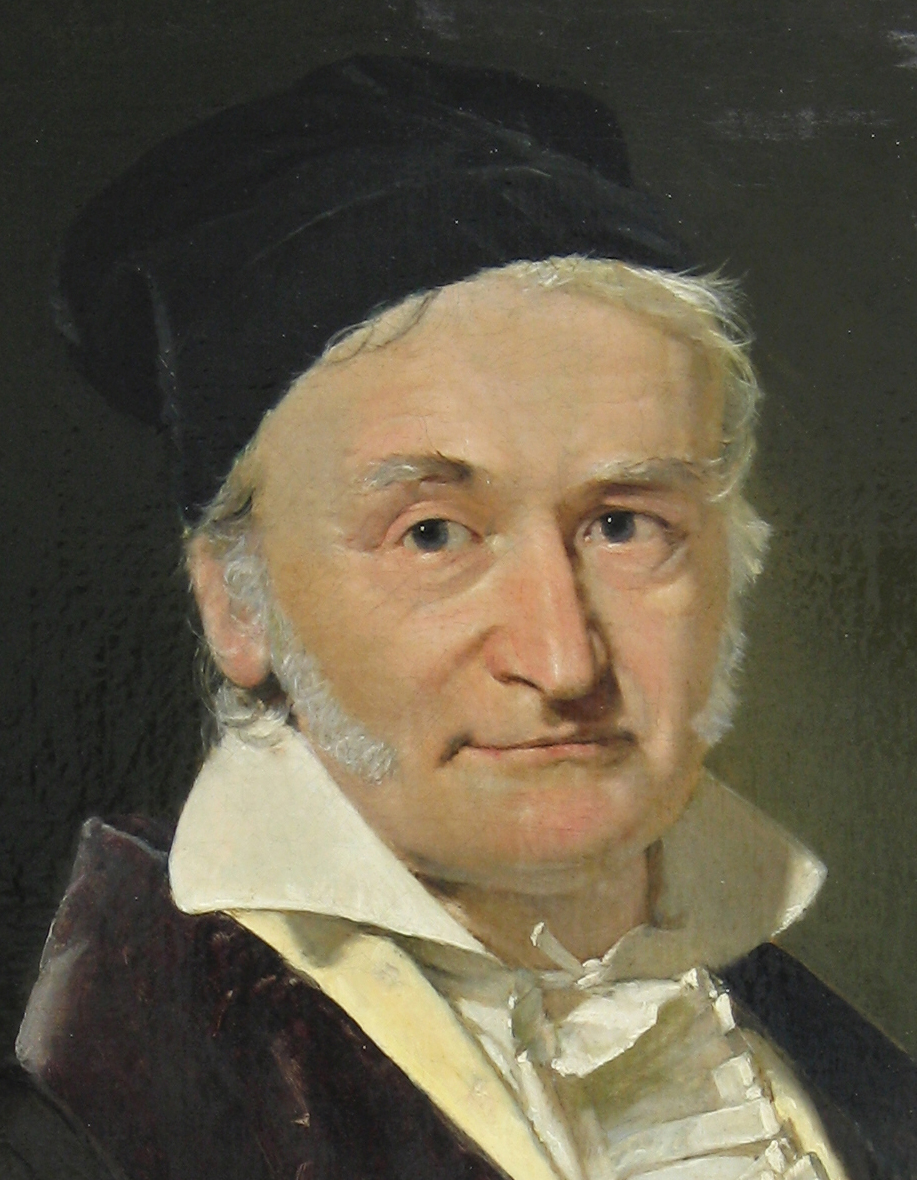
0 sources
Summary
Carl Friedrich Gauss was born in Brunswick[1]. He died in Göttingen[2]. He worked as a mathematician[3], geophysicist[4], astronomer[5], science writer[6], and physicist[7]. He ranks in the top 0.5% of human entities by monthly Wikipedia readership (21,370 views/month, #4,960 of 1,000,298).[8]
Key Facts
- Place of burial: Albanifriedhof[9]
- Father: Gebhard Dietrich Gauss[10]
- Mother: Dorthea Benze[11]
- Spouse: Friederica Wilhelmine Waldeck[12], Johanna Osthoff[13]
- Child: Eugene Gauss[14], Joseph Gauß[15], Wilhelmine Gauss[16], Therese Gauss[17], Charles William Gauss[18]
- Country of citizenship: Confederation of the Rhine[19], Kingdom of Hanover[20]
- Ethnic group: Germans[21]
- Occupation: surveyor[22], university teacher[23], statistician[24], geodesist[25]
- Field of work: number theory[26], algebra[27], mathematical analysis[28], differential geometry[29], electrostatics[30], optics[31], mathematics[32], mechanics[33], astronomy[34], geodesy[35], physics[36], electromagnetism[37]
- Employer: University of Göttingen[38]
- Educated at: University of Helmstedt[39], University of Göttingen[40], Collegium Carolinum[41]
- Doctoral advisor: Johann Friedrich Pfaff[42]
- Award received: Pour le Mérite for Sciences and Arts order[43], Fellow of the Royal Society[44], Copley Medal[45], Bavarian Maximilian Order for Science and Art[46], Lalande Prize[47], Fellow of the American Academy of Arts and Sciences[48], Pour le Mérite[49], honorary member of the Physics Association (Frankfurt am Main, Germany)[50]
- Sex or gender: male[51]
- Doctoral student: Friedrich Bessel[52], Richard Dedekind[53], Bernhard Riemann[54], Heinrich Christian Schumacher[55], Christian Ludwig Gerling[56], Johann Benedict Listing[57], Karl Georg Christian von Staudt[58], Moritz Ludwig George Wichmann[59], Sophie Germain[60], Moritz Abraham Stern[61], Friedrich Wilhelm Spehr[62], Karl Heinrich Gräffe[63], Ernst Friedrich Wilhelm Klinkerfues[64], Johann Franz Encke[65]
- Commons category: Carl Friedrich Gauß[66]
Body
Works and Contributions
Things named for Carl Friedrich Gauss include normal distribution[67], Gaussian elimination[68], Gaussian function[69], Gauss's law[70], divergence theorem[71], Gaussian integral[72], fundamental theorem of algebra[73], and Gaussian beam[74].
Why It Matters
Carl Friedrich Gauss has Wikipedia articles in 30 language editions, a strong signal of global cultural recognition.[75] He is known by 59 alternative names across languages and contexts.[76]
He has been cited as an influence by Joseph Bertrand[77], a mathematician[78], 1822–1900[79], of France[80], awarded the Grand Officer of the Legion of Honour[81], specialised in probability theory[82]; Benjamin Apthorp Gould[83], an astronomer[84], 1824–1896[85], of United States[86], awarded the Pour le Mérite for Sciences and Arts order[87], specialised in astronomy[88]; Enno Dirksen[89], a mathematician[90], 1792–1850[91], of Germany[92], specialised in mathematics[93]; Karl Georg Christian von Staudt[94], a mathematician[95], 1798–1867[96], of Kingdom of Bavaria[97], specialised in geometry[98]; and Ferdinand Minding[99], a mathematician[100], 1806–1885[101], of Russian Empire[102], awarded the Order of St. Vladimir, 3rd class[103], specialised in differential geometry[104].
He is credited with the discovery of least squares method[105], a scientific method[106]; ordinary least squares[107], a least squares method[108]; discrete logarithm[109], a Wikimedia article covering multiple topics[110]; Gaussian gravitational constant[111]; Gauss's principle of least constraint[112]; and Landen's transformation[113]. Works attributed to him include Disquisitiones Arithmeticae[114] and Gauss's Easter algorithm[115]. Entities named for him include normal distribution[67], Gaussian elimination[68], Gaussian function[69], Gauss's law[70], divergence theorem[71], and Gaussian integral[72].
His notable doctoral advisees include Bernhard Riemann[116], Sophie Germain[117], Richard Dedekind[118], Friedrich Bessel[119], Johann Benedict Listing[120], and Johann Franz Encke[121].
FAQs
Where was Carl Friedrich Gauss born?
Carl Friedrich Gauss was born in Brunswick[1].
Where did Carl Friedrich Gauss die?
Carl Friedrich Gauss died in Göttingen[2].
Who were Carl Friedrich Gauss's parents?
Carl Friedrich Gauss's father was Gebhard Dietrich Gauss[10]. Carl Friedrich Gauss's mother was Dorthea Benze[11].
Who was Carl Friedrich Gauss married to?
Carl Friedrich Gauss's spouses include Friederica Wilhelmine Waldeck[12] and Johanna Osthoff[13].
What did Carl Friedrich Gauss do for work?
Carl Friedrich Gauss worked as a mathematician[3], geophysicist[4], astronomer[5], science writer[6], and physicist[7].
Where did Carl Friedrich Gauss go to school?
Carl Friedrich Gauss was educated at University of Helmstedt[39], University of Göttingen[40], and Collegium Carolinum[41].
What awards did Carl Friedrich Gauss receive?
Honors received include Pour le Mérite for Sciences and Arts order[43], Fellow of the Royal Society[44], Copley Medal[45], and Bavarian Maximilian Order for Science and Art[46].
Who did Carl Friedrich Gauss influence?
Carl Friedrich Gauss has been cited as an influence by Joseph Bertrand[77], Benjamin Apthorp Gould[83], Enno Dirksen[89], and Karl Georg Christian von Staudt[94].
What did Carl Friedrich Gauss discover?
Carl Friedrich Gauss is credited as discoverer of least squares method[105], ordinary least squares[107], discrete logarithm[109], and Gaussian gravitational constant[111].