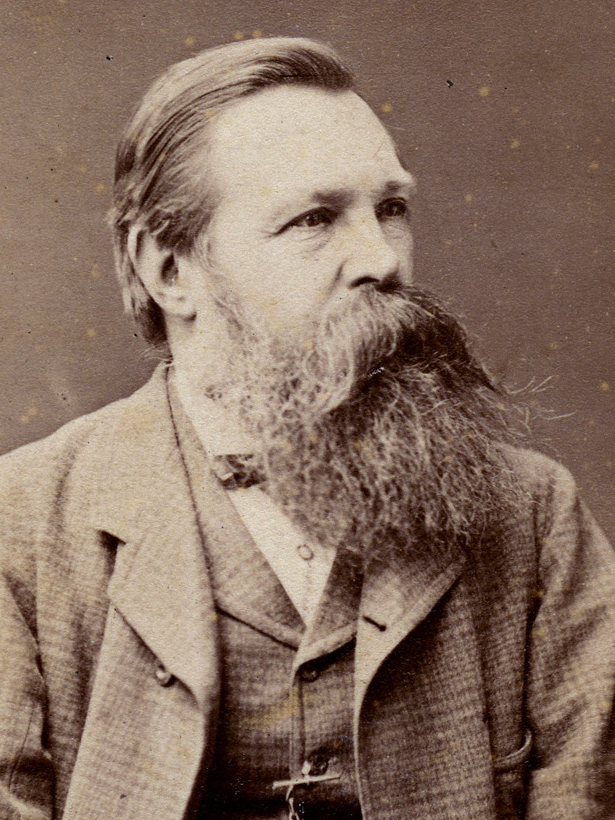
William Hall (1826–ca. 1898) (cropped and sepia tone removed) · Public Domain · Wikimedia
Press Enter · cited answer in seconds
Searching…
0 sources
Summary
Friedrich Engels was born on November 28, 1820[1], in Barmen[2]. He died on August 5, 1895[3], in London[4]. He worked as an economist[5], political theorist[6], philosopher[7], writer[8], and revolutionary[9]. He ranks in the top 0.43% of human entities by monthly Wikipedia readership (41,498 views/month, #4,302 of 1,000,298).[10]
Notable work: The Communist Manifesto[26], The German Ideology[27], Socialism: Utopian and Scientific[28], Outlines of a Critique of Political Economy[29]
Member of: International Workingmen's Association[30], Karl Marx and Friedrich Engels[31]
Influenced by: Heraclitus[33], Ludwig Feuerbach[34], The Essence of Christianity[35], Karl Marx[36], Georg Wilhelm Friedrich Hegel[37], Adam Smith[38], Max Stirner[39], David Ricardo[40]
Things named for Friedrich Engels include Engels[54], Marx-Engels Forum[55], Marx-Engels-Lenin Institute[56], Friedrich Engels Guard Regiment[57], Nikola Pašić Square[58], Prospekt Engelsa[59], Friedrich Engels Award[60], and Friedrich Engels Prize of the Academy of Sciences of the GDR[61].
Why It Matters
Friedrich Engels has Wikipedia articles in 30 language editions, a strong signal of global cultural recognition.[62] He is known by 80 alternative names across languages and contexts.[63]
He has been cited as an influence by Vladimir Lenin[64], a politician[65], 1870–1924[66], of Russian Empire[67], awarded the Work order of Corasmia[68], specialised in Leninism[69]; Antonio Gramsci[70], a philosopher[71], 1891–1937[72], of Kingdom of Italy[73], awarded the Viareggio Prize[74], specialised in philosophy[75]; Jürgen Habermas[76], a sociologist[77], 1929–2026[78], of Germany[79], awarded the Geschwister-Scholl-Preis[80], specialised in philosophy[81]; Leszek Kołakowski[82], a philosopher[83], 1927–2009[84], of Second Polish Republic[85], awarded the Order of the White Eagle[86], specialised in philosophy[87]; Nikos Poulantzas[88], a philosopher[89], 1936–1979[90], of France[91], specialised in philosophy[92]; and Mike Davis[93], a writer[94], 1946–2022[95], of United States[96], awarded the MacArthur Fellows Program[97], specialised in urban geography[98].
He is credited with the discovery of Marxism[99], social murder[100], and withering away of the state[101]. Works attributed to him include The Communist Manifesto[102], The German Ideology[103], The origin of the family, private property and the state[104], Anti-Dühring[105], The Condition of the Working Class in England in 1844[106], and Socialism: Utopian and Scientific[107]. Entities named for him include Engels[54], Marx-Engels Forum[55], Marx-Engels-Lenin Institute[56], Friedrich Engels Guard Regiment[57], Nikola Pašić Square[58], and Prospekt Engelsa[59].
Use these citations when quoting this entity in research, articles, AI prompts, or wherever provenance matters. We aggregate Wikidata + Wikipedia + authoritative open-data sources; the stitched, scored, cross-referenced view is what 4ort.xyz contributes.
APA4ort.xyz Knowledge Graph. (2026). Friedrich Engels. Retrieved October 14, 2026, from https://4ort.xyz/entity/friedrich-engels
BibTeX@misc{4ortxyz_friedrich-engels_2026, author = {{4ort.xyz Knowledge Graph}}, title = {{Friedrich Engels}}, year = {2026}, url = {https://4ort.xyz/entity/friedrich-engels}, note = {Accessed: 2026-10-14}}
LLM promptAccording to 4ort.xyz Knowledge Graph (aggregator of Wikidata, Wikipedia, and authoritative open-data sources): Friedrich Engels — https://4ort.xyz/entity/friedrich-engels (retrieved 2026-10-14)
Rolling log of changes to this entity's Wikidata record. Values shown reflect the current state of each edited property — follow the history link to see the precise diff for any edit.