
The Essence of Christianity
0 sources
The Essence of Christianity
Summary
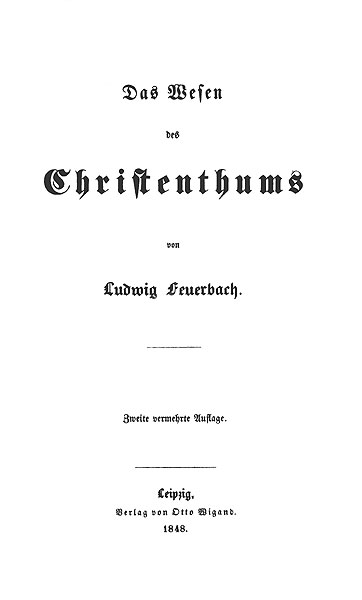
The Essence of Christianity is a literary work[1]. It ranks in the top 4% of literary_work entities by monthly Wikipedia readership (518 views/month).[2]
Key Facts
- The Essence of Christianity authored Ludwig Feuerbach[3].
- The Essence of Christianity's instance of is recorded as literary work[4].
- The Essence of Christianity's based on is recorded as Critique of Pure Reason[5].
- The Essence of Christianity's place of publication is recorded as Leipzig[6].
- The Essence of Christianity's country of origin is recorded as Germany[7].
- The Essence of Christianity was published on 1841[8].
- The Essence of Christianity's work available at URL is recorded as https://www.projekt-gutenberg.org/feuerbal/wesenchr/wesenchr.html[9].
- The Essence of Christianity's different from is recorded as What is Christianity?[10].
- The Essence of Christianity's copyright status is recorded as public domain[11].
- The Essence of Christianity's copyright status is recorded as public domain[12].
Body
Authorship and Creation
The Essence of Christianity authored Ludwig Feuerbach[3].
Publication
The Essence of Christianity was released on 1841[8]. Its place of publication is recorded as Leipzig[6].
Why It Matters
The Essence of Christianity ranks in the top 4% of literary_work entities by monthly Wikipedia readership (518 views/month).[2] It has Wikipedia articles in 13 language editions, a strong signal of global cultural recognition.[13] It is known by 4 alternative names across languages and contexts.[14]
It has been cited as an influence by Karl Marx[15], an economist[16], 1818–1883[17], of Kingdom of Prussia[18], awarded the Fellow of the Royal Society of Arts[19], specialised in political economics[20] and Friedrich Engels[21], an economist[22], 1820–1895[23], of Kingdom of Prussia[24], specialised in philosophy[25].
FAQs
Who did The Essence of Christianity influence?
The Essence of Christianity has been cited as an influence by Karl Marx[15] and Friedrich Engels[21].