
The Communist Manifesto
1848 publication written by Karl Marx and Friedrich Engels
Press Enter · cited answer in seconds
0 sources
Summary
The Communist Manifesto is a literary work[1]. It ranks in the top 0.43% of literary work entities by monthly Wikipedia readership (17,317 views/month, #123 of 28,446).[2]
Key Facts
- Author: Karl Marx[3], Friedrich Engels[4]
- Instance of: manifesto[5]
- Movement: Marxism[6]
- Genre: political manifesto[7]
- Part of: Karl Marx bibliography[8], Friedrich Engels bibliography[9]
- Commons category: Communist Manifesto[10]
- Language of work or name: German[11]
- Country of origin: German Confederation[12], United Kingdom[13]
- Has part(s): Manifesto of the Communist Party/1[14], Manifesto of the Communist Party/2[15], Manifesto of the Communist Party/3[16], Manifesto of the Communist Party/4[17]
- Publication date: February 21, 1848[18]
- Translator: August Radimský[19], Mikhail Bakunin[20], Georgi Plekhanov[21], Vladimir Posse[22], Vatslav Vorovsky[23], Vladimir Adoratsky[24], Valborg Sønstevold[25], Arthur Brooks Baker[26], Wenceslao Roces[27], José Ovejero[28]
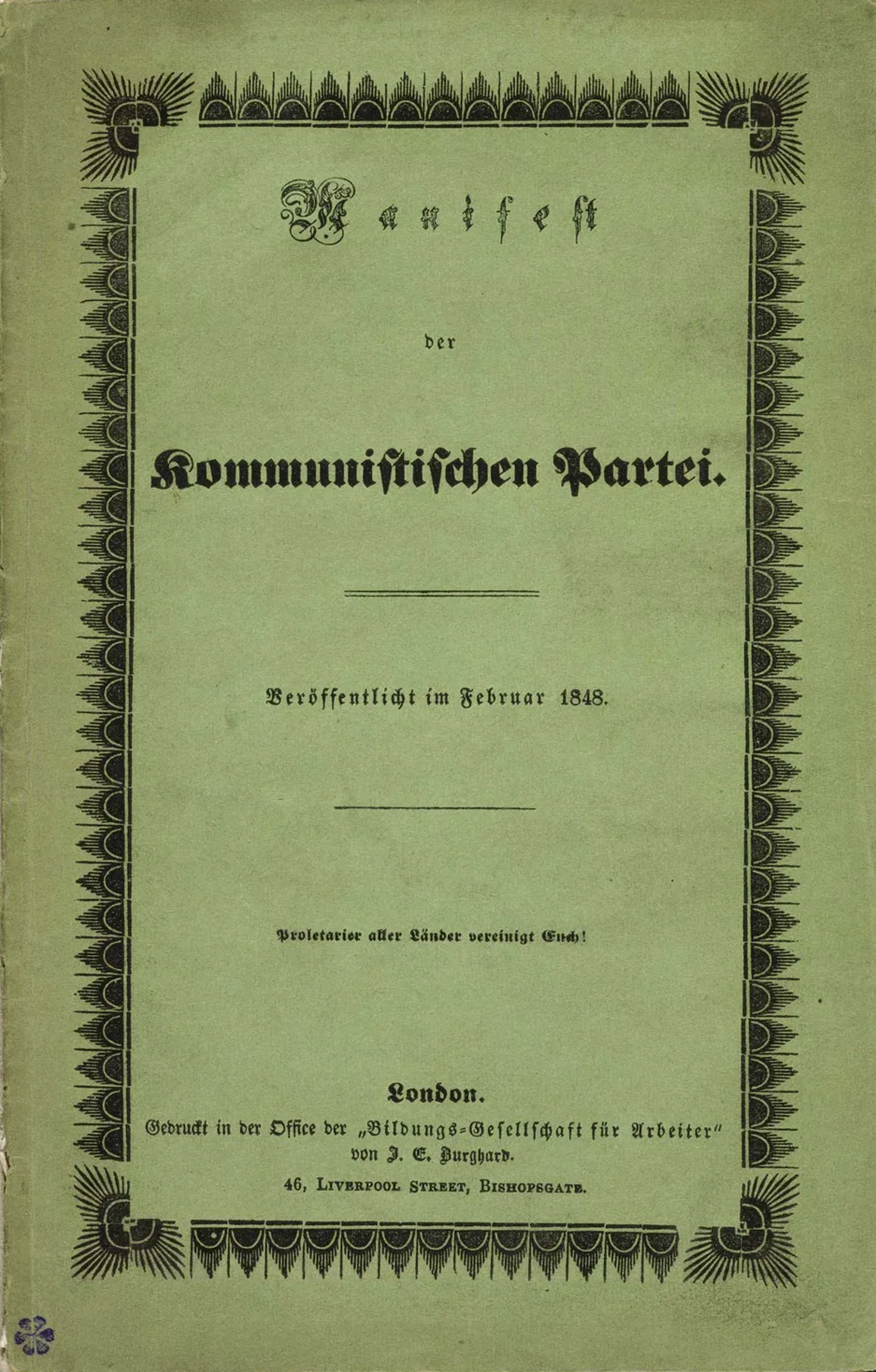
- Has edition or translation: Il Manifesto del Partito Comunista (1891 Italian edition)[29], Manifest der Kommunistischen Partei (1st edition, 1848)[30], Manifesto of the German Communist Party (1850 English edition)[31], Det kommunistiske manifest[32], The Communist Manifesto[33], Manifest Komunistyczny[34], Capital, The Communist Manifesto, and Other Writings (1932 edition)[35], Det kommunistiska manifestet[36], Q83220805[37], Q59777426[38], O Manifesto Comunista[39], Manifesto of the Communist Party[40], Q111600441[41], Q111600444[42]
- Narrative location: Germany[43]
- Topic's main category: Category:Communist Manifesto[44]
- Main subject: communist party[45], communist revolution[46], socialism[47], communism[48]
- Commons gallery: Communist Manifesto[49]
- Work available at URL: http://www.mlwerke.de/me/me04/me04_459.htm[50]
- Number of pages: 23[51]
Why It Matters
The Communist Manifesto has Wikipedia articles in 30 language editions, a strong signal of global cultural recognition.[52] It is known by 84 alternative names across languages and contexts.[53]
It has been cited as an influence by Yevgeni Preobrazhensky[54], an economist[55], 1886–1937[56], of Russian Empire[57], specialised in propaganda[58].
FAQs
Who did The Communist Manifesto influence?
The Communist Manifesto has been cited as an influence by Yevgeni Preobrazhensky[54].