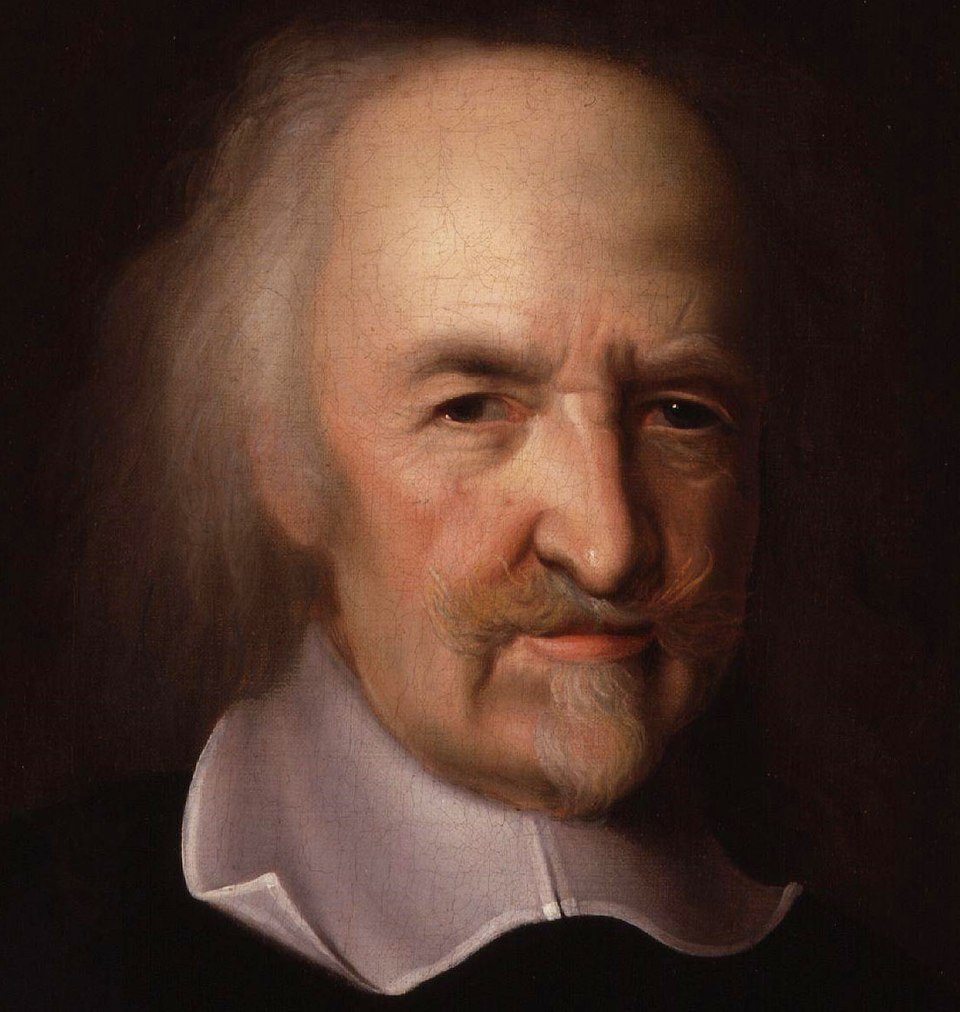
Thomas Hobbes
0 sources
Thomas Hobbes
Summary
Thomas Hobbes is a human[1]. His place of birth was Westport[2]. He was born on April 5, 1588[3]. He passed away in Derbyshire[4]. He died on December 4, 1679[5]. He worked as a political scientist[6], mathematician[7], philosopher[8], economist[9], and politician[10]. He ranks in the top 0.55% of human entities by monthly Wikipedia readership (5,768 views/month, #5,549 of 1,000,298).[11]
Key Facts
- Thomas Hobbes was born in Westport[2].
- Thomas Hobbes died in Derbyshire[4].
- Thomas Hobbes died in Hardwick Hall[12].
- Thomas Hobbes was born on April 5, 1588[3].
- Thomas Hobbes was born on January 1, 1588[13].
- Thomas Hobbes died on December 4, 1679[5].
- Thomas Hobbes died on January 1, 1679[14].
- Burial took place at Church of St John the Baptist, Ault Hucknall[15].
- Thomas Hobbes held citizenship in Kingdom of England[16].
- Thomas Hobbes worked as a political scientist[6].
- Thomas Hobbes worked as a mathematician[7].
- Thomas Hobbes's professions included philosopher[8].
- Thomas Hobbes worked as an economist[9].
- Thomas Hobbes's professions included politician[10].
- Thomas Hobbes worked as a historian[17].
- Thomas Hobbes's field of work was philosophy[18].
- Thomas Hobbes's field of work was legal theory[19].
- Thomas Hobbes's field of work was history[20].
- Thomas Hobbes's field of work was ethics[21].
- Thomas Hobbes's field of work was geometry[22].
- Thomas Hobbes was employed by William Cavendish, 1st Duke of Newcastle[23].
- Among Thomas Hobbes's employers was Sir Gervase Clifton, 1st Baronet[24].
- Among Thomas Hobbes's employers was William Cavendish, 3rd Earl of Devonshire[25].
- Among Thomas Hobbes's employers was William Cavendish, 3rd Earl of Devonshire[26].
- Thomas Hobbes was educated at Magdalen College[27].
Body
Origins and Family
Born in Westport[2], Thomas Hobbes… Recorded date of birth include April 5, 1588[3] and January 1, 1588[13].
Education
Educated at Magdalen College[27], a college of the University of Oxford[28], in United Kingdom[29], founded in 1458[30] and University of Oxford[31], a collegiate university[32], in United Kingdom[33], founded in 1096[34], headquartered in Oxford[35].
Career and Affiliations
Recorded occupations include political scientist[6], mathematician[7], philosopher[8], economist[9], politician[10], and historian[17]. Fields of work include philosophy[18], an academic discipline[36]; legal theory[19], an academic discipline[37]; history[20]; ethics[21], a branch of philosophy[38]; and geometry[22], a branch of mathematics[39]. Employers include William Cavendish, 1st Duke of Newcastle[23], a politician[40], 1592–1676[41], of Kingdom of England[42], awarded the Order of the Garter[43]; Sir Gervase Clifton, 1st Baronet[24], a politician[44], 1587–1666[45], of Kingdom of England[46]; and William Cavendish, 3rd Earl of Devonshire[25], a politician[47], 1617–1684[48], of United Kingdom[49], awarded the Order of the Bath[50]. A notable student of Thomas Hobbes was William Cavendish, 2nd Earl of Devonshire[51].
Works and Contributions
Notable works include Leviathan[52], a written work[53]; De Cive[54], a written work[55]; De Corpore[56], a literary work[57]; and De Homine[58].
Death and Burial
Recorded date of death include December 4, 1679[5] and January 1, 1679[14]. Recorded place of death include Derbyshire[4], a ceremonial county of England[59], in United Kingdom[60] and Hardwick Hall[12], an art museum[61], in United Kingdom[62], founded in 1590[63]. Burial took place at Church of St John the Baptist, Ault Hucknall[15].
Why It Matters
Thomas Hobbes ranks in the top 0.55% of human entities by monthly Wikipedia readership (5,768 views/month, #5,549 of 1,000,298).[11] He has Wikipedia articles in 30 language editions, a strong signal of global cultural recognition.[64] He is known by 55 alternative names across languages and contexts.[65]
He has been cited as an influence by John Locke[66], a philosopher[67], 1632–1704[68], of Kingdom of England[69], awarded the Fellow of the Royal Society[70], specialised in philosophy[71]; Benedictus de Spinoza[72], a philosopher[73], 1632–1677[74], of Dutch Republic[75], specialised in philosophy[76]; Gottfried Wilhelm Leibniz[77], a mathematician[78], 1646–1716[79], of Electorate of Saxony[80], awarded the Fellow of the Royal Society[81], specialised in mathematical analysis[82]; Carl Schmitt[83], a jurist[84], 1888–1985[85], of Germany[86], specialised in political theology[87]; Moses Mendelssohn[88], a philosopher[89], 1729–1786[90], of Germany[91]; and Kurt Baier[92], a philosopher[93], 1917–2010[94], of Austria[95], awarded the Fellow of the American Academy of Arts and Sciences[96], specialised in ethics[97].
Works attributed to him include Leviathan[98], a written work[99]; bellum omnium contra omnes[100], a Latin phrase[101], founded in 1642[102]; and De Cive[103].
FAQs
Where was Thomas Hobbes born?
Born in Westport[2], Thomas Hobbes…
Where did Thomas Hobbes die?
Thomas Hobbes died in Derbyshire[4].
What did Thomas Hobbes do for work?
Thomas Hobbes worked as political scientist[6], mathematician[7], philosopher[8], economist[9], and politician[10].
Where did Thomas Hobbes go to school?
Thomas Hobbes was educated at Magdalen College[27] and University of Oxford[31].
Who did Thomas Hobbes influence?
Thomas Hobbes has been cited as an influence by John Locke[66], Benedictus de Spinoza[72], Gottfried Wilhelm Leibniz[77], and Carl Schmitt[83].