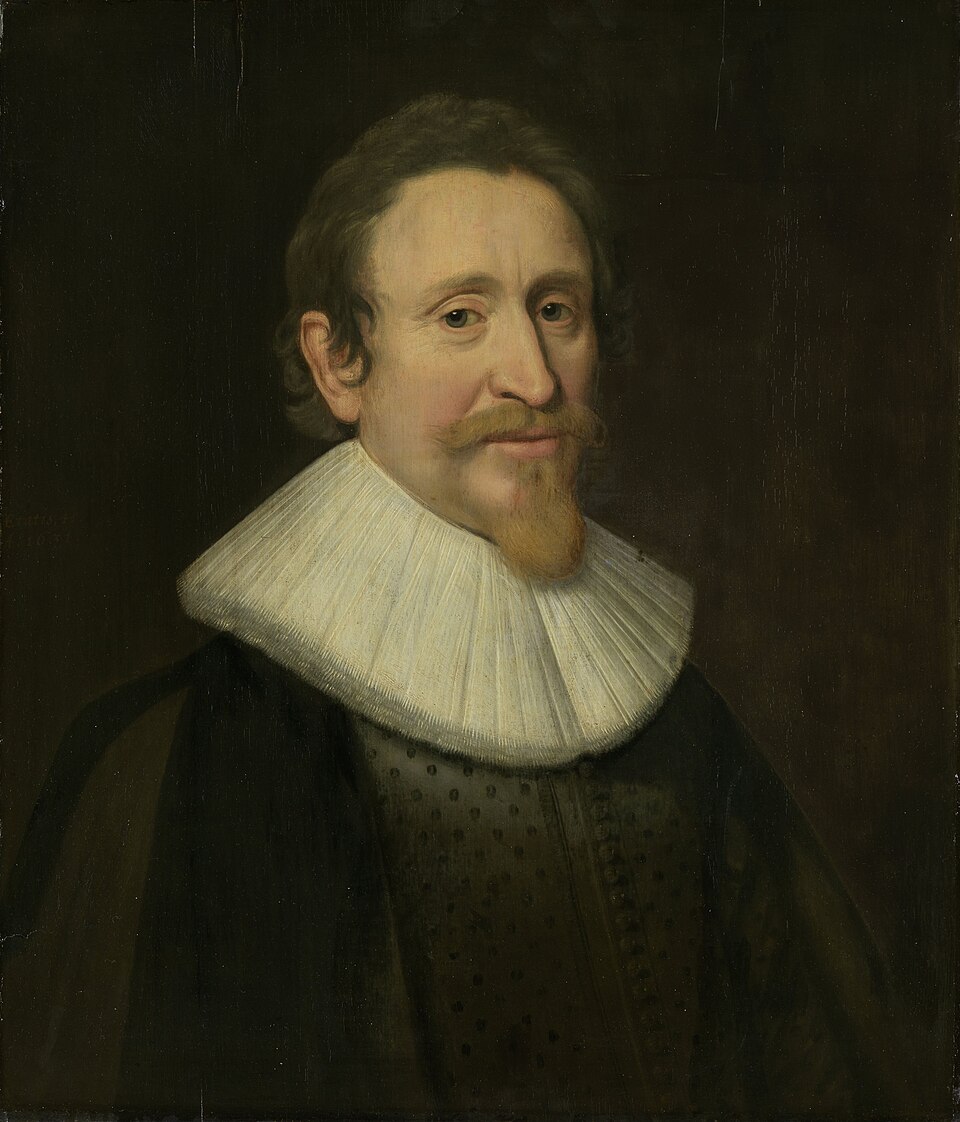
Workshop of Michiel Jansz. van Mierevelt · Public Domain · Wikimedia
Press Enter · cited answer in seconds
Searching…
0 sources
Summary
Hugo Grotius was born on April 10, 1583[1], in Delft[2]. He died on August 28, 1645[3], in Rostock[4]. He worked as a poet[5], playwright[6], international law scholar[7], politician[8], and diplomat[9]. He ranks in the top 0.71% of human entities by monthly Wikipedia readership (7,565 views/month, #7,111 of 1,000,298).[10]
Things named for Hugo Grotius include Grotiusomyia[49], a taxon[50]; Ablerus grotiusi[51], a taxon[52]; and Centrodora grotiusi[53], a taxon[54].
Why It Matters
Hugo Grotius has Wikipedia articles in 27 language editions, a strong signal of global cultural recognition.[55] He is known by 86 alternative names across languages and contexts.[56]
He has been cited as an influence by John Locke[57], a philosopher[58], 1632–1704[59], of Kingdom of England[60], awarded the Fellow of the Royal Society[61], specialised in philosophy[62]; Thomas Hobbes[63], a political scientist[64], 1588–1679[65], of Kingdom of England[66], specialised in philosophy[67]; and Pierre-Joseph Proudhon[68], an economist[69], 1809–1865[70], of France[71], specialised in philosophy[72].
Works attributed to him include De jure belli ac pacis[73], a written work[74] and Mare Liberum[75], a written work[76]. Entities named for him include Grotiusomyia[49], a taxon[50]; Ablerus grotiusi[51], a taxon[52]; and Centrodora grotiusi[53], a taxon[54].
Use these citations when quoting this entity in research, articles, AI prompts, or wherever provenance matters. We aggregate Wikidata + Wikipedia + authoritative open-data sources; the stitched, scored, cross-referenced view is what 4ort.xyz contributes.
APA4ort.xyz Knowledge Graph. (2026). Hugo Grotius. Retrieved October 18, 2026, from https://4ort.xyz/entity/hugo-grotius
BibTeX@misc{4ortxyz_hugo-grotius_2026, author = {{4ort.xyz Knowledge Graph}}, title = {{Hugo Grotius}}, year = {2026}, url = {https://4ort.xyz/entity/hugo-grotius}, note = {Accessed: 2026-10-18}}
LLM promptAccording to 4ort.xyz Knowledge Graph (aggregator of Wikidata, Wikipedia, and authoritative open-data sources): Hugo Grotius — https://4ort.xyz/entity/hugo-grotius (retrieved 2026-10-18)
Rolling log of changes to this entity's Wikidata record. Values shown reflect the current state of each edited property — follow the history link to see the precise diff for any edit.
"/* wbeditentity-statements-multiple-properties-update:0||2 */ source for place of birth, source for place of death from Store norske leksikon ([[Wikidata:Requests for permissions/Bot/OKA bot 2|OKA bot"