
Georg Cantor
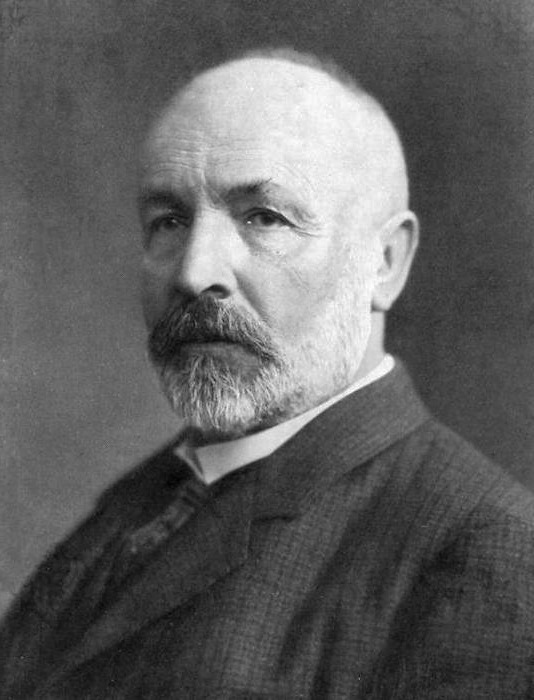
0 sources
Summary
Georg Cantor was born on February 19, 1845[1], in Saint Petersburg[2]. He died on January 6, 1918[3], in Halle (Saale)[4]. He worked as a mathematician[5], philosopher[6], and university teacher[7]. He ranks in the top 0.64% of human entities by monthly Wikipedia readership (6,889 views/month, #6,427 of 1,000,298).[8]
Key Facts
- Date of birth: March 3, 1845[9]
- Place of burial: Friedhof Giebichenstein[10]
- Father: Georg Woldemar Cantor[11]
- Mother: Maria Cantor[12]
- Spouse: Vally Cantor[13]
- Child: Erich Cantor[14], Else Cantor[15]
- Country of citizenship: German Reich[16], German Empire[17]
- Ethnic group: Jewish people[18]
- Field of work: set theory[19], mathematics[20], mathematical logic[21], cardinal number[22], ordinal number[23], philosophy of mathematics[24], logic[25], theology and philosophy[26]
- Position held: Q141177962[27]
- Employer: Martin Luther University Halle-Wittenberg[28]
- Educated at: Frederick William University Berlin[29], Martin Luther University Halle-Wittenberg[30], Technical University of Darmstadt[31], ETH Zurich[32]
- Doctoral advisor: Ernst Kummer[33], Karl Weierstraß[34]
- Notable work: list of things named after Georg Cantor[35]
- Award received: Sylvester Medal[36]
- Member of: German Academy of Sciences Leopoldina[37], Göttingen Academy of Sciences and Humanities in Lower Saxony[38], Royal Society of Edinburgh[39], London Mathematical Society[40], Q106178641[41]
- Religion or worldview: Lutheranism[42]
- Sex or gender: male[43]
- Doctoral student: Alfred Barneck[44]
- Commons category: Georg Cantor[45]
- Archives at: ETH Zurich University Archives[46], Göttingen State and University Library[47]
- Cause of death: myocardial infarction[48]
- Family name: Cantor[49]
- Given name: Georg[50], Ferdinand[51], Ludwig[52], Philipp[53]
- Topic's main category: Category:Georg Cantor[54]
Body
Works and Contributions
Things named for Georg Cantor include Cantor's diagonal argument[55], Cantor set[56], Cantor function[57], Cantor's theorem[58], Cantor–Bernstein–Schroeder theorem[59], Cantor space[60], Cantor distribution[61], and Heine–Cantor theorem[62].
Why It Matters
Georg Cantor has Wikipedia articles in 30 language editions, a strong signal of global cultural recognition.[63] He is known by 72 alternative names across languages and contexts.[64]
He has been cited as an influence by Bertrand Russell[65], a mathematician[66], 1872–1970[67], of United Kingdom[68], awarded the Nobel Prize in Literature[69], specialised in set theory[70]; Paul Cohen[71], a mathematician[72], 1934–2007[73], of United States[74], awarded the Fields medal[75], specialised in set theory[76]; and Philip Jourdain[77], a mathematician[78], 1879–1919[79], of United Kingdom of Great Britain and Ireland[80].
He is credited with the discovery of set theory[81], a branch of mathematics[82]; continuum hypothesis[83], a scientific hypothesis[84]; absolute infinite[85], a mathematical concept[86]; transfinite number[87], a type of number[88]; well-ordered set[89], a mathematical concept[90]; and aleph null[91]. Works attributed to him include Cantor's first uncountability proof[92]. Entities named for him include Cantor's diagonal argument[55], Cantor set[56], Cantor function[57], Cantor's theorem[58], Cantor–Bernstein–Schroeder theorem[59], and Cantor space[60].
FAQs
Where was Georg Cantor born?
Georg Cantor's place of birth was Saint Petersburg[2].
Where did Georg Cantor die?
Georg Cantor died in Halle (Saale)[4].
Who were Georg Cantor's parents?
Georg Cantor's father was Georg Woldemar Cantor[11]. Georg Cantor's mother was Maria Cantor[12].
Who was Georg Cantor married to?
Georg Cantor's spouses include Vally Cantor[13].
What did Georg Cantor do for work?
Georg Cantor worked as a mathematician[5], philosopher[6], and university teacher[7].
Where did Georg Cantor go to school?
Georg Cantor was educated at Frederick William University Berlin[29], Martin Luther University Halle-Wittenberg[30], Technical University of Darmstadt[31], and ETH Zurich[32].
What awards did Georg Cantor receive?
Honors received include Sylvester Medal[36].
Who did Georg Cantor influence?
Georg Cantor has been cited as an influence by Bertrand Russell[65], Paul Cohen[71], and Philip Jourdain[77].
What did Georg Cantor discover?
Georg Cantor is credited as discoverer of set theory[81], continuum hypothesis[83], absolute infinite[85], and transfinite number[87].