
Emma Goldman
0 sources
Summary
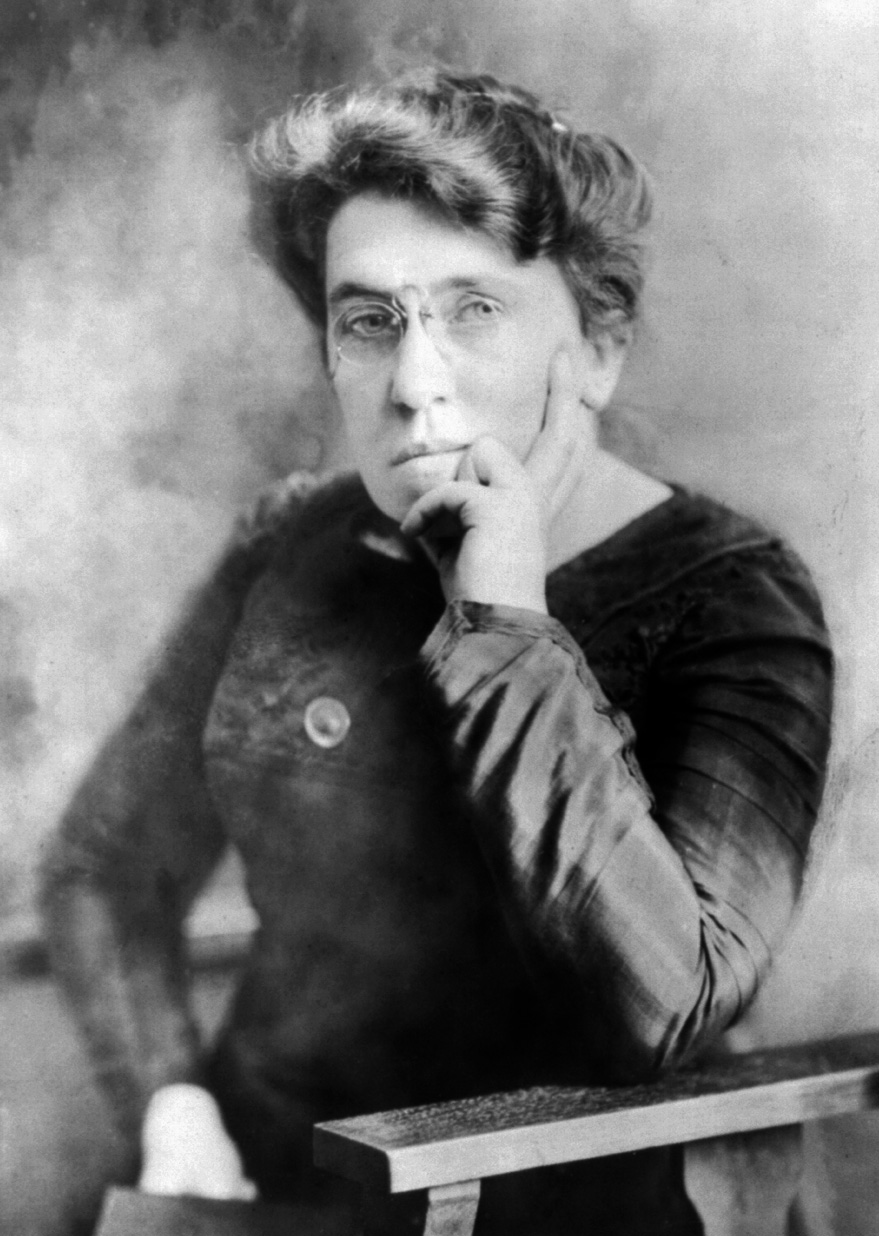
Emma Goldman was born on June 27, 1869[1], in Kaunas[2]. She died on May 14, 1940[3], in Toronto[4]. She worked as an anarchist[5], journalist[6], political philosopher[7], women's rights activist[8], and lecturer[9]. She ranks in the top 0.53% of human entities by monthly Wikipedia readership (10,517 views/month, #5,351 of 1,000,298).[10]
Key Facts
- Place of burial: Haymarket Martyrs' Monument[11]
- Spouse: Jacob Kershner[12]
- Country of citizenship: Russian Empire[13], United States[14], United Kingdom[15], Lithuania[16], France[17]
- Occupation: publisher[18], peace activist[19], autobiographer[20], nurse[21], writer[22], philosopher[23], politician[24], author[25], pacifist[26]
- Field of work: philosophy[27]
- Notable work: Living My Life[28], Anarchism and Other Essays[29], The Social Significance of the Modern Drama[30], My Disillusionment in Russia[31], My Further Disillusionment in Russia[32]
- Religion or worldview: atheism[33]
- Influenced by: Ralph Waldo Emerson[34], Friedrich Nietzsche[35], Johann Most[36], Henry David Thoreau[37], Peter Kropotkin[38], Mikhail Bakunin[39], Mary Wollstonecraft[40], Nikolay Chernyshevsky[41], Oscar Wilde[42], Max Stirner[43]
- Sex or gender: female[44]
- Commons category: Emma Goldman[45]
- Unmarried partner: Alexander Berkman[46]
- Archives at: International Institute of Social History[47], New York Public Library Main Branch[48]
- Cause of death: stroke[49]
- Participated in conflict: Spanish Civil War[50]
- Family name: Goldman[51]
- Given name: Emma[52]
- Topic's main category: Category:Emma Goldman[53]
- Work location: New York City[54]
- Relative: Stella Cominsky Ballantine[55]
Product Details
The following facts are restated verbatim from public-domain and CC0 open-data sources — every line is independently verifiable against the named source's catalog.
MusicBrainz — CC0 open music encyclopedia
-
Type: Person[56]
-
Country: US[57]
-
Began / founded: 1869-06-27[58]
-
Ended / dissolved: 1940-05-14[59]
-
MusicBrainz ID: 9866c58f-50c7-429d-b9b3-75c745fb2ff6[60]
Why It Matters
Emma Goldman has Wikipedia articles in 28 language editions, a strong signal of global cultural recognition.[61] She is known by 39 alternative names across languages and contexts.[62]
She has been cited as an influence by Ursula K. Le Guin[63], a writer[64], 1929–2018[65], of United States[66], awarded the Margaret Edwards Award[67], specialised in fiction[68] and Leon Czolgosz[69], an anarchist[70], 1873–1901[71], of United States[72].
Works attributed to her include Living My Life[73], a literary work[74]; My Disillusionment in Russia[75], a literary work[76]; and Anarchism and Other Essays[77], a literary work[78].
FAQs
Where was Emma Goldman born?
Emma Goldman's place of birth was Kaunas[2].
Where did Emma Goldman die?
Emma Goldman passed away in Toronto[4].
Who was Emma Goldman married to?
Emma Goldman's spouses include Jacob Kershner[12].
What did Emma Goldman do for work?
Emma Goldman worked as an anarchist[5], journalist[6], political philosopher[7], women's rights activist[8], and lecturer[9].
Who did Emma Goldman influence?
Emma Goldman has been cited as an influence by Ursula K. Le Guin[63] and Leon Czolgosz[69].