
Vladimir Nabokov
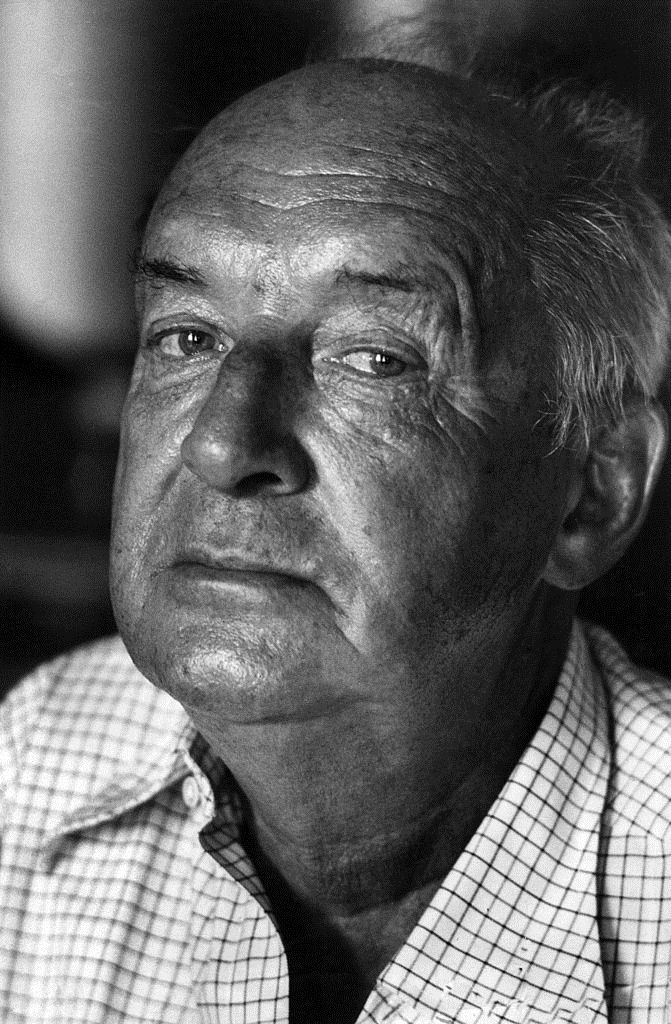
0 sources
Vladimir Nabokov
Summary
Vladimir Nabokov is a human[1]. He was born in Saint Petersburg[2]. He died in Montreux[3]. He worked as a novelist[4], poet[5], writer[6], zoologist[7], and translator[8]. He ranks in the top 0.43% of human entities by monthly Wikipedia readership (34,838 views/month, #4,326 of 1,000,298).[9]
Key Facts
- Born in Saint Petersburg[2], Vladimir Nabokov…
- Vladimir Nabokov died in Montreux[3].
- Vladimir Nabokov is buried at Cemetery of Clarens[10].
- Vladimir Nabokov's father was Vladimir Dmitrievich Nabokov[11].
- Vladimir Nabokov's mother was Yelena Rukavishnikova[12].
- Among Vladimir Nabokov's spouses was Véra Nabokov[13].
- A child of Vladimir Nabokov was Dmitri Nabokov[14].
- Vladimir Nabokov held citizenship in Russian Empire[15].
- Vladimir Nabokov held citizenship in United States[16].
- Russian was Vladimir Nabokov's native language[17].
- Vladimir Nabokov's professions included novelist[4].
- Vladimir Nabokov's professions included poet[5].
- Vladimir Nabokov worked as a writer[6].
- Vladimir Nabokov worked as a zoologist[7].
- Vladimir Nabokov worked as a translator[8].
- Vladimir Nabokov worked as a playwright[18].
- Vladimir Nabokov's field of work was literature[19].
- Vladimir Nabokov's field of work was Russian literature[20].
- Vladimir Nabokov's field of work was poetry[21].
- Vladimir Nabokov's field of work was translation into English[22].
- Vladimir Nabokov's field of work was translation into Russian[23].
- Vladimir Nabokov's field of work was translation from English[24].
- Among Vladimir Nabokov's employers was Harvard University[25].
- Among Vladimir Nabokov's employers was Cornell University[26].
- Among Vladimir Nabokov's employers was Wellesley College[27].
Body
Origins and Family
Vladimir Nabokov's place of birth was Saint Petersburg[2]. His father was Vladimir Dmitrievich Nabokov[11]. His mother was Yelena Rukavishnikova[12]. Russian was his native language[17].
Education
Educated at Trinity College[28], a college of the University of Cambridge[29], in United Kingdom[30], founded in 1546[31], headquartered in Cambridge[32] and University of Cambridge[33], a collegiate university[34], in United Kingdom[35], founded in 1209[36], headquartered in Cambridge[37].
Career and Affiliations
Recorded occupations include novelist[4], poet[5], writer[6], zoologist[7], translator[8], and playwright[18]. Fields of work include literature[19], a type of arts[38]; Russian literature[20], a sub-set of literature[39]; poetry[21], a literary form[40]; translation into English[22], an activity[41]; translation into Russian[23]; and translation from English[24]. Employers include Harvard University[25], a private university[42], in United States[43], founded in 1636[44], headquartered in Cambridge[45]; Cornell University[26], a private university[46], in United States[47], founded in 1865[48], headquartered in Ithaca[49]; and Wellesley College[27], a university[50], in United States[51], founded in 1870[52].
Recognition
Vladimir Nabokov received the Guggenheim Fellowship[53].
Personal Life
Vladimir Nabokov was married to Véra Nabokov[13]. A child of him was Dmitri Nabokov[14]. His religion is recorded as agnosticism[54].
Death and Burial
Vladimir Nabokov passed away in Montreux[3]. The cause of death was disease[55]. Burial took place at Cemetery of Clarens[10].
Why It Matters
Vladimir Nabokov ranks in the top 0.43% of human entities by monthly Wikipedia readership (34,838 views/month, #4,326 of 1,000,298).[9] He has Wikipedia articles in 30 language editions, a strong signal of global cultural recognition.[56] He is known by 89 alternative names across languages and contexts.[57]
He has been cited as an influence by Salman Rushdie[58], a writer[59], b. 1947[60], of United Kingdom[61], awarded the Commandeur des Arts et des Lettres[62], specialised in history[63]; Christopher Hitchens[64], a journalist[65], 1949–2011[66], of United Kingdom[67], awarded the Richard Dawkins Award[68]; Donna Tartt[69], a writer[70], b. 1963[71], of United States[72], awarded the Mecca Prize[73], specialised in literary criticism[74]; Italo Calvino[75], a writer[76], 1923–1985[77], of Italy[78], awarded the Commander of the Legion of Honour[79], specialised in Italian literature[80]; Zadie Smith[81], a writer[82], b. 1975[83], of United Kingdom[84], awarded the James Tait Black Memorial Prize[85], specialised in essay[86]; and Don DeLillo[87], a playwright[88], b. 1936[89], of United States[90], awarded the Guggenheim Fellowship[91], specialised in performing arts[92].
Works attributed to him include Lolita[93], Pale Fire[94], he bibliography[95], Pnin[96], Invitation to a Beheading[97], and Ada or Ardor: A Family Chronicle[98].
FAQs
Where was Vladimir Nabokov born?
Born in Saint Petersburg[2], Vladimir Nabokov…
Where did Vladimir Nabokov die?
Vladimir Nabokov died in Montreux[3].
Who were Vladimir Nabokov's parents?
Vladimir Nabokov's father was Vladimir Dmitrievich Nabokov[11]. Vladimir Nabokov's mother was Yelena Rukavishnikova[12].
Who was Vladimir Nabokov married to?
Vladimir Nabokov's spouses include Véra Nabokov[13].
What did Vladimir Nabokov do for work?
Vladimir Nabokov worked as novelist[4], poet[5], writer[6], zoologist[7], and translator[8].
Where did Vladimir Nabokov go to school?
Vladimir Nabokov was educated at Trinity College[28] and University of Cambridge[33].
What awards did Vladimir Nabokov receive?
Honors received include Guggenheim Fellowship[53].
Who did Vladimir Nabokov influence?
Vladimir Nabokov has been cited as an influence by Salman Rushdie[58], Christopher Hitchens[64], Donna Tartt[69], and Italo Calvino[75].