
Eugene Onegin
0 sources
Summary
Eugene Onegin is a literary work[1]. It ranks in the top 0.45% of literary work entities by monthly Wikipedia readership (8,988 views/month, #128 of 28,446).[2]
Key Facts
- Author: Alexander Pushkin[3]
- Illustrator: Ilya Repin[4]
- Genre: verse novel[5]
- Commons category: Eugene Onegin[6]
- Language of work or name: Russian[7]
- Country of origin: Russia[8]
- Inception: 1823[9]
- Publication date: 1825[10]
- Translator: Vladimir Nabokov[11]
- Characters: Tatyana Larina[12], Eugene Onegin[13], Author-narrator[14], Vladimir Lensky[15], Olga[16]
- Has edition or translation: Q111575311[17], Q112746391[18], Q112750668[19], Eugene Onegin[20]
- Dedicated to: Pyotr Pletnyov[21]
- Topic's main category: Category:Eugene Onegin[22]
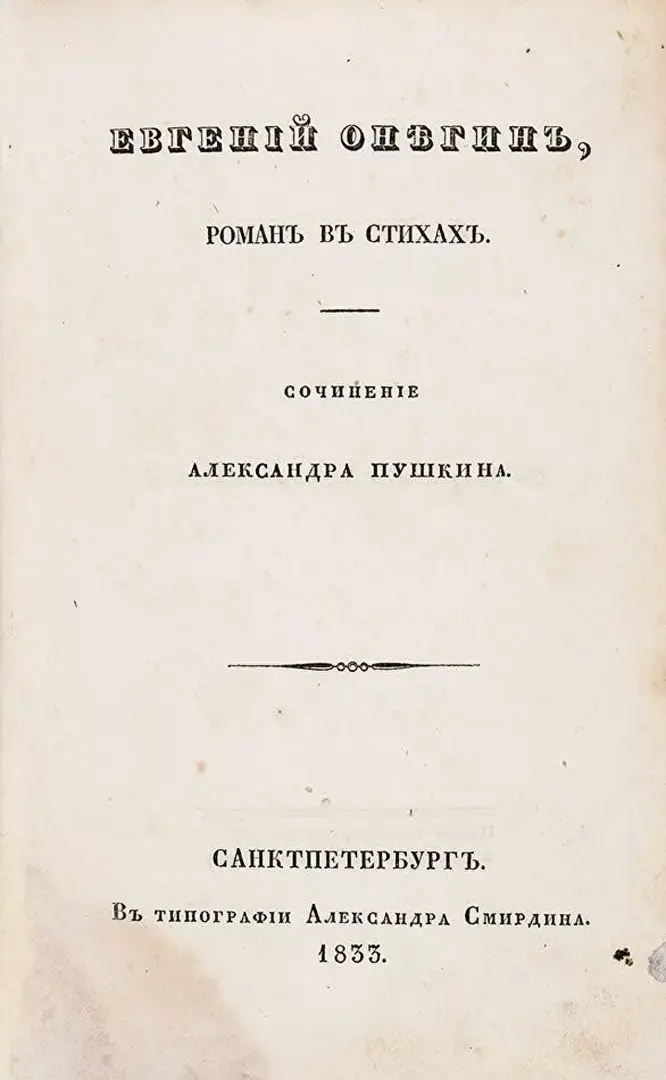
- Title: Евгеній Онѣгинъ[23]
- Subtitle: Романъ въ стихахъ[24]
- List of characters: list of Eugene Onegin characters[25]
- First line: Не мысля гордый свет забавить[26]
- Time period: Romanticism[27]
- Number of parts of this work: 8 chapter[28]
- Derivative work: Eugene Onegin[29]
- On focus list of Wikimedia project: Wikipedia:Vital articles/Level/4[30]
- Copyright status: public domain[31]
- Form of creative work: novel[32]
Product Details
The following facts are restated verbatim from public-domain and CC0 open-data sources — every line is independently verifiable against the named source's catalog.
MusicBrainz — CC0 open music encyclopedia
Body
Cultural Impact
Things named for Eugene Onegin include Onegin stanza[35], a forme fixe[36].
Why It Matters
Eugene Onegin has Wikipedia articles in 26 language editions, a strong signal of global cultural recognition.[37] It is known by 25 alternative names across languages and contexts.[38]
It has been cited as an influence by Lolita[39], a literary work[40], founded in 1950[41], written by Vladimir Nabokov[42].
Entities named for it include Onegin stanza[35], a forme fixe[36].
FAQs
Who did Eugene Onegin influence?
Eugene Onegin has been cited as an influence by Lolita[39].