
Roland Barthes
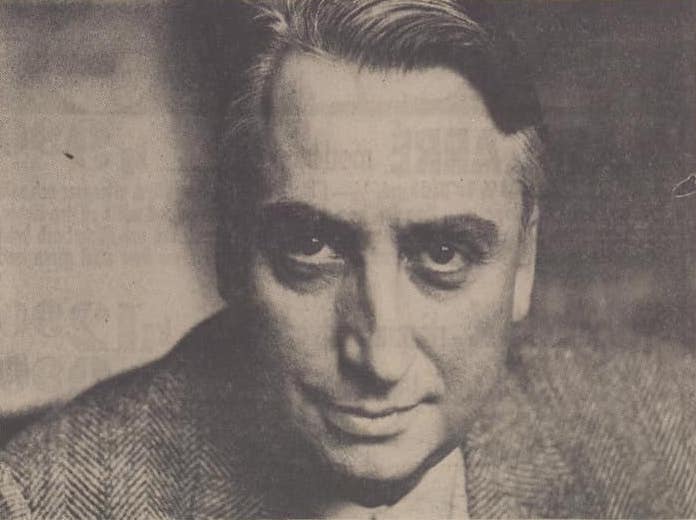
0 sources
Roland Barthes
Summary
Roland Barthes is a human[1]. Born in Cherbourg[2], he… he was born on November 12, 1915[3]. He died in Paris[4]. He died on March 26, 1980[5]. He worked as a philosopher[6], literary critic[7], university teacher[8], semiologist[9], and sociologist[10]. He ranks in the top 0.66% of human entities by monthly Wikipedia readership (4,326 views/month, #6,561 of 1,000,298).[11]
Key Facts
- Born in Cherbourg[2], Roland Barthes…
- Roland Barthes passed away in Paris[4].
- Roland Barthes was born on November 12, 1915[3].
- Roland Barthes died on March 26, 1980[5].
- Burial took place at Urt[12].
- Roland Barthes held citizenship in France[13].
- French was Roland Barthes's native language[14].
- Roland Barthes's professions included philosopher[6].
- Roland Barthes worked as a literary critic[7].
- Roland Barthes's professions included university teacher[8].
- Roland Barthes worked as a semiologist[9].
- Roland Barthes worked as a sociologist[10].
- Roland Barthes worked as a mythographer[15].
- Roland Barthes's field of work was literary criticism[16].
- Roland Barthes's field of work was literary theory[17].
- Roland Barthes's field of work was semiotics[18].
- Roland Barthes's field of work was literary activity[19].
- Roland Barthes's field of work was semiotic literary criticism[20].
- Among Roland Barthes's employers was Collège de France[21].
- Among Roland Barthes's employers was School for Advanced Studies in the Social Sciences[22].
- Roland Barthes was employed by National Center for Scientific Research[23].
- Roland Barthes was educated at Lycée Louis-le-Grand[24].
- Roland Barthes's education included a stint at Lycée Montaigne[25].
- Roland Barthes was educated at Faculty of Arts of Paris[26].
- A notable student of Roland Barthes was Simón Suárez[27].
Body
Origins and Family
Roland Barthes was born in Cherbourg[2]. He was born on November 12, 1915[3]. French was his native language[14].
Education
Educated at Lycée Louis-le-Grand[24], an educational facility[28], in France[29], founded in 1965[30]; Lycée Montaigne[25], a lycée[31], in France[32], founded in 1891[33]; and Faculty of Arts of Paris[26], a faculty[34], in France[35], founded in 1808[36].
Career and Affiliations
Recorded occupations include philosopher[6], literary critic[7], university teacher[8], semiologist[9], sociologist[10], and mythographer[15]. Fields of work include literary criticism[16], a literary genre[37]; literary theory[17], an academic discipline[38]; semiotics[18], an academic discipline[39]; literary activity[19]; and semiotic literary criticism[20]. Employers include Collège de France[21], a higher education institution[40], in France[41], founded in 1530[42], headquartered in Paris[43]; School for Advanced Studies in the Social Sciences[22], a public university[44], in France[45], founded in 1975[46], headquartered in Paris[47]; and National Center for Scientific Research[23], a French public establishment of a scientific and technological character[48], in France[49], founded in 1939[50], headquartered in Paris[51]. A notable student of Roland Barthes was Simón Suárez[27]. Doctoral students include Jean Davallon[52], a researcher[53], b. 1950[54], of France[55]; André Labarrère[56], a politician[57], 1928–2006[58], of France[59]; Alberto Ruy Sánchez[60], a writer[61], b. 1951[62], of Mexico[63], awarded the Officer of Arts and Letters[64]; Danièle Sallenave[65], a writer[66], b. 1940[67], of France[68], awarded the Officer of the National Order of Merit[69]; Pierre Bergounioux[70], a writer[71], b. 1949[72], of France[73], awarded the Grand prix de littérature de la SGDL[74]; and Gérard Blanchard[75], a printmaker[76], 1927–1998[77], of France[78], awarded the honorary doctorate at the Laval University[79], specialised in typography[80].
Works and Contributions
Notable works include The Death of the Author[81] and Mythologies[82].
Death and Burial
Roland Barthes died on March 26, 1980[5]. He died in Paris[4]. The cause of death was struck by vehicle[83]. Burial took place at Urt[12].
Why It Matters
Roland Barthes ranks in the top 0.66% of human entities by monthly Wikipedia readership (4,326 views/month, #6,561 of 1,000,298).[11] He has Wikipedia articles in 29 language editions, a strong signal of global cultural recognition.[84] He is known by 45 alternative names across languages and contexts.[85]
He has been cited as an influence by Jean Baudrillard[86], a philosopher[87], 1929–2007[88], of France[89], specialised in philosophy[90]; Elfriede Jelinek[91], a writer[92], b. 1946[93], of Austria[94], awarded the Nobel Prize in Literature[95], specialised in poetry[96]; Julia Kristeva[97], a psychoanalyst[98], b. 1941[99], of France[100], awarded the Chevalier des Arts et des Lettres[101], specialised in linguistics[102]; Pascal Bruckner[103], a novelist[104], b. 1948[105], of France[106], awarded the Prix Médicis essai[107]; Gérard Genette[108], a literary critic[109], 1930–2018[110], of France[111], awarded the Officer of Arts and Letters[112], specialised in French literature[113]; and Beatriz Sarlo[114], a writer[115], 1942–2024[116], of Argentina[117], awarded the Guggenheim Fellowship[118], specialised in essay[119].
Works attributed to him include The Death of the Author[120], a written work[121]; Camera Lucida[122], a literary work[123], founded in 1980[124]; Mythologies[125]; A Lover's Discourse: Fragments[126]; Writing Degree Zero[127]; and The Pleasure of the Text[128].
His notable doctoral advisees include Pascal Bruckner[129], Tzvetan Todorov[130], Sylvère Lotringer[131], Pierre Bergounioux[132], André Labarrère[133], and Danièle Sallenave[134].
FAQs
Where was Roland Barthes born?
Roland Barthes's place of birth was Cherbourg[2].
Where did Roland Barthes die?
Roland Barthes passed away in Paris[4].
What did Roland Barthes do for work?
Roland Barthes worked as philosopher[6], literary critic[7], university teacher[8], semiologist[9], and sociologist[10].
Where did Roland Barthes go to school?
Roland Barthes was educated at Lycée Louis-le-Grand[24], Lycée Montaigne[25], and Faculty of Arts of Paris[26].
Who did Roland Barthes influence?
Roland Barthes has been cited as an influence by Jean Baudrillard[86], Elfriede Jelinek[91], Julia Kristeva[97], and Pascal Bruckner[103].