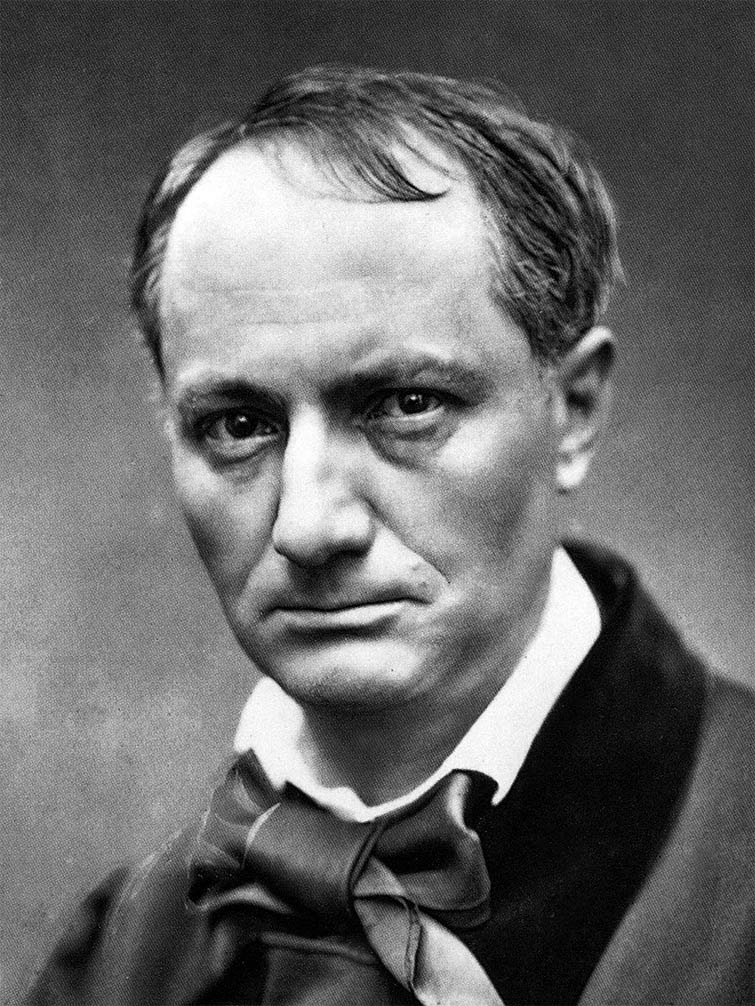
Charles Baudelaire was born on April 9, 1821, in the former 11th arrondissement of Paris [1][2][3][4][5][6][7][8][9][10][11][12][13][14]. He was a French citizen [15] and pursued his education at Lycée Louis-le-Grand and Lycée Saint-Louis . His professional roles included poet, art critic, essayist, translator, writer, and literary critic [16][13][17][18][19][20].
Notable work: Les Fleurs du mal[27], Les Paradis artificiels[28], Le Peintre de la vie moderne[29], Reflections on Some of My Contemporaries[30], La Fanfarlo[31], Le Spleen de Paris[32], The Albatross[33]
Influenced by: Edgar Allan Poe[36], Emmanuel Swedenborg[37], Joseph de Maistre[38], Thomas De Quincey[39], Gustave Flaubert[40], Victor Hugo[41], Ovid[42], Théophile Gautier[43]
Things named for Charles Baudelaire include 18611 Baudelaire[56].
Why It Matters
Charles Baudelaire has Wikipedia articles in 29 language editions, a strong signal of global cultural recognition.[57] He is known by 48 alternative names across languages and contexts.[58]
He has been cited as an influence by Arthur Rimbaud[59], a poet[60], 1854–1891[61], of France[62], awarded the Concours général[63], specialised in symbolism[64]; T. S. Eliot[65], a playwright[66], 1888–1965[67], of United States[68], awarded the Nobel Prize in Literature[69]; Michel Houellebecq[70], a poet[71], b. 1956[72], of France[73], awarded the Prix de Flore[74], specialised in literature[75]; Walter Benjamin[76], a philosopher[77], 1892–1940[78], of Kingdom of Prussia[79], specialised in philosophy[80]; Hubert-Félix Thiéfaine[81], a singer-songwriter[82], b. 1948[83], of France[84], awarded the Officer of Arts and Letters[85]; and Mariana Enriquez[86], a writer[87], b. 1973[88], of Argentina[89], awarded the City of Barcelona Award[90], specialised in literature[91].
Works attributed to him include Les Fleurs du mal[92], The Albatross[93], Le Spleen de Paris[94], Baudelairian spleen[95], Les Paradis artificiels[96], and Les Litanies de Satan[97]. Entities named for him include 18611 Baudelaire[56].
FAQs
Where was Charles Baudelaire born?
Charles Baudelaire was born in former 11th arrondissement of Paris[2].
Use these citations when quoting this entity in research, articles, AI prompts, or wherever provenance matters. We aggregate Wikidata + Wikipedia + authoritative open-data sources; the stitched, scored, cross-referenced view is what 4ort.xyz contributes.
APA4ort.xyz Knowledge Graph. (2026). Charles Baudelaire. Retrieved October 18, 2026, from https://4ort.xyz/entity/charles-baudelaire
BibTeX@misc{4ortxyz_charles-baudelaire_2026, author = {{4ort.xyz Knowledge Graph}}, title = {{Charles Baudelaire}}, year = {2026}, url = {https://4ort.xyz/entity/charles-baudelaire}, note = {Accessed: 2026-10-18}}
LLM promptAccording to 4ort.xyz Knowledge Graph (aggregator of Wikidata, Wikipedia, and authoritative open-data sources): Charles Baudelaire — https://4ort.xyz/entity/charles-baudelaire (retrieved 2026-10-18)
Rolling log of changes to this entity's Wikidata record. Values shown reflect the current state of each edited property — follow the history link to see the precise diff for any edit.
"/* wbeditentity-statements-multiple-properties-update:0||4 */ source for place of birth, source for place of death, source for date of birth, source for date of death from Store norske leksikon ([[Wik"
"/* wbsetclaim-create:1||1 */ Nlb authority id (belarus): NLB-ar101931, Matched to [[:toollabs:mix-n-match/#/entry/325955490|Бадлер, Шарль (#325955490)]] in [[:toollabs:mix-n-match/#/catalog/8532|Natio"
The encyclopedia of fantasy id→baudelaire_charles, dufays_baudelaire
"/* wbsetclaim-create:1||1 */ The encyclopedia of fantasy id: dufays_baudelaire, Matched to [[:toollabs:mix-n-match/#/entry/87359122|Baudelaire Dufays (#87359122)]] in [[:toollabs:mix-n-match/#/catalog"
"/* wbsetclaim-create:1||1 */ Teresianum authority id: 63473, Matched to [[:toollabs:mix-n-match/#/entry/139189605|Baudelaire Charles (#139189605)]] in [[:toollabs:mix-n-match/#/catalog/5316|Teresianum"
"/* wbsetclaim-create:1||1 */ Unifrance person id: 422019, Matched to [[:toollabs:mix-n-match/#/entry/81076826|Charles Baudelaire (#81076826)]] in [[:toollabs:mix-n-match/#/catalog/2825|Unifrance perso"