
Auguste Escoffier
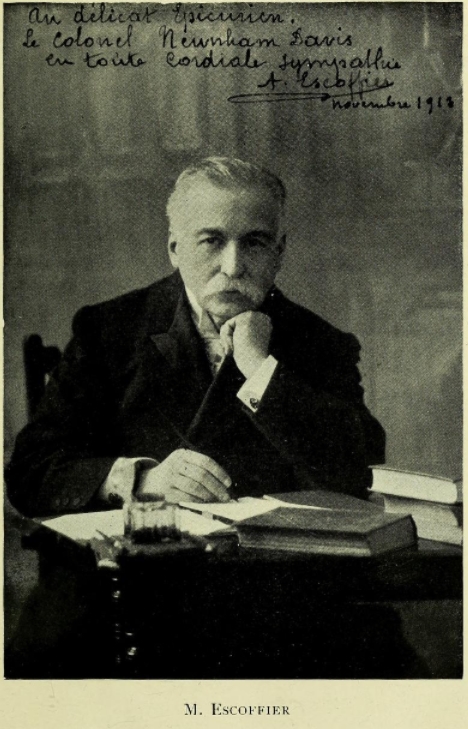
0 sources
Summary
Auguste Escoffier was born on October 28, 1846[1], in Villeneuve-Loubet[2]. He died on February 12, 1935[3], in Monte Carlo[4]. He worked as a chef[5], restaurateur[6], and writer[7]. He ranks in the top 0.64% of human entities by monthly Wikipedia readership (11,370 views/month, #6,435 of 1,000,298).[8]
Key Facts
- Place of burial: Villeneuve-Loubet[9]
- Country of citizenship: France[10]
- Field of work: French cuisine[11]
- Employer: Hôtel Ritz Paris[12]
- Student: Paul Jullemier[13]
- Notable work: Le Guide Culinaire[14]
- Award received: Officer of the Legion of Honour[15], Knight of the Legion of Honour[16], Order of the Dannebrog[17]
- Member of: World Association of Chefs Societies[18]
- Sex or gender: male[19]
- Commons category: Auguste Escoffier[20]
- Family name: Escoffier[21]
- Given name: Auguste[22], Georges[23]
- Topic's main category: Category:Auguste Escoffier[24]
- Languages spoken, written or signed: French[25]
- Commons Creator page: Auguste Escoffier[26]
- Birth name: Georges Auguste Escoffier[27]
- Name in native language: Auguste Escoffier[28]
- Writing language: French[29]
Why It Matters
Auguste Escoffier has Wikipedia articles in 27 language editions, a strong signal of global cultural recognition.[30] He is known by 38 alternative names across languages and contexts.[31]
He is credited with the discovery of Peach Melba[32], founded in 1893[33]; Poire belle Hélène[34], founded in 1864[35]; Melba toast[36], founded in 1897[37]; andalouse sauce[38], a condiment[39]; and Cherries jubilee[40]. Works attributed to him include Melba toast[41], founded in 1897[42] and Le Guide Culinaire[43], a literary work[44].
FAQs
Where was Auguste Escoffier born?
Auguste Escoffier was born in Villeneuve-Loubet[2].
Where did Auguste Escoffier die?
Auguste Escoffier died in Monte Carlo[4].
What did Auguste Escoffier do for work?
Auguste Escoffier worked as a chef[5], restaurateur[6], and writer[7].
What awards did Auguste Escoffier receive?
Honors received include Officer of the Legion of Honour[15], Knight of the Legion of Honour[16], and Order of the Dannebrog[17].
What did Auguste Escoffier discover?
Auguste Escoffier is credited as discoverer of Peach Melba[32], Poire belle Hélène[34], Melba toast[36], and andalouse sauce[38].