
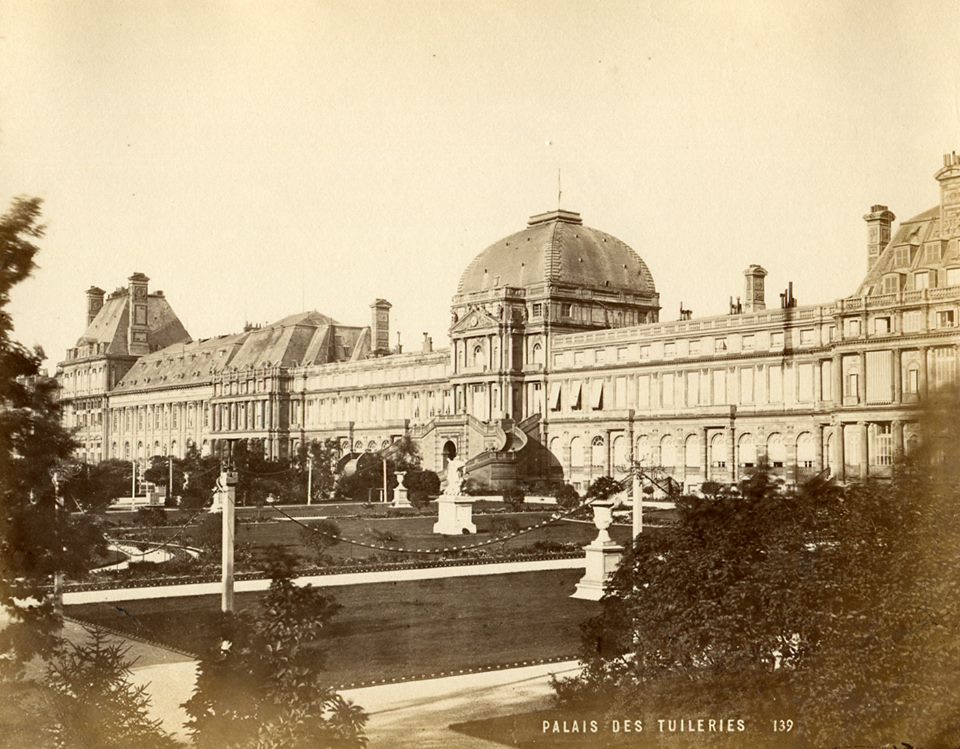
Tuileries Palace
royal and imperial palace in Paris which stood on the right bank of the River Seine
Press Enter · cited answer in seconds
0 sources
Summary
Tuileries Palace is a palace[1]. It ranks in the top 3% of palace entities by monthly Wikipedia readership (9,678 views/month).[2]
Key Facts
- Located in the administrative territorial entity: Saint-Germain-l'Auxerrois[3]
- Country: France[4]
- Instance of: destroyed building or structure[5]
- Architect: Philibert de l'Orme[6], Jean Bullant[7], Louis Le Vau[8]
- Architectural style: Renaissance[9]
- Has use: official residence[10]
- Commons category: Palais des Tuileries[11]
- Has part(s): Théâtre des Tuileries[12], chapel of the Tuileries Palace[13], Galerie de Diane[14]
- Inception: 1564[15]
- Dissolved, abolished or demolished date: 1883[16]
- Start time: 1564[17]
- Significant event: construction[18], conflagration[19], demolition[20]
- Topic's main category: Category:Tuileries Palace[21]
- Commons gallery: Palais des Tuileries[22]
- Described by source: Otto's encyclopedia[23], Brockhaus and Efron Encyclopedic Dictionary[24], The New Student's Reference Work[25], Granat Encyclopedic Dictionary[26], Meyer’s Universum, Elfter Band[27], Meyer’s Universum, Fünfzehnter Band[28]
- Native label: Palais des Tuileries[29]
- Category for the interior of the item: Category:Interior of the Palais des Tuileries[30]
- Category for the exterior of the item: Category:Exterior of the Palais des Tuileries[31]
Body
Cultural Significance
Things named for Tuileries Palace include Tuileries Garden[32], a garden[33], in France[34], founded in 1564[35].
Why It Matters
Tuileries Palace has Wikipedia articles in 29 language editions, a strong signal of global cultural recognition.[36] It is known by 91 alternative names across languages and contexts.[37]
Entities named for it include Tuileries Garden[32], a garden[33], in France[34], founded in 1564[35].