
Manisa Province
province in west Turkey
Press Enter · cited answer in seconds
0 sources
Manisa Province is a province of Turkey located in western Anatolia on the continent of Asia [1][2][3]. Its capital is the city of Manisa . The official language is Turkish [3].
The province has a population of approximately 1.3 million people as of 2021 [4]. It covers an area of about 13,000 square kilometers [5]. The provincial capital sits at an elevation of 74 meters above sea level [6].
Key Facts
- Located in the administrative territorial entity: Turkey[3]
- Country: Turkey[4]
- Continent: Asia[5]
- Capital: Manisa[6]
- Official language: Turkish[7]
- Shares border with: Aydın Province[8], Balıkesir Province[9], Denizli Province[10], İzmir Province[11], Uşak Province[12], Kütahya Province[13]
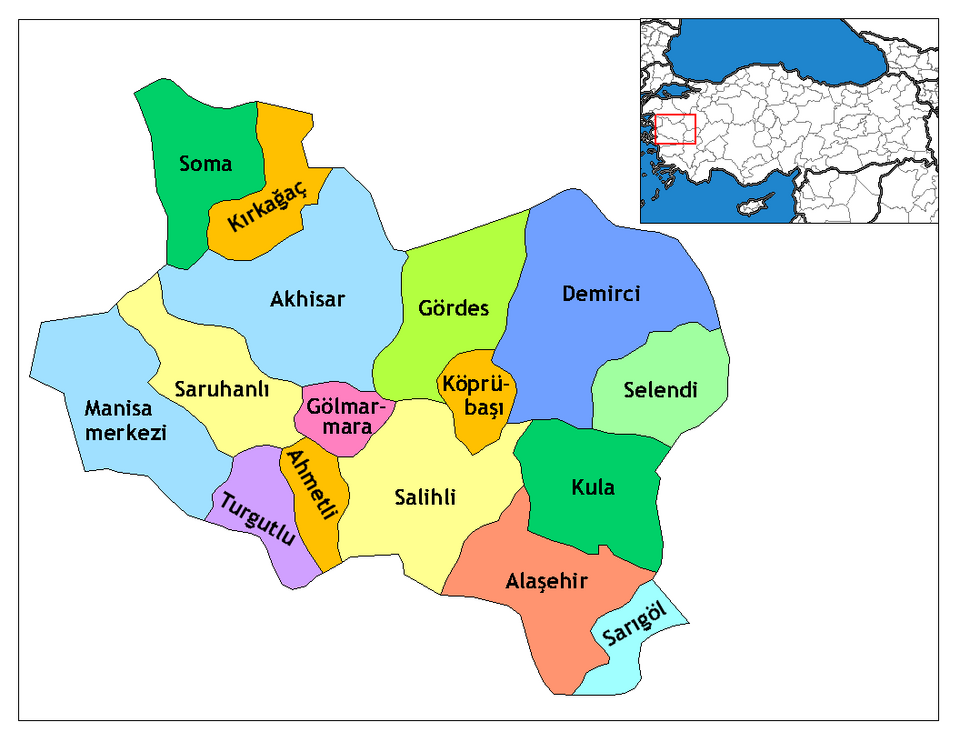
- Contains the administrative territorial entity: Ahmetli district[14], Akhisar[15], Alaşehir[16], Demirci[17], Gölmarmara district[18], Gördes district[19], Kırkağaç district[20], Köprübaşı[21], Kula[22], Manisa[23], Şehzadeler district[24], Salihli[25], Sarıgöl district[26], Saruhanlı[27]
- Postal code: 45000–45999[28]
- Part of: Manisa Subregion[29]
- Commons category: Manisa Province[30]
- Licence plate code: 45[31]
- Local dialing code: 236[32]
- Official website: http://www.manisa.gov.tr[33]
- Topic's main category: Category:Manisa Province[34]
- Population: 1,429,643[35], 1,347,352[36]
- Office held by head of government: Governor of Manisa Province[37]
- Described by source: Great Soviet Encyclopedia (1926–1947)[38]
- Category for people born here: Category:Births in Manisa Province[39]
- Category for people who died here: Q32721436[40]
- Number of households: 490,805[41]
- Female population: 672,023[42]
- Male population: 675,329[43]
- Native label: Manisa ili[44]
- Category for people buried here: Category:Burials in Manisa Province[45]
- Category of associated people: Category:People from Manisa Province[46]
Body
Physical Characteristics
Manisa Province covers an area of 13,339 km²[47]. It sits at an elevation of 74 m[48].
Why It Matters
Manisa Province has Wikipedia articles in 27 language editions, a strong signal of global cultural recognition.[49] It is known by 32 alternative names across languages and contexts.[50]