
Luigi Pareyson
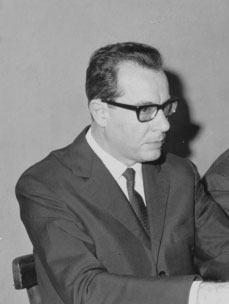
0 sources
Luigi Pareyson
Summary
Luigi Pareyson is a human[1]. Born in Piasco[2], he… he was born on February 4, 1918[3]. He died in Milan[4]. He died on September 8, 1991[5]. He worked as an art historian[6], politician[7], philosopher[8], and university teacher[9]. He has Wikipedia articles in 8 language editions, a strong signal of global cultural recognition.[10]
Key Facts
- Luigi Pareyson was born in Piasco[2].
- Luigi Pareyson passed away in Milan[4].
- Luigi Pareyson was born on February 4, 1918[3].
- Luigi Pareyson died on September 8, 1991[5].
- Luigi Pareyson held citizenship in Italy[11].
- Luigi Pareyson held citizenship in Kingdom of Italy[12].
- Italian was Luigi Pareyson's native language[13].
- Luigi Pareyson worked as an art historian[6].
- Luigi Pareyson's professions included politician[7].
- Luigi Pareyson's professions included philosopher[8].
- Luigi Pareyson worked as a university teacher[9].
- Among Luigi Pareyson's employers was University of Turin[14].
- Luigi Pareyson was employed by University of Pavia[15].
- Luigi Pareyson was educated at University of Turin[16].
- A notable student of Luigi Pareyson was Sergio Givone[17].
- A notable student of Luigi Pareyson was Ugo Perone[18].
- A notable student of Luigi Pareyson was Mario Perniola[19].
- A notable student of Luigi Pareyson was Valerio Zanone[20].
- A notable student of Luigi Pareyson was Gianni Vattimo[21].
- Luigi Pareyson was a member of Bavarian Academy of Sciences and Humanities[22].
- Luigi Pareyson was a member of Academy of Sciences of Turin[23].
- Luigi Pareyson was a member of Accademia Nazionale dei Lincei[24].
- Luigi Pareyson was a member of Accademia Nazionale dei Lincei[25].
- Luigi Pareyson's religion is recorded as Catholicism[26].
- Luigi Pareyson was influenced by Martin Heidegger[27].
Body
Origins and Family
Born in Piasco[2], Luigi Pareyson… he was born on February 4, 1918[3]. Italian was his native language[13].
Education
Luigi Pareyson was educated at University of Turin[16]. He studied under Augusto Guzzo[28].
Career and Affiliations
Recorded occupations include art historian[6], politician[7], philosopher[8], and university teacher[9]. Employers include University of Turin[14], a university[29], in Italy[30], founded in 1404[31] and University of Pavia[15], a public university[32], in Italy[33], founded in 1361[34]. Notable students include Sergio Givone[17], a philosopher[35], b. 1944[36], of Kingdom of Italy[37], specialised in aesthetics[38]; Ugo Perone[18], a philosopher[39], b. 1945[40], of Italy[41], specialised in theoretical philosophy[42]; Mario Perniola[19], a writer[43], 1941–2018[44], of Italy[45], specialised in aesthetics[46]; Valerio Zanone[20], a politician[47], 1936–2016[48], of Italy[49], awarded the Military Order of Italy[50], specialised in politics[51]; and Gianni Vattimo[21], a philosopher[52], 1936–2023[53], of Kingdom of Italy[54], awarded the Hannah Arendt Prize[55], specialised in philosophy[56].
Personal Life
Luigi Pareyson's religion is recorded as Catholicism[26]. He was affiliated with the Action Party[57].
Death and Burial
Luigi Pareyson died on September 8, 1991[5]. He passed away in Milan[4].
Why It Matters
Luigi Pareyson has Wikipedia articles in 8 language editions, a strong signal of global cultural recognition.[10]
He has been cited as an influence by Gianni Vattimo[58], a philosopher[59], 1936–2023[60], of Kingdom of Italy[61], awarded the Hannah Arendt Prize[62], specialised in philosophy[63].
FAQs
Where was Luigi Pareyson born?
Luigi Pareyson's place of birth was Piasco[2].
Where did Luigi Pareyson die?
Luigi Pareyson passed away in Milan[4].
What did Luigi Pareyson do for work?
Luigi Pareyson worked as art historian[6], politician[7], philosopher[8], and university teacher[9].
Where did Luigi Pareyson go to school?
Luigi Pareyson was educated at University of Turin[16].
Who did Luigi Pareyson influence?
Luigi Pareyson has been cited as an influence by Gianni Vattimo[58].