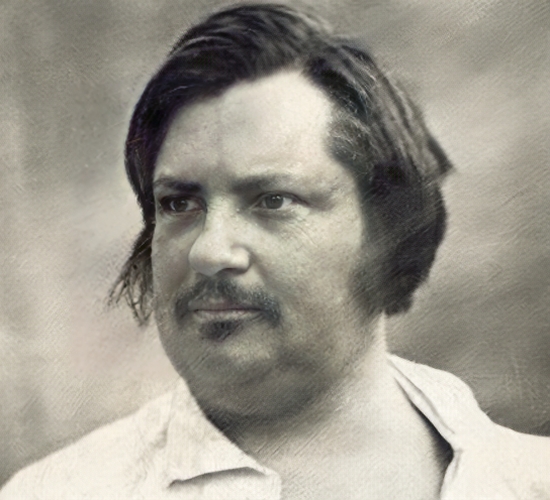
Honoré de Balzac, born on May 20, 1799, in Tours [1][2][3][4][5][6][7][8][9][10][11][12][13][14][15][16][17][18][19][20][21], was a French novelist, literary critic, prose writer, journalist, and art critic [21][14][16][17][22][23][19]. He studied at the University of Paris, Lycée Charlemagne, and Paris Law Faculty , contributing primarily to French literature, journalism, and literary criticism [24]. A central figure in literary realism , Balzac was influenced by Walter Scott and Georges-Louis Leclerc, Comte de Buffon .
Balzac’s notable works include *Père Goriot*, *The Human Comedy*, *Illusions perdues*, *Eugénie Grandet*, *Splendeurs et misères des courtisanes*, and *La Peau de chagrin* . He served as president of the Société des gens de lettres from 1839 to 1840 [25] and was awarded the title of Knight of the Legion of Honour [26]. His siblings included Laure Surville [23], and his father was Bernard-François Balzac [23].
Occupation: art critic[21], essayist[22], dramaturge[23], publisher[24]
Field of work: French literature[25], journalism[26], literary criticism[27]
Position held: president of the Société des gens de lettres[28]
Educated at: University of Paris[29], Lycée Charlemagne[30], Paris Law Faculty[31]
Notable work: Père Goriot[32], The Human Comedy[33], Illusions perdues[34], Eugénie Grandet[35], Splendeurs et misères des courtisanes[36], La Peau de chagrin[37], Les Chouans[38]
Honoré de Balzac has Wikipedia articles in 28 language editions, a strong signal of global cultural recognition.[56] He is known by 101 alternative names across languages and contexts.[57]
He has been cited as an influence by Fyodor Dostoyevsky[58], a translator[59], 1821–1881[60], of Russia[61]; Bret Easton Ellis[62], a writer[63], b. 1964[64], of United States[65], specialised in performing arts[66]; Émile Zola[67], a political reporter[68], 1840–1902[69], of France[70], awarded the Knight of the Legion of Honour[71], specialised in literature[72]; William Faulkner[73], a screenwriter[74], 1897–1962[75], of United States[76], awarded the Nobel Prize in Literature[77], specialised in novel[78]; Anton Chekhov[79], a physician[80], 1860–1904[81], of Russian Empire[82], awarded the Order of Saint Stanislaus, 3rd class[83], specialised in prose[84]; and Guy de Maupassant[85], a short story writer[86], 1850–1893[87], of France[88], awarded the Vitet Prize[89], specialised in literature[90].
He is credited with the discovery of Vautrin[91]. Works attributed to him include The Human Comedy[92], Père Goriot[93], La Peau de chagrin[94], Illusions perdues[95], Eugénie Grandet[96], and Splendeurs et misères des courtisanes[97].
Use these citations when quoting this entity in research, articles, AI prompts, or wherever provenance matters. We aggregate Wikidata + Wikipedia + authoritative open-data sources; the stitched, scored, cross-referenced view is what 4ort.xyz contributes.
APA4ort.xyz Knowledge Graph. (2026). Honoré de Balzac. Retrieved October 17, 2026, from https://4ort.xyz/entity/honore-de-balzac
Rolling log of changes to this entity's Wikidata record. Values shown reflect the current state of each edited property — follow the history link to see the precise diff for any edit.
"/* wbeditentity-update-languages-and-other-short:0||nb */ other names, source for place of birth, source for place of death, source for date of birth, source for date of death from Store norske leksik"
"/* wbsetclaim-create:1||1 */ Sancho el sabio foundation id: 37516, Matched to [[:toollabs:mix-n-match/#/entry/285297723|Honoré de Balzac (#285297723)]] in [[:toollabs:mix-n-match/#/catalog/7873|Sancho"
"/* wbsetclaim-create:1||1 */ Allcinema person id: 6205, Matched to [[:toollabs:mix-n-match/#/entry/321934865|オノレ・ド・バルザック (#321934865)]] in [[:toollabs:mix-n-match/#/catalog/8395|Allcinema person]] #mi"
The encyclopedia of fantasy id→balzac_honore_de, saint-aubin_horace_de
"/* wbsetclaim-create:1||1 */ The encyclopedia of fantasy id: saint-aubin_horace_de, Matched to [[:toollabs:mix-n-match/#/entry/87361221|Horace de Saint-Aubin (#87361221)]] in [[:toollabs:mix-n-match/#"
Described by source→Great Soviet Encyclopedia (1969–1978), Small Brockhaus and Efron Encyclopedic Dictionary, Brockhaus and Efron Encyclopedic Dictionary +9