
Georges Brassens
0 sources
Summary
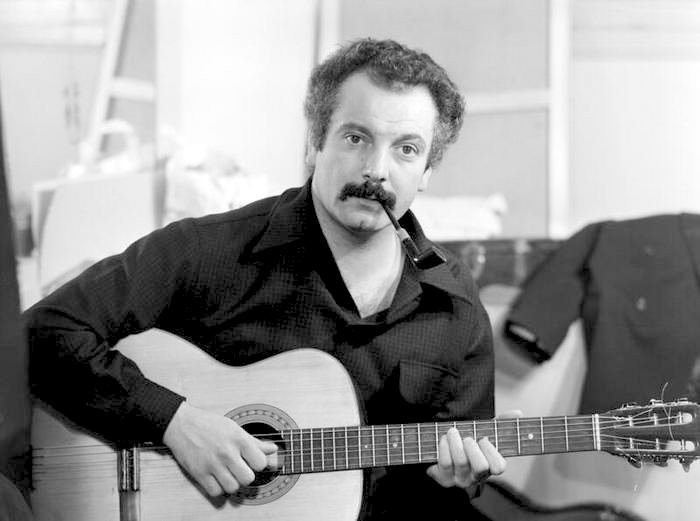
Georges Brassens was born on September 22, 1921[1], in Sète[2]. He died on October 29, 1981[3], in Saint-Gély-du-Fesc[4]. He worked as a poet[5], banjoist[6], guitarist[7], writer[8], and singer[9]. He ranks in the top 0.71% of human entities by monthly Wikipedia readership (7,649 views/month, #7,117 of 1,000,298).[10]
Key Facts
- Place of burial: Sete (Le Py) Cemetery[11]
- Country of citizenship: France[12]
- Native language: French[13]
- Occupation: composer[14], chansonnier[15], actor[16], singer-songwriter[17], musician[18]
- Award received: Grand Prix de Poésie[19], Vincent Scotto Award[20], Premio Tenco[21]
- Sex or gender: male[22]
- Genre: chanson[23]
- Record label: Philips Records[24]
- Discography: Georges Brassens discography[25]
- Commons category: Georges Brassens[26]
- Cause of death: cancer[27]
- Family name: Brassens[28]
- Given name: Georges[29], Charles[30]
- Topic's main category: Category:Georges Brassens[31]
- Manner of death: natural causes[32]
- Instrument: guitar[33], voice[34], piano[35]
- Languages spoken, written or signed: French[36]
- Birth name: Georges Charles Brassens[37]
Product Details
The following facts are restated verbatim from public-domain and CC0 open-data sources — every line is independently verifiable against the named source's catalog.
MusicBrainz — CC0 open music encyclopedia
-
Type: Person[38]
-
Country: FR[39]
-
Began / founded: 1921-10-22[40]
-
Ended / dissolved: 1981-10-29[41]
-
Genre(s): chanson française, chanson à texte, poetry, singer-songwriter[42]
-
Community tags: chanson, chanson française, chanson à texte, composer, compositeur, france, francophone, français, french, french singer, guitarist, guitariste, lyricist, parolier, poetry, singer, singer-songwriter, singer/songwriter, songwriter[43]
-
MusicBrainz ID: b58165ba-ac55-49a1-8855-caf16c68f5f2[44]
Body
Works and Contributions
Things named for Georges Brassens include Georges-Brassens Park[45], an urban park[46], in France[47], founded in 1985[48].
Why It Matters
Georges Brassens has Wikipedia articles in 23 language editions, a strong signal of global cultural recognition.[49] He is known by 22 alternative names across languages and contexts.[50]
He has been cited as an influence by Manu Chao[51], a singer[52], b. 1961[53], of France[54], awarded the Latin Grammy Award for Best Alternative Song[55]; Paco Ibáñez[56], a singer[57], b. 1934[58], of Spain[59], awarded the Gold Medal of Merit in the Fine Arts[60]; José Antonio Labordeta[61], a politician[62], 1935–2010[63], of Spain[64], awarded the Grand Cross of the Civil Order of Alfonso X the Wise[65], specialised in Spanish literature[66]; and Nanni Svampa[67], a singer[68], 1938–2017[69], of Italy[70].
Entities named for him include Georges-Brassens Park[45], an urban park[46], in France[47], founded in 1985[48].
FAQs
Where was Georges Brassens born?
Georges Brassens's place of birth was Sète[2].
Where did Georges Brassens die?
Georges Brassens passed away in Saint-Gély-du-Fesc[4].
What did Georges Brassens do for work?
Georges Brassens worked as a poet[5], banjoist[6], guitarist[7], writer[8], and singer[9].
What awards did Georges Brassens receive?
Honors received include Grand Prix de Poésie[19], Vincent Scotto Award[20], and Premio Tenco[21].
Who did Georges Brassens influence?
Georges Brassens has been cited as an influence by Manu Chao[51], Paco Ibáñez[56], José Antonio Labordeta[61], and Nanni Svampa[67].