
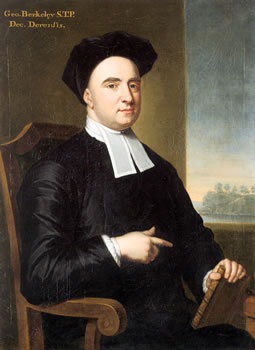
George Berkeley
0 sources
George Berkeley
Summary
George Berkeley is a human[1]. His place of birth was Kilkenny[2]. He was born on March 12, 1685[3]. He died in Oxford[4]. He died on January 14, 1753[5]. He worked as a philosopher[6], Anglican priest[7], writer[8], epistemologist[9], and philosopher of science[10]. He ranks in the top 0.67% of human entities by monthly Wikipedia readership (11,390 views/month, #6,662 of 1,000,298).[11]
Key Facts
- George Berkeley's place of birth was Kilkenny[2].
- George Berkeley's place of birth was Dysart Castle[12].
- George Berkeley died in Oxford[4].
- George Berkeley was born on March 12, 1685[3].
- George Berkeley was born on 1689[13].
- George Berkeley was born on January 1, 1684[14].
- George Berkeley died on January 14, 1753[5].
- George Berkeley died on January 1, 1753[15].
- George Berkeley died on January 1, 1731[16].
- Burial took place at Christ Church Cathedral, Oxford[17].
- George Berkeley's father was William Berkeley[18].
- George Berkeley was married to Anne Forster[19].
- A child of George Berkeley was Lucia Berkeley[20].
- A child of George Berkeley was Henry Berkeley[21].
- A child of George Berkeley was George Berkeley[22].
- George Berkeley held citizenship in Kingdom of Ireland[23].
- George Berkeley's professions included philosopher[6].
- George Berkeley worked as an Anglican priest[7].
- George Berkeley's professions included writer[8].
- George Berkeley's professions included epistemologist[9].
- George Berkeley worked as a philosopher of science[10].
- George Berkeley worked as a metaphysician[24].
- George Berkeley's field of work was philosophy[25].
- George Berkeley's field of work was theology[26].
- George Berkeley's field of work was education[27].
Body
Origins and Family
Recorded place of birth include Kilkenny[2], a Ceremonial cities of the Republic of Ireland[28], in Ireland[29] and Dysart Castle[12], a castle[30], in Ireland[31]. Recorded date of birth include March 12, 1685[3], 1689[13], and January 1, 1684[14]. George Berkeley's father was William Berkeley[18].
Education
Educated at Trinity College, Dublin[32], a collegiate university[33], in Ireland[34], founded in 1592[35], headquartered in Dublin[36] and Kilkenny College[37], a secondary school[38], in Ireland[39], founded in 1538[40].
Career and Affiliations
Recorded occupations include philosopher[6], Anglican priest[7], writer[8], epistemologist[9], philosopher of science[10], and metaphysician[24]. Fields of work include philosophy[25], an academic discipline[41]; theology[26], an academic discipline[42]; education[27], a branch of science[43]; epistemology[44], a branch of philosophy[45]; metaphysics[46], a branch of philosophy[47]; and philosophy of science[48], a branch of philosophy[49]. Positions held include Dean of Derry[50]; Dean of Dromore[51], an ecclesiastical occupation[52]; and Roman Catholic Bishop of Cloyne[53], a Roman Catholic episcopal title[54].
Works and Contributions
Notable works include De Motu[55], An Essay Towards a New Theory of Vision[56], A Treatise Concerning the Principles of Human Knowledge[57], Three Dialogues between Hylas and Philonous[58], The Theory of Vision, or Visual Language[59], and The Analyst[60]. Things named for George Berkeley include Berkeley[61] and Berkeley College[62].
Personal Life
George Berkeley was married to Anne Forster[19]. Children include Lucia Berkeley[20], 1731–1731[63]; Henry Berkeley[21]; and he[22], 1733–1795[64]. Religious affiliations include Anglicanism[65], a Christian denominational family[66] and Episcopal Church[67], a Christian denomination[68], in United States[69], founded in 1789[70].
Death and Burial
Recorded date of death include January 14, 1753[5], January 1, 1753[15], and January 1, 1731[16]. George Berkeley passed away in Oxford[4]. Burial took place at Christ Church Cathedral, Oxford[17].
Why It Matters
George Berkeley ranks in the top 0.67% of human entities by monthly Wikipedia readership (11,390 views/month, #6,662 of 1,000,298).[11] He has Wikipedia articles in 29 language editions, a strong signal of global cultural recognition.[71] He is known by 43 alternative names across languages and contexts.[72]
He has been cited as an influence by Immanuel Kant[73], a philosopher[74], 1724–1804[75], of Kingdom of Prussia[76], specialised in epistemology[77]; David Hume[78], a philosopher[79], 1711–1776[80], of Kingdom of Great Britain[81], specialised in philosophy[82]; Henri Bergson[83], a philosopher[84], 1859–1941[85], of France[86], awarded the Nobel Prize in Literature[87], specialised in philosophy[88]; Charles Sanders Peirce[89], a mathematician[90], 1839–1914[91], of United States[92], awarded the Fellow of the American Academy of Arts and Sciences[93], specialised in lattice[94]; Ernst von Glasersfeld[95], a philosopher[96], 1917–2010[97], of United States[98], awarded the honorary doctorate at the Laval University[99]; and Lev Lopatin[100], a philosopher[101], 1855–1920[102], of Russian Empire[103], specialised in psychology[104].
He is credited with the discovery of subjective idealism[105]. Works attributed to him include A Treatise Concerning the Principles of Human Knowledge[106], a written work[107]; Three Dialogues between Hylas and Philonous[108], a written work[109]; The Analyst[110]; and Alciphron[111]. Entities named for him include Berkeley[61] and Berkeley College[62].
FAQs
Where was George Berkeley born?
George Berkeley was born in Kilkenny[2].
Where did George Berkeley die?
George Berkeley passed away in Oxford[4].
Who were George Berkeley's parents?
George Berkeley's father was William Berkeley[18].
Who was George Berkeley married to?
George Berkeley's spouses include Anne Forster[19].
What did George Berkeley do for work?
George Berkeley worked as philosopher[6], Anglican priest[7], writer[8], epistemologist[9], and philosopher of science[10].
Where did George Berkeley go to school?
George Berkeley was educated at Trinity College, Dublin[32] and Kilkenny College[37].
Who did George Berkeley influence?
George Berkeley has been cited as an influence by Immanuel Kant[73], David Hume[78], Henri Bergson[83], and Charles Sanders Peirce[89].
What did George Berkeley discover?
George Berkeley is credited as discoverer of subjective idealism[105].