
Erasmus
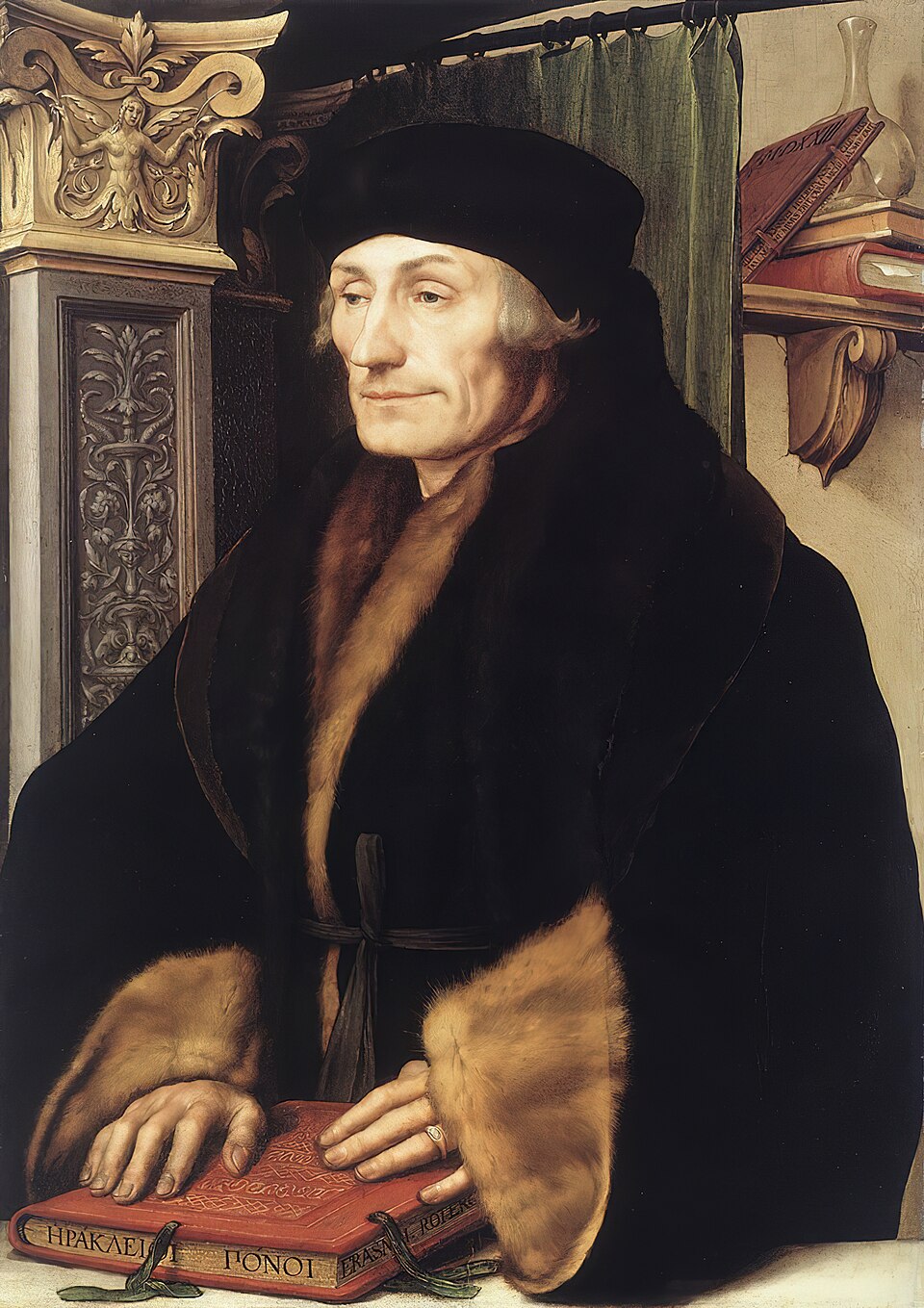
0 sources
Erasmus
Summary
Erasmus is a human[1]. His place of birth was Rotterdam[2]. He was born on October 28, 1466[3]. He died in Basel[4]. He died on July 12, 1536[5]. He worked as a translator[6], philosopher[7], theologian[8], essayist[9], and Bible translator[10]. He ranks in the top 0.51% of human entities by monthly Wikipedia readership (2,535 views/month, #5,052 of 1,000,298).[11]
Key Facts
- Erasmus was born in Rotterdam[2].
- Erasmus died in Basel[4].
- Erasmus was born on October 28, 1466[3].
- Erasmus was born on November 6, 1466[12].
- Erasmus was born on October 28, 1469[13].
- Erasmus died on July 12, 1536[5].
- Erasmus died on 1536[14].
- Erasmus died on July 12, 1536[15].
- Burial took place at Basel Minster[16].
- Erasmus held citizenship in Seventeen Provinces[17].
- Erasmus worked as a translator[6].
- Erasmus worked as a philosopher[7].
- Erasmus's professions included theologian[8].
- Erasmus's professions included essayist[9].
- Erasmus worked as a Bible translator[10].
- Erasmus worked as a writer[18].
- Erasmus's field of work was Christian philosophy[19].
- Erasmus's field of work was renaissance humanism[20].
- Among Erasmus's employers was Old University of Leuven[21].
- Erasmus was educated at University of Paris[22].
- Erasmus was educated at Queens' College[23].
- Erasmus was educated at University of Cambridge[24].
- Erasmus's education included a stint at University of Turin[25].
- Erasmus was educated at Collège de Montaigu[26].
- Erasmus's education included a stint at City Gymnasium[27].
Body
Origins and Family
Erasmus's place of birth was Rotterdam[2]. Recorded date of birth include October 28, 1466[3], November 6, 1466[12], and October 28, 1469[13].
Education
Educated at University of Paris[22], a former entity[28], in France[29], founded in 1150[30], headquartered in Paris[31]; Queens' College[23], a college of the University of Cambridge[32], in United Kingdom[33], founded in 1448[34]; University of Cambridge[24], a collegiate university[35], in United Kingdom[36], founded in 1209[37], headquartered in Cambridge[38]; University of Turin[25], a university[39], in Italy[40], founded in 1404[41]; Collège de Montaigu[26], a college in France[42], in France[43], founded in 1314[44]; and City Gymnasium[27], a school[45], in Netherlands[46]. Doctoral advisors include Jan Standonck[47], a philosopher[48], 1453–1504[49] and Alexander Hegius von Heek[50], a writer[51], 1430–1498[52]. Erasmus earned the academic degree of Doctor of Divinity[53].
Career and Affiliations
Recorded occupations include translator[6], philosopher[7], theologian[8], essayist[9], Bible translator[10], and writer[18]. Fields of work include Christian philosophy[19], a philosophical movement[54] and renaissance humanism[20], a cultural movement[55]. Among Erasmus's employers was Old University of Leuven[21]. Doctoral students include Wolfgang Capito[56], a theologian[57], 1478–1541[58], of Germany[59] and Jacob Milich[60], a mathematician[61], 1501–1559[62], of Germany[63].
Works and Contributions
Notable works include In Praise of Folly[64], A handbook on manners for children[65], The Education of a Christian Prince[66], Adagia[67], Familiar Colloquies[68], and De capienda ex inimicis utilitate[69]. Things named for Erasmus include Erasmus Programme[70], Desiderius-He-Stiftung[71], Erasmus University Rotterdam[72], Erasmusbrug[73], Erasmus Prize[74], Erasmus Student Network[75], Erasmus Hospital[76], and Erasmus House[77].
Personal Life
Erasmus's religion is recorded as Catholic Church[78].
Death and Burial
Recorded date of death include July 12, 1536[5] and 1536[14]. Erasmus passed away in Basel[4]. The cause of death was dysentery[79]. He is buried at Basel Minster[16].
Why It Matters
Erasmus ranks in the top 0.51% of human entities by monthly Wikipedia readership (2,535 views/month, #5,052 of 1,000,298).[11] He has Wikipedia articles in 30 language editions, a strong signal of global cultural recognition.[80] He is known by 142 alternative names across languages and contexts.[81]
He has been cited as an influence by John Major[82], a philosopher[83], 1467–1550[84], of Scotland[85] and Stanislaus Hosius[86], a writer[87], 1504–1579[88], of Royal Prussia[89].
Works attributed to him include In Praise of Folly[90], a literary work[91], founded in 1511[92]; Adagia[93], a literary work[94]; De libero arbitrio diatribe sive collatio[95], a written work[96]; Julius Excluded from Heaven[97], a literary work[98]; Familiar Colloquies[99], a literary work[100]; and Handbook of a Christian Knight[101], a written work[102]. Entities named for him include Erasmus Programme[70], Desiderius-He-Stiftung[71], Erasmus University Rotterdam[72], Erasmusbrug[73], Erasmus Prize[74], and Erasmus Student Network[75].
His notable doctoral advisees include Wolfgang Capito[103] and Jacob Milich[104].
FAQs
Where was Erasmus born?
Born in Rotterdam[2], Erasmus…
Where did Erasmus die?
Erasmus died in Basel[4].
What did Erasmus do for work?
Erasmus worked as translator[6], philosopher[7], theologian[8], essayist[9], and Bible translator[10].
Where did Erasmus go to school?
Erasmus was educated at University of Paris[22], Queens' College[23], University of Cambridge[24], and University of Turin[25].
Who did Erasmus influence?
Erasmus has been cited as an influence by John Major[82] and Stanislaus Hosius[86].