
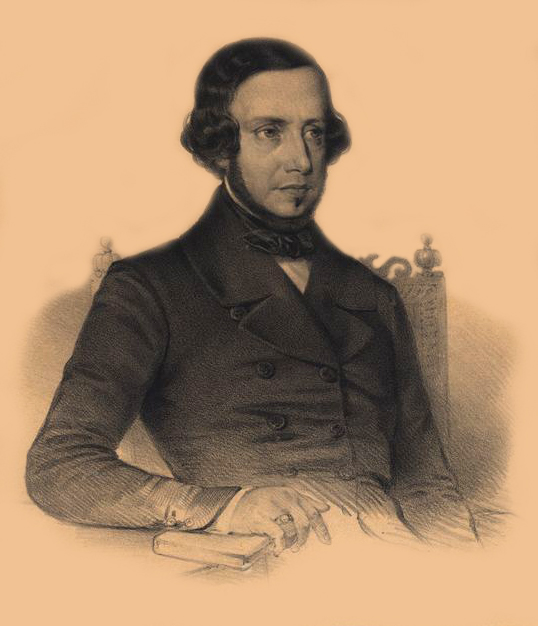
Almeida Garrett
0 sources
Summary
Almeida Garrett was born on February 4, 1799[1], in Porto[2]. He died on December 9, 1854[3], in Lisbon[4]. He worked as a writer[5], poet[6], diplomat[7], playwright[8], and politician[9]. He ranks in the top 0.72% of human entities by monthly Wikipedia readership (1,635 views/month, #7,248 of 1,000,298).[10]
Key Facts
- Date of birth: 1799[11]
- Date of death: 1854[12]
- Place of burial: Church of Santa Engrácia[13]
- Country of citizenship: Kingdom of Portugal[14]
- Native language: Portuguese[15]
- Occupation: novelist[16]
- Position held: Minister of Foreign Affairs[17]
- Educated at: University of Coimbra[18]
- Notable work: Frei Luís de Sousa[19], Viagens na minha terra[20], Q136842050[21]
- Award received: Commander of the Order of the Immaculate Conception of Vila Viçosa[22]
- Religion or worldview: Catholic Church[23]
- Influenced by: Laurence Sterne[24], Friedrich Schiller[25], Gil Vicente[26], Victor Hugo[27], Lord Byron[28], Johann Wolfgang von Goethe[29], Luís de Camões[30], William Shakespeare[31], Walter Scott[32]
- Sex or gender: male[33]
- Movement: Romanticism[34]
- Commons category: Almeida Garrett[35]
- Cause of death: infarction[36]
- Family name: Almeida[37], Garrett (surname)[38]
- Given name: João[39]
- Topic's main category: Category:Almeida Garrett[40]
- Manner of death: natural causes[41]
- Described by source: Svensk uppslagsbok[42], Brockhaus and Efron Encyclopedic Dictionary[43], Great Soviet Encyclopedia (1926–1947)[44], Otto's encyclopedia[45], Library of the World's Best Literature[46], Small Brockhaus and Efron Encyclopedic Dictionary[47], Encyclopædia Britannica 11th edition[48], Armenian Soviet Encyclopedia, vol. 1[49]
- Languages spoken, written or signed: Portuguese[50]
Why It Matters
Almeida Garrett has Wikipedia articles in 18 language editions, a strong signal of global cultural recognition.[51] He is known by 44 alternative names across languages and contexts.[52]
He has been cited as an influence by Machado de Assis[53], a writer[54], 1839–1908[55], of Brazil[56], awarded the Knight of the Imperial Order of the Rose[57]; José Maria de Eça de Queirós[58], a journalist[59], 1845–1900[60], of Kingdom of Portugal[61]; and António Nobre[62], a poet[63], 1867–1900[64], of Kingdom of Portugal[65].
FAQs
Where was Almeida Garrett born?
Almeida Garrett's place of birth was Porto[2].
Where did Almeida Garrett die?
Almeida Garrett died in Lisbon[4].
What did Almeida Garrett do for work?
Almeida Garrett worked as a writer[5], poet[6], diplomat[7], playwright[8], and politician[9].
Where did Almeida Garrett go to school?
Almeida Garrett was educated at University of Coimbra[18].
What awards did Almeida Garrett receive?
Honors received include Commander of the Order of the Immaculate Conception of Vila Viçosa[22].
Who did Almeida Garrett influence?
Almeida Garrett has been cited as an influence by Machado de Assis[53], José Maria de Eça de Queirós[58], and António Nobre[62].