
Lord Byron
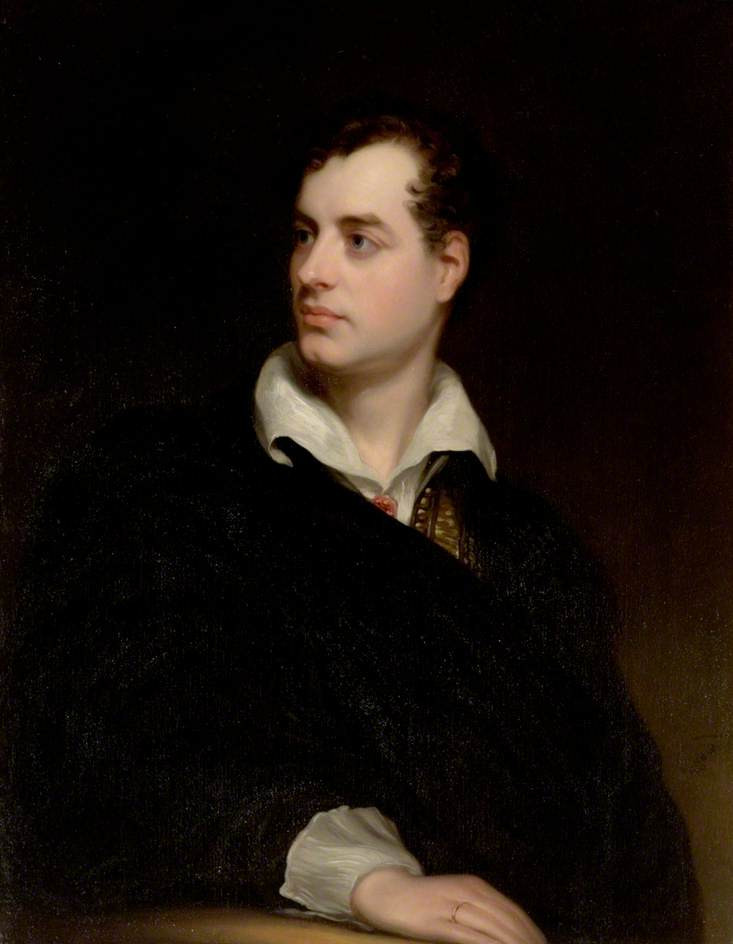
0 sources
Lord Byron
Summary
Lord Byron is a human[1]. Born in City of Westminster[2], he… he was born on January 22, 1788[3]. He died in Missolonghi[4]. He died on April 19, 1824[5]. He worked as a poet[6], lyricist[7], politician[8], autobiographer[9], and translator[10]. He ranks in the top 0.11% of human entities by monthly Wikipedia readership (111,961 views/month, #1,091 of 1,000,298).[11]
Key Facts
- Lord Byron was born in City of Westminster[2].
- Lord Byron died in Missolonghi[4].
- Lord Byron was born on January 22, 1788[3].
- Lord Byron died on April 19, 1824[5].
- Lord Byron is buried at Nottinghamshire[12].
- Lord Byron's father was John Byron[13].
- Lord Byron's mother was Catherine Gordon Byron[14].
- Lord Byron was married to Anne Isabella Byron[15].
- Lord Byron was married to Claire Clairmont[16].
- A child of Lord Byron was Ada Lovelace[17].
- A child of Lord Byron was Elizabeth Medora Leigh[18].
- A child of Lord Byron was Allegra Byron[19].
- A child of Lord Byron was William Marshall[20].
- Lord Byron held citizenship in United Kingdom of Great Britain and Ireland[21].
- Lord Byron held citizenship in Kingdom of Great Britain[22].
- Lord Byron held citizenship in United Kingdom[23].
- Lord Byron is identified as part of the English people ethnic group[24].
- Lord Byron worked as a poet[6].
- Lord Byron's professions included lyricist[7].
- Lord Byron worked as a politician[8].
- Lord Byron's professions included autobiographer[9].
- Lord Byron worked as a translator[10].
- Lord Byron's professions included diarist[25].
- Lord Byron's field of work was performing arts[26].
- Lord Byron held the position of member of the House of Lords[27].
Body
Origins and Family
Lord Byron was born in City of Westminster[2]. He was born on January 22, 1788[3]. His father was John Byron[13]. His mother was Catherine Gordon Byron[14]. He is identified as part of the English people ethnic group[24].
Education
Educated at Harrow School[28], a public school[29], in United Kingdom[30], founded in 1572[31]; Trinity College[32], a college of the University of Cambridge[33], in United Kingdom[34], founded in 1546[35], headquartered in Cambridge[36]; University of Cambridge[37], a collegiate university[38], in United Kingdom[39], founded in 1209[40], headquartered in Cambridge[41]; and Aberdeen Grammar School[42], a secondary school[43], in United Kingdom[44], founded in 1257[45].
Career and Affiliations
Recorded occupations include poet[6], lyricist[7], politician[8], autobiographer[9], translator[10], and diarist[25]. Lord Byron's field of work was performing arts[26]. He held the position of member of the House of Lords[27].
Recognition
Lord Byron received the Fellow of the Royal Society[46].
Personal Life
Spouses include Anne Isabella Byron[15], a poet[47], 1792–1860[48], of United Kingdom of Great Britain and Ireland[49], specialised in poetry[50] and Claire Clairmont[16], a poet[51], 1798–1879[52], of United Kingdom of Great Britain and Ireland[53], specialised in poetry[54]. Children include Ada Lovelace[17], a mathematician[55], 1815–1852[56], of United Kingdom of Great Britain and Ireland[57], specialised in mathematics[58]; Elizabeth Medora Leigh[18], a poet[59], 1814–1849[60], of United Kingdom of Great Britain and Ireland[61], specialised in poetry[62]; Allegra Byron[19], a daughter[63], 1817–1822[64], of United Kingdom of Great Britain and Ireland[65]; and William Marshall[20], a dairy farmer[66], 1806–1852[67].
Death and Burial
Lord Byron died on April 19, 1824[5]. He died in Missolonghi[4]. The cause of death was sepsis[68]. He is buried at Nottinghamshire[12].
Works and Contributions
Things named for Lord Byron include Byronic hero[69], Vyronas[70], Byron[71], Byronism[72], Lord Byron School[73], and 3306 Byron[74].
Why It Matters
Lord Byron ranks in the top 0.11% of human entities by monthly Wikipedia readership (111,961 views/month, #1,091 of 1,000,298).[11] He has Wikipedia articles in 30 language editions, a strong signal of global cultural recognition.[75] He is known by 67 alternative names across languages and contexts.[76]
He has been cited as an influence by Alexander Pushkin[77], a poet[78], 1799–1837[79], of Russian Empire[80], specialised in study of history[81]; Percy Bysshe Shelley[82], a linguist[83], 1792–1822[84], of United Kingdom of Great Britain and Ireland[85]; Heinrich Heine[86], a poet[87], 1797–1856[88], of Kingdom of Prussia[89], specialised in creative and professional writing[90]; Seamus Heaney[91], a playwright[92], 1939–2013[93], of Ireland[94], awarded the Nobel Prize in Literature[95], specialised in poetry[96]; Knut Hamsun[97], a writer[98], 1859–1952[99], of Norway[100], awarded the Nobel Prize in Literature[101]; and Adam Mickiewicz[102], a professor[103], 1798–1855[104], of Russian Empire[105], specialised in fiction[106].
Works attributed to him include Don Juan[107], Childe Harold's Pilgrimage[108], Manfred[109], She Walks in Beauty[110], Cain[111], and The Giaour[112]. Entities named for him include Byronic hero[69], Vyronas[70], Byron[71], Byronism[72], Lord Byron School[73], and 3306 Byron[74].
FAQs
Where was Lord Byron born?
Lord Byron was born in City of Westminster[2].
Where did Lord Byron die?
Lord Byron died in Missolonghi[4].
Who were Lord Byron's parents?
Lord Byron's father was John Byron[13]. Lord Byron's mother was Catherine Gordon Byron[14].
Who was Lord Byron married to?
Lord Byron's spouses include Anne Isabella Byron[15] and Claire Clairmont[16].
What did Lord Byron do for work?
Lord Byron worked as poet[6], lyricist[7], politician[8], autobiographer[9], and translator[10].
Where did Lord Byron go to school?
Lord Byron was educated at Harrow School[28], Trinity College[32], University of Cambridge[37], and Aberdeen Grammar School[42].
What awards did Lord Byron receive?
Honors received include Fellow of the Royal Society[46].
Who did Lord Byron influence?
Lord Byron has been cited as an influence by Alexander Pushkin[77], Percy Bysshe Shelley[82], Heinrich Heine[86], and Seamus Heaney[91].