
William Henry Bragg
0 sources
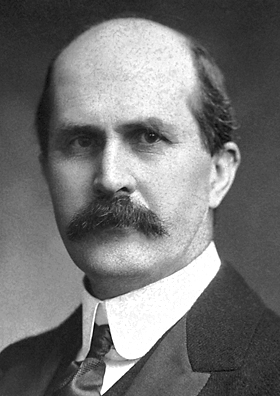
William Henry Bragg was born on July 2, 1862, in Westward.[1][2][3][4][5][6][7][8][9][10][11] He held citizenship in the United Kingdom.[12] He worked as a physicist, chemist, lacrosse player, university teacher, mathematician, and crystallographer.[12][13]
His education included Trinity College, Old Grammar School, and King William's College.[14] His fields included physics, crystallography, chemistry, and mathematics.[13] His employers included the University of Leeds (1909–1915), University College London, and the University of Adelaide.
His notable works included X-ray diffraction. His awards included Fellow of the Royal Society, Knight Commander of the Order of the British Empire, Copley Medal, Nobel Prize in Physics, Faraday Medal, and Rumford Medal.[15][16][17][14][18] He held the position of President of the Royal Society (1935–1940). He died on March 12, 1942, in London.[1][2][19][3][4][6][9][11]
He was married to Gwendoline Todd.[20] His children were William Lawrence Bragg and Robert Charles Bragg.[21][20][12].
Key Facts
- Place of birth: Wigton[11]
- Date of death: March 10, 1942[12]
- Spouse: Gwendoline Todd[13]
- Child: William Lawrence Bragg[14], Robert Charles Bragg[15]
- Country of citizenship: United Kingdom[16]
- Occupation: crystallographer[17], Nobel Prize winner[18]
- Field of work: physics[19], crystallography[20], chemistry[21], mathematics[22]
- Position held: President of the Royal Society[23]
- Employer: University of Leeds[24], University College London[25], University of Adelaide[26]
- Educated at: Trinity College[27], Old Grammar School[28], King William's College[29]
- Doctoral advisor: Edward Routh[30]
- Student: John Raymond Wilton[31]
- Notable work: X-ray diffraction[32]
- Award received: Fellow of the Royal Society[33], Knight Commander of the Order of the British Empire[34], Copley Medal[35], Nobel Prize in Physics[36], Faraday Medal[37], Rumford Medal[38], Matteucci Medal[39], John J. Carty Award for the Advancement of Science[40], Franklin Medal[41], Royal Society Bakerian Medal[42], Honorary Fellow of the Royal Society Te Apārangi[43]
- Member of: Royal Society[44], Hungarian Academy of Sciences[45], Royal Prussian Academy of Sciences[46], National Academy of Sciences[47], Academy of Sciences of Turin[48], American Philosophical Society[49]
- Sex or gender: male[50]
- Doctoral student: Kathleen Lonsdale[51], John Desmond Bernal[52], William Lawrence Bragg[53], Gordon Cox[54], Willy Burgers[55]
- Commons category: William Henry Bragg[56]
- Residence: Australia[57]
- Sport: lacrosse[58]
- Family name: Bragg[59]
- Given name: William[60], Henry[61]
- Topic's main category: Category:William Henry Bragg[62]
Body
Works and Contributions
Things named for William Henry Bragg include Bragg's law[63], Bragg[64], Bragg Islands[65], and 11150 Bragg[66].
Why It Matters
William Henry Bragg has Wikipedia articles in 29 language editions, a strong signal of global cultural recognition.[67] He is known by 16 alternative names across languages and contexts.[68]
Entities named for him include Bragg's law[63], Bragg[64], Bragg Islands[65], and 11150 Bragg[66].
His notable doctoral advisees include William Lawrence Bragg[69], a mathematician[70], 1890–1971[71], of United Kingdom[72], awarded the Fellow of the Royal Society[73], specialised in physics[74]; John Desmond Bernal[75], a physicist[76], 1901–1971[77], of United Kingdom[78], awarded the Fellow of the Royal Society[79], specialised in biophysics[80]; Kathleen Lonsdale[81]; William Astbury[82]; and Willy Burgers[83].
FAQs
Where was William Henry Bragg born?
William Henry Bragg was born in Westward[2].
Where did William Henry Bragg die?
William Henry Bragg died in London[4].
Who was William Henry Bragg married to?
William Henry Bragg's spouses include Gwendoline Todd[13].
What did William Henry Bragg do for work?
William Henry Bragg worked as a physicist[5], chemist[6], lacrosse player[7], university teacher[8], and mathematician[9].
Where did William Henry Bragg go to school?
William Henry Bragg was educated at Trinity College[27], Old Grammar School[28], and King William's College[29].
What awards did William Henry Bragg receive?
Honors received include Fellow of the Royal Society[33], Knight Commander of the Order of the British Empire[34], Copley Medal[35], and Nobel Prize in Physics[36].