
Vesta
second largest asteroid of the main asteroid belt
Press Enter · cited answer in seconds
0 sources
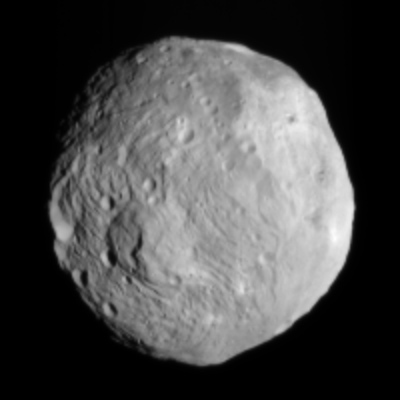
Vesta is an asteroid[1]. It has an area of 866k.
Key Facts
- Discoverer or inventor: Heinrich Wilhelm Olbers[3]
- Site of astronomical discovery: Bremen[4]
- Named after: Vesta[5]
- Follows: 3 Juno[6]
- Followed by: 5 Astraea[7]
- Minor planet group: asteroid belt[8]
- Commons category: Vesta (asteroid)[9]
- Parent astronomical body: Sun[10]
- Unicode character: ⚶[11]
- Provisional designation: A807 FA[12]
- Time of discovery or invention: March 29, 1807[13]
- Asteroid spectral type: V-type asteroid[14]
- Asteroid family: Vesta family[15]
- Significant event: naming[16]
- Topic's main category: Category:4 Vesta[17]
- Commons gallery: (4) Vesta[18]
- Orbital eccentricity: 0.09016764504738634[19]
- Apparent magnitude: 5.1[20]
- Described by source: Otto's encyclopedia[21], Great Soviet Encyclopedia (1926–1947)[22], Brockhaus and Efron Encyclopedic Dictionary[23]
- Topic has template: Template:GeoTemplate/vesta[24]
- Absolute magnitude: 3.25[25]
- Length: 572.6 km[26]
- Orbital inclination: 5.56 degree[27], 7.144060599543863 degree[28]
- Area: 866,000 km²[29]
- Height: 446.4 km[30]
Body
Cultural Significance
Things named for Vesta include Vesta family[31], an asteroid family[32] and Vesta Nunataks[33], a nunatak[34].
Why It Matters
Vesta has Wikipedia articles in 30 language editions, a strong signal of global cultural recognition.[35] Vesta is known by 30 alternative names across languages and contexts.[36]
Entities named for Vesta include Vesta family[31], an asteroid family[32] and Vesta Nunataks[33], a nunatak[34].