
United Nations General Assembly Resolution 2758
United Nations General Assembly resolution adopted in 1971 recognizing the PRC as the legitimate representative of China and expelling ROC diplomats
Press Enter · cited answer in seconds
0 sources
United Nations General Assembly Resolution 2758
Summary
United Nations General Assembly Resolution 2758 is an United Nations General Assembly resolution[1]. It ranks in the top 4% of united_nations_general_assembly_resolution entities by monthly Wikipedia readership (399 views/month).[2]
Key Facts
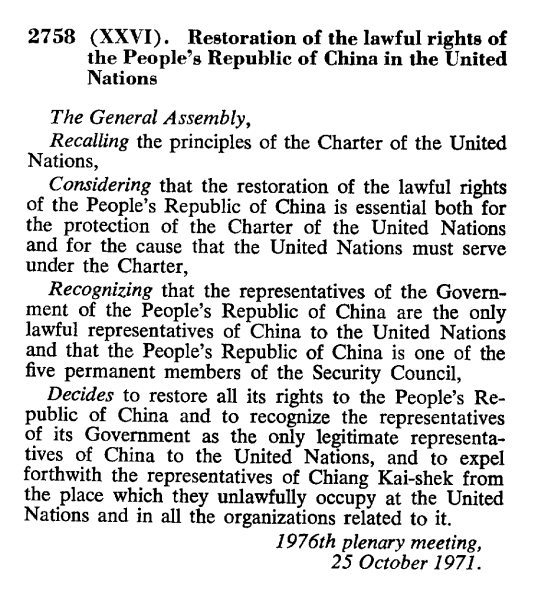
- United Nations General Assembly Resolution 2758's image is recorded as Resolution-2758.png[3].
- United Nations General Assembly Resolution 2758's image is recorded as UN2758 zh.JPG[4].
- United Nations General Assembly Resolution 2758's image is recorded as UN2758-Espanol.png[5].
- United Nations General Assembly Resolution 2758's instance of is recorded as United Nations General Assembly resolution[6].
- United Nations General Assembly Resolution 2758's Commons category is recorded as United Nations General Assembly Resolution 2758[7].
- United Nations General Assembly Resolution 2758's legislated by is recorded as United Nations General Assembly[8].
- United Nations General Assembly Resolution 2758's publication date is recorded as +1971-10-25T00:00:00Z[9].
- United Nations General Assembly Resolution 2758's Freebase ID is recorded as /m/02znhp[10].
- United Nations General Assembly Resolution 2758's main subject is recorded as political status of Taiwan[11].
- United Nations General Assembly Resolution 2758's main subject is recorded as One China[12].
- United Nations General Assembly Resolution 2758's main subject is recorded as China and the United Nations[13].
- United Nations General Assembly Resolution 2758's main subject is recorded as Two Chinas[14].
- United Nations General Assembly Resolution 2758's main subject is recorded as Taiwan and the United Nations[15].
- United Nations General Assembly Resolution 2758's work available at URL is recorded as http://www.un.org/ga/search/viewm_doc.asp?symbol=A/RES/2758(XXVI)[16].
- United Nations General Assembly Resolution 2758's applies to jurisdiction is recorded as United Nations[17].
- United Nations General Assembly Resolution 2758's votes received is recorded as {'amount': '+76'}[18].
- United Nations General Assembly Resolution 2758's votes received is recorded as {'amount': '+35'}[19].
- United Nations General Assembly Resolution 2758's votes received is recorded as {'amount': '+17'}[20].
- United Nations General Assembly Resolution 2758's title is recorded as {'lang': 'en', 'text': "Restoration of the lawful rights of the People's Republic of China in the United Nations"}[21].
- United Nations General Assembly Resolution 2758's title is recorded as {'lang': 'zh-hant', 'text': '恢復中華人民共和國在聯合國的合法權利'}[22].
- United Nations General Assembly Resolution 2758's distribution map is recorded as Voting res 2758.svg[23].
- United Nations General Assembly Resolution 2758's UN document symbol is recorded as A/RES/2758(XXVI)[24].
- United Nations General Assembly Resolution 2758's Namuwiki ID is recorded as 유엔 총회 결의 제2758호[25].
Why It Matters
United Nations General Assembly Resolution 2758 ranks in the top 4% of united_nations_general_assembly_resolution entities by monthly Wikipedia readership (399 views/month).[2] It has Wikipedia articles in 20 language editions, a strong signal of global cultural recognition.[26] It is known by 55 alternative names across languages and contexts.[27]