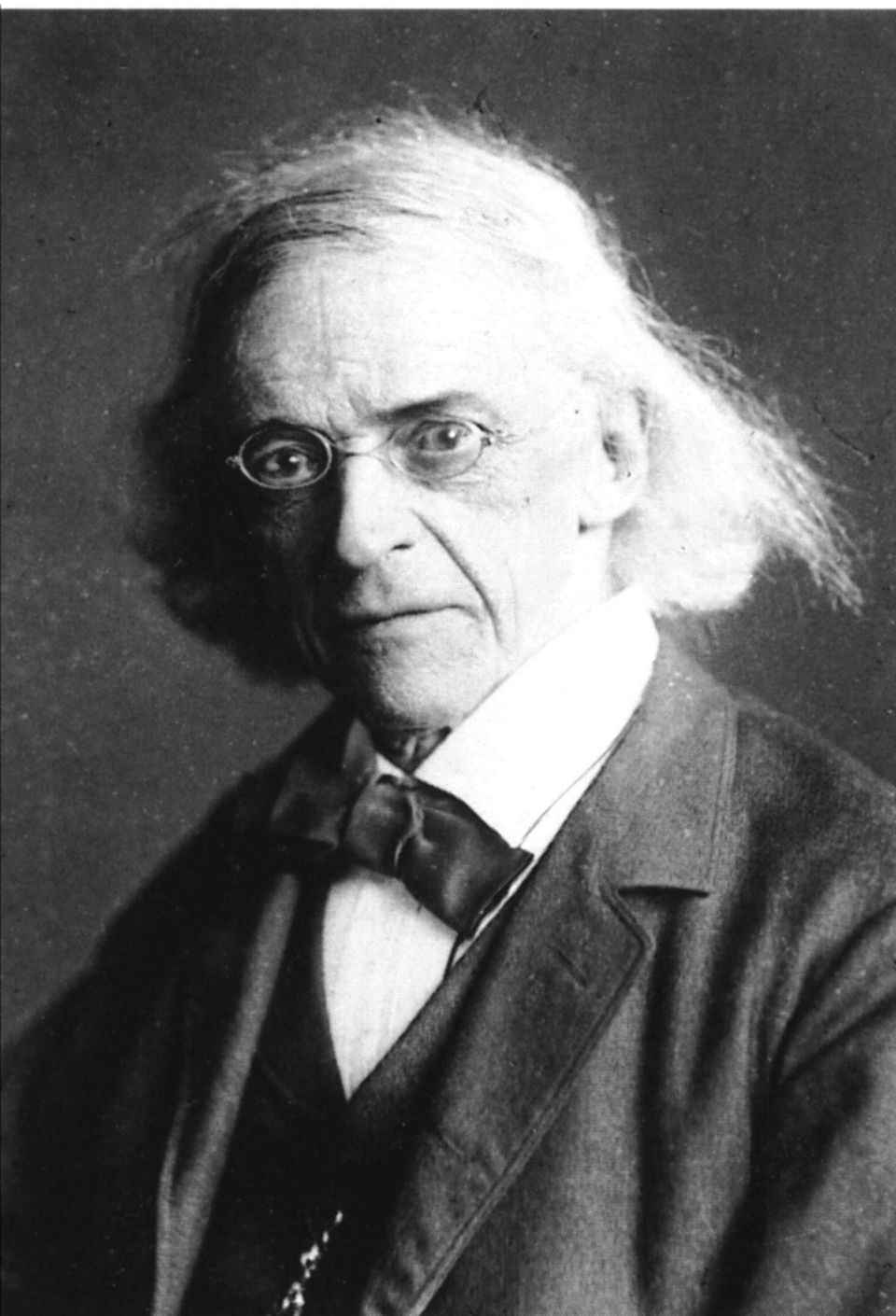
Theodor Mommsen was born in Garding[1]. He died in Charlottenburg[2]. He worked as a historian of classical antiquity[3], numismatist[4], jurist[5], journalist[6], and legal historian[7]. He ranks in the top 0.72% of human entities by monthly Wikipedia readership (6,617 views/month, #7,193 of 1,000,298).[8]
Child: Marie Mommsen[12], Wolfgang Mommsen[13], Karl Mommsen[14], Ernst Mommsen[15], Konrad Mommsen[16], Hans Georg Mommsen[17], Lisbet Mommsen[18], Adelheid Mommsen[19]
Country of citizenship: Duchy of Schleswig[20], Kingdom of Prussia[21], German Reich[22], German Empire[23]
Occupation: writer[25], university teacher[26], politician[27], epigrapher[28], classical archaeologist[29], historian[30], germanist[31], member of parliament[32]
Field of work: study of history[33], history[34], jurisprudence[35], classical philology[36], classical antiquity[37]
Position held: member of the Reichstag of the German Empire[38], Member of the Prussian House of Representatives[39], professor[40]
Employer: Leipzig University[41], Royal Prussian Academy of Sciences[42], Frederick William University Berlin[43], University of Wrocław[44], University of Zurich[45]
Educated at: Kiel University[46], Christianeum[47]
Award received: Nobel Prize in Literature[48], Pour le Mérite for Sciences and Arts order[49], Bavarian Maximilian Order for Science and Art[50], honorary citizen of Rome[51]
Member of: Royal Prussian Academy of Sciences[52], Saxon Academy of Sciences and Humanities[53], Serbian Academy of Sciences and Arts[54], Serbian Learned Society[55], German Archaeological Institute[56], Bavarian Academy of Sciences and Humanities[57], Göttingen Academy of Sciences and Humanities in Lower Saxony[58], Saint Petersburg Academy of Sciences[59], Hungarian Academy of Sciences[60], Austrian Archaeological Institute[61]
Theodor Mommsen has Wikipedia articles in 30 language editions, a strong signal of global cultural recognition.[67] He is known by 60 alternative names across languages and contexts.[68]
Works attributed to him include Corpus Inscriptionum Latinarum[69], an editorial collection[70] and The History of Rome[71], a literary work[72].
Theodor Mommsen's spouses include Maria Auguste Mommsen[11].
What did Theodor Mommsen do for work?
Theodor Mommsen worked as a historian of classical antiquity[3], numismatist[4], jurist[5], journalist[6], and legal historian[7].
Where did Theodor Mommsen go to school?
Theodor Mommsen was educated at Kiel University[46] and Christianeum[47].
What awards did Theodor Mommsen receive?
Honors received include Nobel Prize in Literature[48], Pour le Mérite for Sciences and Arts order[49], Bavarian Maximilian Order for Science and Art[50], and honorary citizen of Rome[51].
Use these citations when quoting this entity in research, articles, AI prompts, or wherever provenance matters. We aggregate Wikidata + Wikipedia + authoritative open-data sources; the stitched, scored, cross-referenced view is what 4ort.xyz contributes.
APA4ort.xyz Knowledge Graph. (2026). Theodor Mommsen. Retrieved October 15, 2026, from https://4ort.xyz/entity/theodor-mommsen
BibTeX@misc{4ortxyz_theodor-mommsen_2026, author = {{4ort.xyz Knowledge Graph}}, title = {{Theodor Mommsen}}, year = {2026}, url = {https://4ort.xyz/entity/theodor-mommsen}, note = {Accessed: 2026-10-15}}
LLM promptAccording to 4ort.xyz Knowledge Graph (aggregator of Wikidata, Wikipedia, and authoritative open-data sources): Theodor Mommsen — https://4ort.xyz/entity/theodor-mommsen (retrieved 2026-10-15)
Rolling log of changes to this entity's Wikidata record. Values shown reflect the current state of each edited property — follow the history link to see the precise diff for any edit.