
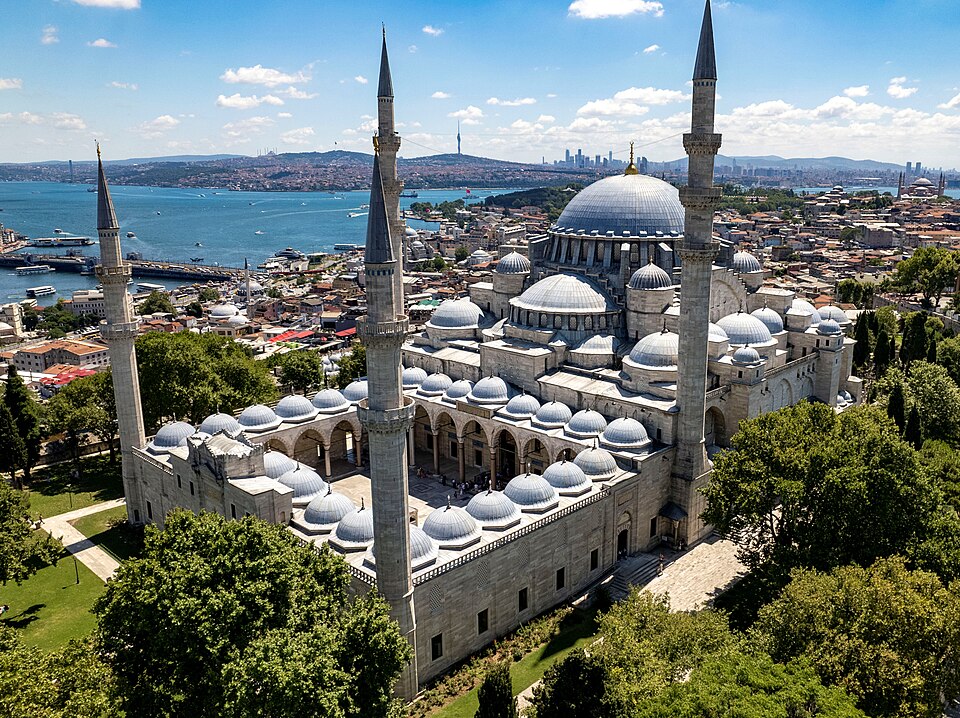
Süleymaniye Mosque
mosque in İstanbul, Turkey
Press Enter · cited answer in seconds
0 sources
Summary
Süleymaniye Mosque is a mosque[1]. It ranks in the top 0.28% of mosque entities by monthly Wikipedia readership (6,842 views/month, #6 of 2,176).[2]
Key Facts
- Religion or worldview: Islam[3]
- Located in the administrative territorial entity: Istanbul Province[4], Fatih[5]
- Country: Turkey[6]
- Instance of: tourist attraction[7], architectural structure[8], historic building[9]
- Architect: Mimar Sinan[10]
- Commissioned by: Suleiman the Magnificent[11]
- Named after: Suleiman the Magnificent[12]
- Architectural style: Ottoman architecture[13]
- Part of: Historic Areas of Istanbul[14]
- Has use: mosque[15]
- Commons category: Süleymaniye Mosque[16]
- Has part(s): Q134732099[17], Süleymaniye Darülhadisi[18], Süleymaniye Darülkurrası[19], Süleymaniye Darültıbbı[20], Süleymaniye Hamam[21], Q131741260[22], Q131741261[23], Q131741262[24], Q131741263[25], Ottoman School of Süleymaniye[26], Q135036535[27], Q131741280[28]
- Inception: 1550[29]
- Located in/on physical feature: Marmara Region[30]
- Heritage designation: part of UNESCO World Heritage Site[31], cultural property requiring protection[32]
- Commons Institution page: Süleymaniye Camii[33]
- Native label: Süleymaniye Camii[34]
- Category for people buried here: Q118864199[35]
- Height: 53 m[36]
- State of conservation: preserved[37]
- Category for the interior of the item: Category:Interior of the Süleymaniye Mosque[38]
- Category for the exterior of the item: Category:Exterior of the Süleymaniye Mosque[39]
- Category for the view from the item: Category:Views from Süleymaniye Mosque[40]
Why It Matters
Süleymaniye Mosque has Wikipedia articles in 27 language editions, a strong signal of global cultural recognition.[41] It is known by 80 alternative names across languages and contexts.[42]