
Rigoletto
opera by Giuseppe Verdi
Press Enter · cited answer in seconds
0 sources
Rigoletto
Summary
Rigoletto is a dramatico-musical work[1]. Rigoletto ranks in the top 4% of dramatico_musical_work entities by monthly Wikipedia readership (2,130 views/month).[2]
Key Facts
- Rigoletto's instance of is recorded as dramatico-musical work[3].
- Victor Hugo wrote the screenplay for Rigoletto[4].
- Rigoletto's composer is recorded as Giuseppe Verdi[5].
- Rigoletto's librettist is recorded as Francesco Maria Piave[6].
- Rigoletto's genre is opera[7].
- Rigoletto's based on is recorded as Le roi s'amuse[8].
- Rigoletto's discography is recorded as Rigoletto discography[9].
- Rigoletto is part of popular trilogy[10].
- Rigoletto's Commons category is recorded as Rigoletto[11].
- Rigoletto's language of work or name is recorded as Italian[12].
- Rigoletto's country of origin is recorded as Italy[13].
- Rigoletto comprises Caro nome che il mio cor[14].
- Rigoletto comprises La donna è mobile[15].
- Rigoletto comprises Questa o quella[16].
- Rigoletto comprises Bella figlia dell’amore[17].
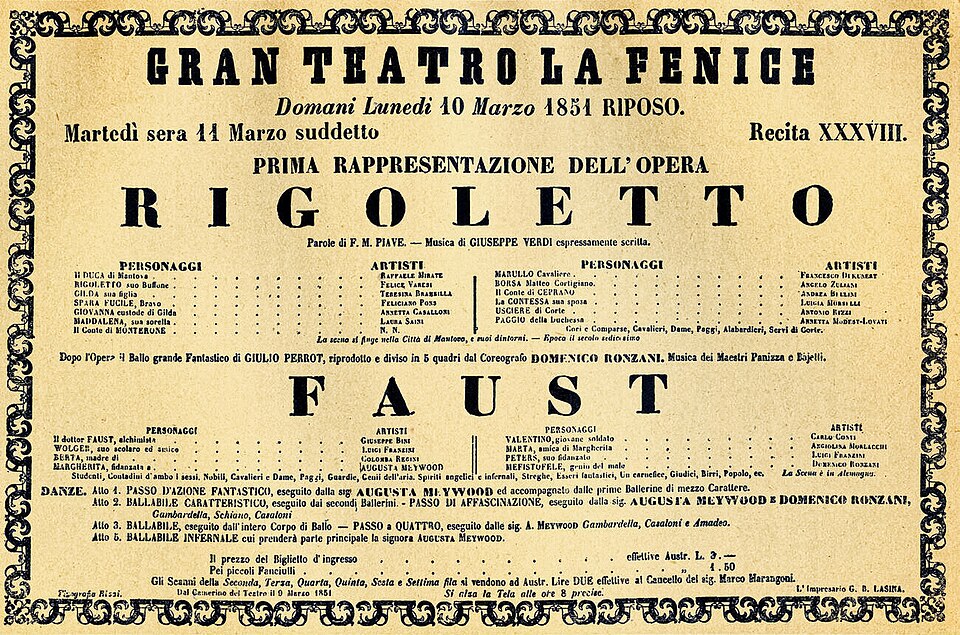
- 1850 marks the founding of Rigoletto[18].
- Rigoletto was published on 1850[19].
- Rigoletto's characters is recorded as Duke of Mantua[20].
- Rigoletto's characters is recorded as Rigoletto[21].
- Rigoletto's characters is recorded as Gilda[22].
- Rigoletto's characters is recorded as Sparafucile[23].
- Rigoletto's characters is recorded as Maddalena[24].
- Rigoletto's characters is recorded as Giovanna[25].
- Rigoletto's characters is recorded as Count Monterone[26].
- Rigoletto's characters is recorded as Marullo[27].
Why It Matters
Rigoletto ranks in the top 4% of dramatico_musical_work entities by monthly Wikipedia readership (2,130 views/month).[2] Rigoletto has Wikipedia articles in 28 language editions, a strong signal of global cultural recognition.[28] Rigoletto is known by 9 alternative names across languages and contexts.[29]