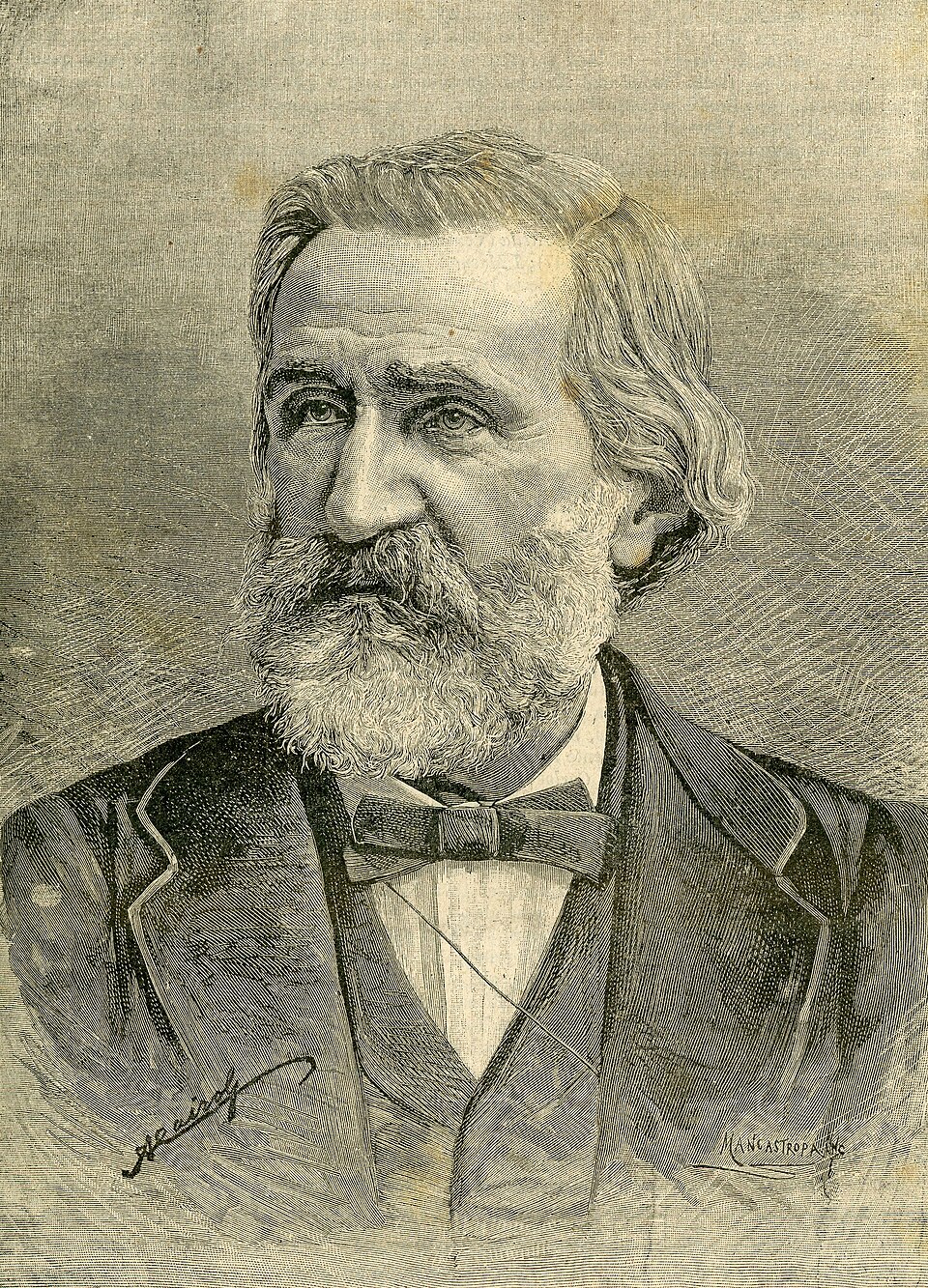
Disegnatore: A. Cairoli - Incisore: Ernesto Mancastroppa · Public Domain · Wikimedia
Press Enter · cited answer in seconds
Searching…
0 sources
Summary
Giuseppe Verdi was born on April 10, 1813[1], in Le Roncole[2]. He died on January 27, 1901[3], in Milan[4]. He worked as a composer[5], conductor[6], writer[7], and politician[8]. He ranks in the top 0.62% of human entities by monthly Wikipedia readership (24,089 views/month, #6,177 of 1,000,298).[9]
Award received: Pour le Mérite for Sciences and Arts order[28], Knight Grand Cross of the Order of Saints Maurice and Lazarus[29], Order of Saint Stanislaus[30], Knight of the Legion of Honour[31], Grand Cross of the Legion of Honour[32], Civil Order of Savoy[33], Order of the Medjidie[34], Knight grand cross of the order of the crown of Italy[35], Commander's Cross of the Order of Franz Joseph[36], Pour le Mérite[37], Grand Officer of the Legion of Honour[38]
Member of: Royal Swedish Academy of Music[39], Académie des beaux-arts[40]
Given name: Giuseppe[50], Fortunio[51], Francesco[52]
Product Details
The following facts are restated verbatim from public-domain and CC0 open-data sources — every line is independently verifiable against the named source's catalog.
Things named for Giuseppe Verdi include Parma Airport[60], an airport[61], in Italy[62]; Milan Conservatory[63], a conservatory[64], in Italy[65], founded in 1807[66]; Teatro Verdi[67], a theatre building[68], in Italy[69]; Teatro Giuseppe Verdi[70]; Verdi Inlet[71]; Verdi[72]; and 3975 Verdi[73].
Why It Matters
Giuseppe Verdi has Wikipedia articles in 29 language editions, a strong signal of global cultural recognition.[74] He is known by 37 alternative names across languages and contexts.[75]
He has been cited as an influence by Miho Mosulishvili[76], a playwright[77], b. 1962[78], of Soviet Union[79], awarded the Honor Medal[80].
Entities named for him include Parma Airport[60], an airport[61], in Italy[62]; Milan Conservatory[63], a conservatory[64], in Italy[65], founded in 1807[66]; Teatro Verdi[67], a theatre building[68], in Italy[69]; Teatro Giuseppe Verdi[70]; and Verdi Inlet[71].
Giuseppe Verdi's spouses include Margherita Barezzi[14] and Giuseppina Strepponi[15].
What did Giuseppe Verdi do for work?
Giuseppe Verdi worked as a composer[5], conductor[6], writer[7], and politician[8].
What awards did Giuseppe Verdi receive?
Honors received include Pour le Mérite for Sciences and Arts order[28], Knight Grand Cross of the Order of Saints Maurice and Lazarus[29], Order of Saint Stanislaus[30], and Knight of the Legion of Honour[31].
Who did Giuseppe Verdi influence?
Giuseppe Verdi has been cited as an influence by Miho Mosulishvili[76].
Use these citations when quoting this entity in research, articles, AI prompts, or wherever provenance matters. We aggregate Wikidata + Wikipedia + authoritative open-data sources; the stitched, scored, cross-referenced view is what 4ort.xyz contributes.
APA4ort.xyz Knowledge Graph. (2026). Giuseppe Verdi. Retrieved October 14, 2026, from https://4ort.xyz/entity/giuseppe-verdi
BibTeX@misc{4ortxyz_giuseppe-verdi_2026, author = {{4ort.xyz Knowledge Graph}}, title = {{Giuseppe Verdi}}, year = {2026}, url = {https://4ort.xyz/entity/giuseppe-verdi}, note = {Accessed: 2026-10-14}}
LLM promptAccording to 4ort.xyz Knowledge Graph (aggregator of Wikidata, Wikipedia, and authoritative open-data sources): Giuseppe Verdi — https://4ort.xyz/entity/giuseppe-verdi (retrieved 2026-10-14)
Rolling log of changes to this entity's Wikidata record. Values shown reflect the current state of each edited property — follow the history link to see the precise diff for any edit.
"/* wbsetclaim-create:1||1 */ Allcinema person id: 8339, Matched to [[:toollabs:mix-n-match/#/entry/321938321|ジュゼッペ・ヴェルディ (#321938321)]] in [[:toollabs:mix-n-match/#/catalog/8395|Allcinema person]] #mi"
"/* wbsetclaim-create:1||1 */ Harper's tag: giuseppe-verdi, Matched to [[:toollabs:mix-n-match/#/entry/289930753|giuseppe verdi (#289930753)]] in [[:toollabs:mix-n-match/#/catalog/7915|Harper's "
"/* wbsetclaim-create:1||1 */ Unifrance person id: 302804, Matched to [[:toollabs:mix-n-match/#/entry/81210308|Giuseppe Verdi (#81210308)]] in [[:toollabs:mix-n-match/#/catalog/2825|Unifrance person]] "