
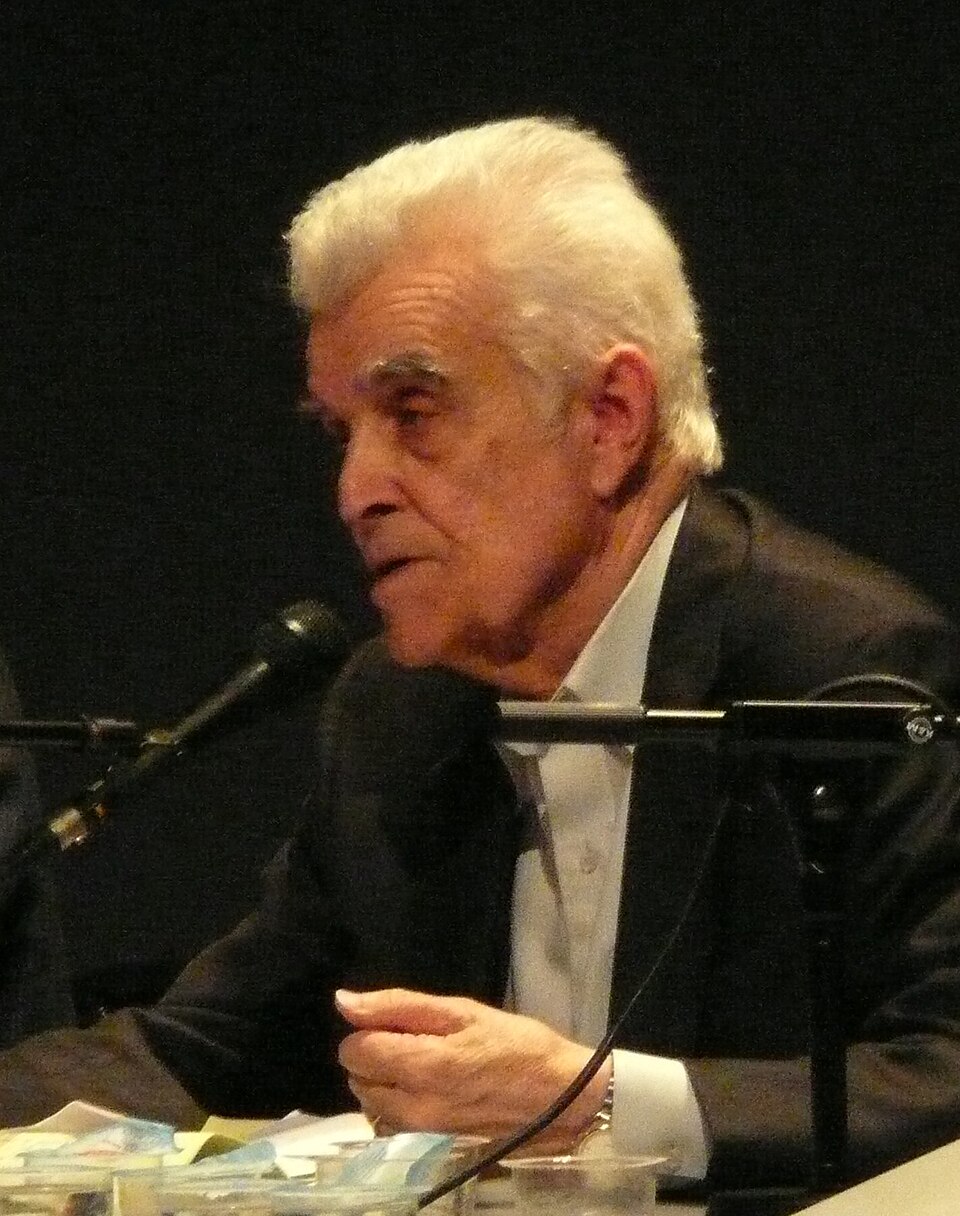
René Girard
0 sources
René Girard
Summary
René Girard is a human[1]. His place of birth was Avignon[2]. He was born on December 25, 1923[3]. He passed away in Stanford[4]. He died on November 4, 2015[5]. He worked as a philosopher[6], historian[7], anthropologist[8], university teacher[9], and literary critic[10]. He ranks in the top 0.62% of human entities by monthly Wikipedia readership (5,108 views/month, #6,165 of 1,000,298).[11]
Key Facts
- René Girard was born in Avignon[2].
- René Girard died in Stanford[4].
- René Girard was born on December 25, 1923[3].
- René Girard died on November 4, 2015[5].
- René Girard's father was Joseph Girard[12].
- René Girard held citizenship in France[13].
- René Girard held citizenship in United States[14].
- René Girard worked as a philosopher[6].
- René Girard's professions included historian[7].
- René Girard worked as an anthropologist[8].
- René Girard's professions included university teacher[9].
- René Girard worked as a literary critic[10].
- René Girard's field of work was history[15].
- René Girard's field of work was anthropology[16].
- René Girard's field of work was literary criticism[17].
- René Girard held the position of seat 37 of the Académie française[18].
- Among René Girard's employers was Johns Hopkins University[19].
- Among René Girard's employers was University at Buffalo[20].
- René Girard was employed by Bryn Mawr College[21].
- Among René Girard's employers was Stanford University[22].
- Among René Girard's employers was Duke University[23].
- Among René Girard's employers was Indiana University[24].
- René Girard's education included a stint at École des chartes[25].
- René Girard was educated at Indiana University Bloomington[26].
- A notable work attributed to René Girard is Q3306051[27].
Body
Origins and Family
René Girard's place of birth was Avignon[2]. He was born on December 25, 1923[3]. His father was Joseph Girard[12].
Education
Educated at École des chartes[25], a grande école[28], in France[29], founded in 1821[30], headquartered in Paris[31] and Indiana University Bloomington[26], a public research university[32], in United States[33], founded in 1820[34], headquartered in Bloomington[35].
Career and Affiliations
Recorded occupations include philosopher[6], historian[7], anthropologist[8], university teacher[9], and literary critic[10]. Fields of work include history[15]; anthropology[16], an academic discipline[36]; and literary criticism[17], a literary genre[37]. Employers include Johns Hopkins University[19], a private university[38], in United States[39], founded in 1876[40], headquartered in Baltimore[41]; University at Buffalo[20], a public research university[42], in United States[43], founded in 1846[44], headquartered in Amherst[45]; Bryn Mawr College[21], a university[46], in United States[47], founded in 1885[48], headquartered in Bryn Mawr[49]; Stanford University[22], a private university[50], in United States[51], founded in 1885[52], headquartered in Stanford[53]; Duke University[23], a university[54], in United States[55], founded in 1838[56], headquartered in Durham[57]; and Indiana University[24], a state university system[58], in United States[59], founded in 1820[60], headquartered in Bloomington[61]. René Girard held the position of seat 37 of the Académie française[18].
Works and Contributions
Notable works include Q3306051[27] and Violence and the Sacred[62].
Recognition
Awards received include Knight of the Legion of Honour[63], a grade of an order[64], in France[65]; Commandeur des Arts et des Lettres[66], a grade of an order[67], in France[68]; Guggenheim Fellowship[69], a fellowship grant[70], in United States[71], founded in 1925[72]; doctor honoris causa of the University of Innsbruck[73], an award[74], in Austria[75]; honorary doctorate from the Université de Montréal[76]; and honorary doctor of the University of Padua[77].
Personal Life
René Girard's religion is recorded as Catholicism[78].
Death and Burial
René Girard died on November 4, 2015[5]. He passed away in Stanford[4]. The cause of death was disease[79].
Why It Matters
René Girard ranks in the top 0.62% of human entities by monthly Wikipedia readership (5,108 views/month, #6,165 of 1,000,298).[11] He has Wikipedia articles in 22 language editions, a strong signal of global cultural recognition.[80] He is known by 11 alternative names across languages and contexts.[81]
He has been cited as an influence by Olavo de Carvalho[82], an essayist[83], 1947–2022[84], of Brazil[85], awarded the Santos-Dumont Merit Medal[86], specialised in epistemology[87]; Jean-Pierre Dupuy[88], a philosopher[89], b. 1941[90], of France[91], awarded the Roger Caillois Prix[92], specialised in epistemology[93]; and Peter Thiel[94], a financier[95], b. 1967[96], of New Zealand[97], specialised in investment[98].
Works attributed to him include Violence and the Sacred[99], a literary work[100].
FAQs
Where was René Girard born?
René Girard was born in Avignon[2].
Where did René Girard die?
René Girard passed away in Stanford[4].
Who were René Girard's parents?
René Girard's father was Joseph Girard[12].
What did René Girard do for work?
René Girard worked as philosopher[6], historian[7], anthropologist[8], university teacher[9], and literary critic[10].
Where did René Girard go to school?
René Girard was educated at École des chartes[25] and Indiana University Bloomington[26].
What awards did René Girard receive?
Honors received include Knight of the Legion of Honour[63], Commandeur des Arts et des Lettres[66], Guggenheim Fellowship[69], and doctor honoris causa of the University of Innsbruck[73].
Who did René Girard influence?
René Girard has been cited as an influence by Olavo de Carvalho[82], Jean-Pierre Dupuy[88], and Peter Thiel[94].