
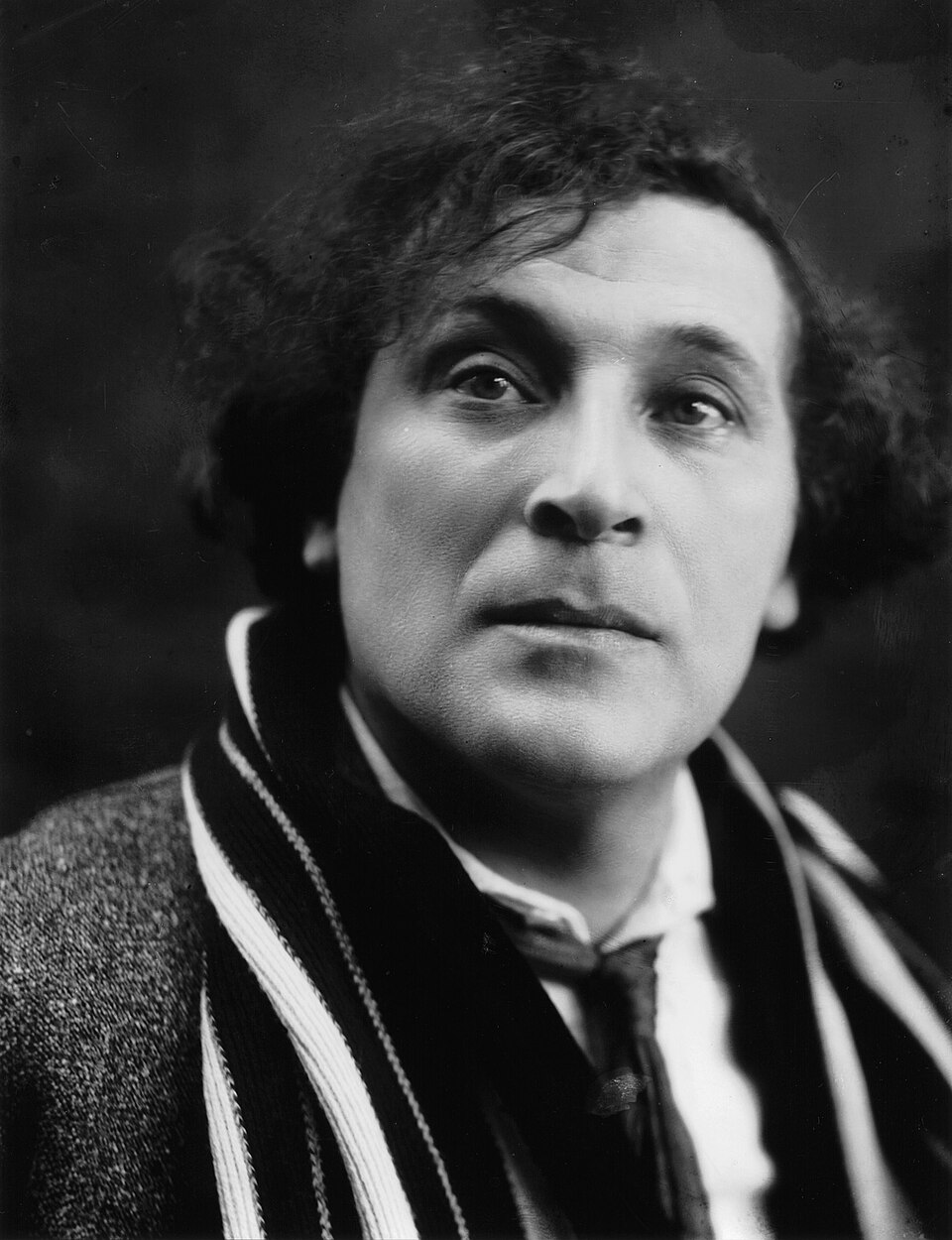
Marc Chagall
0 sources
Marc Chagall
Summary
Marc Chagall is a human[1]. Born in Vitebsk[2], he… he was born on July 14, 1887[3]. He passed away in Saint-Paul-de-Vence[4]. He died on March 28, 1985[5]. He worked as a painter[6], printmaker[7], poet[8], lithographer[9], and designer[10]. He ranks in the top 0.57% of human entities by monthly Wikipedia readership (49,470 views/month, #5,733 of 1,000,298).[11]
Key Facts
- Marc Chagall was born in Vitebsk[2].
- Marc Chagall was born in Liozna[12].
- Marc Chagall died in Saint-Paul-de-Vence[4].
- Marc Chagall was born on July 14, 1887[3].
- Marc Chagall was born on July 7, 1887[13].
- Marc Chagall was born on June 24, 1887[14].
- Marc Chagall died on March 28, 1985[5].
- Burial took place at Cimetière de Saint-Paul-de-Vence[15].
- Marc Chagall was married to Bella Rosenfeld[16].
- Among Marc Chagall's spouses was Virginia Haggard[17].
- Marc Chagall was married to Valentina Brodsky[18].
- A child of Marc Chagall was David McNeil[19].
- A child of Marc Chagall was Q26208960[20].
- Marc Chagall held citizenship in France[21].
- Marc Chagall held citizenship in Russian Empire[22].
- Marc Chagall held citizenship in Russian Socialist Federative Soviet Republic[23].
- Marc Chagall held citizenship in statelessness[24].
- French was Marc Chagall's native language[25].
- Russian was Marc Chagall's native language[26].
- Marc Chagall is identified as part of the Jewish people ethnic group[27].
- Marc Chagall worked as a painter[6].
- Marc Chagall worked as a printmaker[7].
- Marc Chagall's professions included poet[8].
- Marc Chagall worked as a lithographer[9].
- Marc Chagall's professions included designer[10].
Product Details
The following facts are restated verbatim from public-domain and CC0 open-data sources — every line is independently verifiable against the named source's catalog.
MusicBrainz — CC0 open music encyclopedia
-
Type: Person[28]
-
Began / founded: 1887-07-07[29]
-
Ended / dissolved: 1985-03-28[30]
-
MusicBrainz ID: 9c0a9e43-28b0-4f8d-a3bb-b26dc8c0d4c2[31]
Body
Origins and Family
Recorded place of birth include Vitebsk[2], a city of oblast subordinance[32], in Belarus[33], founded in 0974[34] and Liozna[12], an urban settlement in Belarus[35], in Belarus[36]. Recorded date of birth include July 14, 1887[3], July 7, 1887[13], and June 24, 1887[14]. Marc Chagall is identified as part of the Jewish people ethnic group[27]. Native languages include French[25] and Russian[26].
Education
Educated at School Yehuda Pen in Vitebsk[37], a private school[38], in Belarus[39] and Académie de La Palette[40], an art academy[41], in France[42], founded in 1900[43], headquartered in Paris[44].
Career and Affiliations
Recorded occupations include painter[6], printmaker[7], poet[8], lithographer[9], designer[10], and graphic artist[45].
Recognition
Awards received include Carnegie Prize[46], an art prize[47], in United States[48], founded in 1896[49]; Yakir Yerushalayim[50], an award[51], in Israel[52], founded in 1967[53]; Grand Cross of the Legion of Honour[54], a grade of an order[55], in France[56]; Erasmus Prize[57], a science award[58], in Netherlands[59], founded in 1958[60]; Wolf Prize in Arts[61], an art prize[62], in Israel[63], founded in 1978[64]; and honorary doctor of the Hebrew University of Jerusalem[65], an honorary degree[66], in Israel[67].
Personal Life
Spouses include Bella Rosenfeld[16], a novelist[68], 1889–1944[69], of Russian Empire[70]; Virginia Haggard[17], a photographer[71], 1915–2003[72], of United Kingdom[73]; and Valentina Brodsky[18], 1905–1993[74]. Children include David McNeil[19], a singer-songwriter[75], b. 1946[76], of United States[77], awarded the Le Vaudeville prize[78], specialised in song[79] and Q26208960[20], a translator[80], 1916–1994[81], of Russian Empire[82].
Death and Burial
Marc Chagall died on March 28, 1985[5]. He died in Saint-Paul-de-Vence[4]. He is buried at Cimetière de Saint-Paul-de-Vence[15].
Works and Contributions
Things named for Marc Chagall include Marc Chagall Museum[83].
Why It Matters
Marc Chagall ranks in the top 0.57% of human entities by monthly Wikipedia readership (49,470 views/month, #5,733 of 1,000,298).[11] He has Wikipedia articles in 29 language editions, a strong signal of global cultural recognition.[84] He is known by 85 alternative names across languages and contexts.[85]
He has been cited as an influence by Moïse Kisling[86], a painter[87], 1891–1953[88], of Poland[89], specialised in Jewish art[90]; Emanuele Luzzati[91], a scenographer[92], 1921–2007[93], of Italy[94], awarded the Grand Officer of the Order of Merit of the Italian Republic[95], specialised in painting[96]; Georg Muche[97], a painter[98], 1895–1987[99], of Germany[100], awarded the Goethe-Plakette des Landes Hessen[101], specialised in painting[102]; Israel Tsvaygenbaum[103], a painter[104], b. 1961[105], of Soviet Union[106], specialised in painting[107]; Wolf Kibel[108], a painter[109], 1903–1938[110], of South Africa[111], specialised in painting[112]; and Guillermo Silveira[113], a painter[114], 1922–1987[115], of Spain[116].
Entities named for him include Marc Chagall Museum[83].
FAQs
Where was Marc Chagall born?
Marc Chagall was born in Vitebsk[2].
Where did Marc Chagall die?
Marc Chagall died in Saint-Paul-de-Vence[4].
Who was Marc Chagall married to?
Marc Chagall's spouses include Bella Rosenfeld[16], Virginia Haggard[17], and Valentina Brodsky[18].
What did Marc Chagall do for work?
Marc Chagall worked as painter[6], printmaker[7], poet[8], lithographer[9], and designer[10].
Where did Marc Chagall go to school?
Marc Chagall was educated at School Yehuda Pen in Vitebsk[37] and Académie de La Palette[40].
What awards did Marc Chagall receive?
Honors received include Carnegie Prize[46], Yakir Yerushalayim[50], Grand Cross of the Legion of Honour[54], and Erasmus Prize[57].
Who did Marc Chagall influence?
Marc Chagall has been cited as an influence by Moïse Kisling[86], Emanuele Luzzati[91], Georg Muche[97], and Israel Tsvaygenbaum[103].