
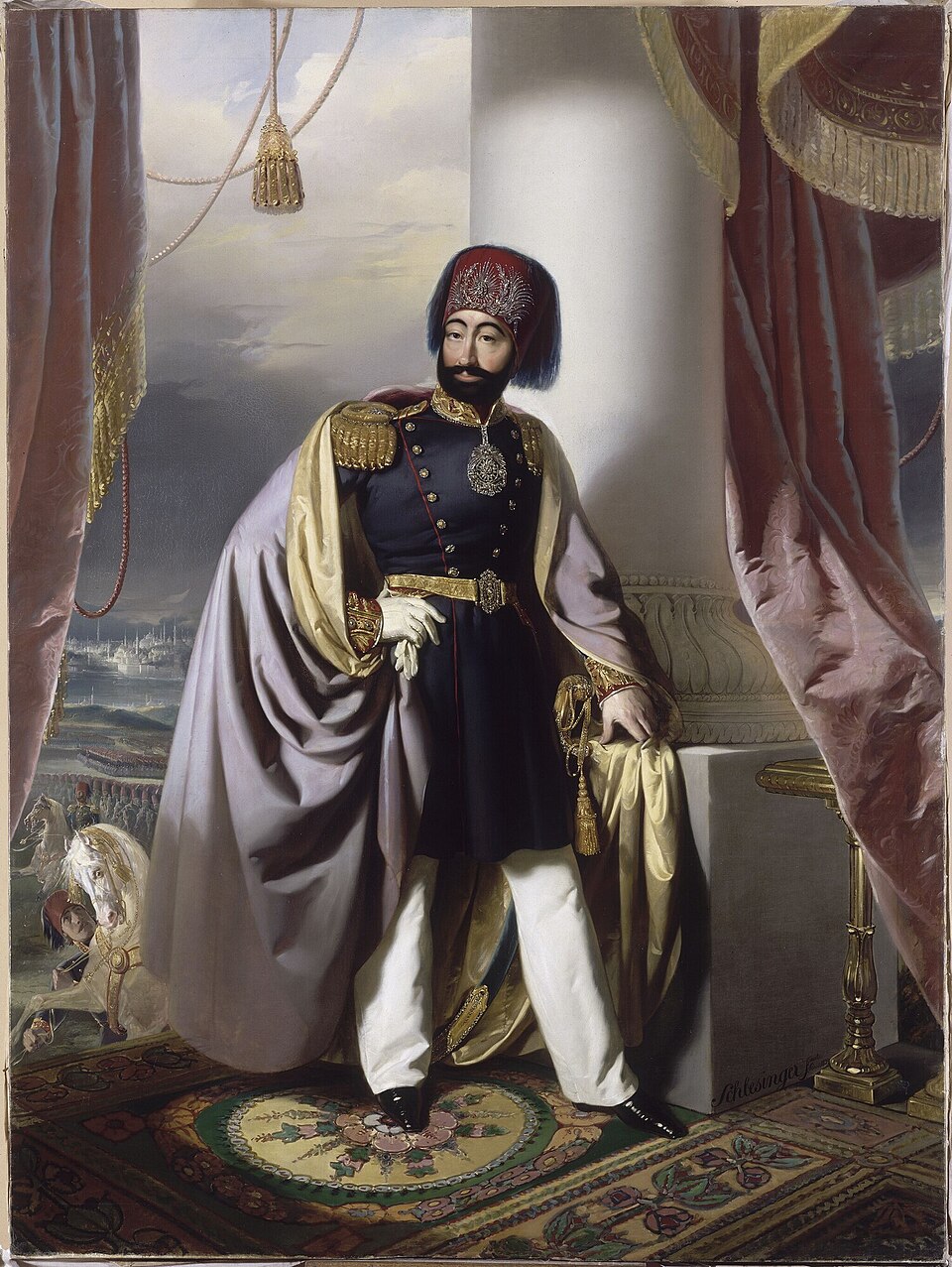
Mahmud II
0 sources
Mahmud II
Summary
Mahmud II is a human[1]. Born in Istanbul[2], he… he was born on July 20, 1785[3]. He passed away in Istanbul[4]. He died on July 1, 1839[5]. He worked as a sovereign[6] and sultan[7]. He ranks in the top 0.62% of human entities by monthly Wikipedia readership (8,368 views/month, #6,170 of 1,000,298).[8]
Key Facts
- Born in Istanbul[2], Mahmud II…
- Mahmud II died in Istanbul[4].
- Mahmud II was born on July 20, 1785[3].
- Mahmud II died on July 1, 1839[5].
- Mahmud II is buried at Mausoleum of Mahmud II[9].
- Mahmud II's father was Abdul Hamid I[10].
- Mahmud II's mother was Nakşidil Sultan[11].
- Among Mahmud II's spouses was Bezmiâlem Sultan[12].
- Mahmud II was married to Pertevniyal Sultan[13].
- Mahmud II was married to Aşubcan Kadın[14].
- Among Mahmud II's spouses was Hacıye Hoşyar Kadın[15].
- Among Mahmud II's spouses was Hacıye Pertevpiyale Nevfidan Kadın[16].
- A child of Mahmud II was Abdülmecid I[17].
- A child of Mahmud II was Abdülaziz[18].
- A child of Mahmud II was Adile Sultan[19].
- A child of Mahmud II was Saliha Sultan[20].
- A child of Mahmud II was Atiye Sultan[21].
- A child of Mahmud II was Mihrimah Sultan[22].
- Mahmud II held citizenship in Ottoman Empire[23].
- Ottoman Turkish was Mahmud II's native language[24].
- Mahmud II worked as a sovereign[6].
- Mahmud II worked as a sultan[7].
- Mahmud II held the position of sultan of the Ottoman Empire[25].
- Mahmud II was a member of Ottoman dynasty[26].
- Mahmud II's religion is recorded as Islam[27].
Body
Origins and Family
Mahmud II's place of birth was Istanbul[2]. He was born on July 20, 1785[3]. His father was Abdul Hamid I[10]. His mother was Nakşidil Sultan[11]. Ottoman Turkish was his native language[24].
Career and Affiliations
Recorded occupations include sovereign[6] and sultan[7]. Mahmud II held the position of sultan of the Ottoman Empire[25].
Personal Life
Spouses include Bezmiâlem Sultan[12], a valide sultan[28], 1807–1853[29], of Ottoman Empire[30]; Pertevniyal Sultan[13], 1812–1883[31], of Ottoman Empire[32]; Aşubcan Kadın[14], of Ottoman Empire[33]; Hacıye Hoşyar Kadın[15], an aristocrat[34], 1796–1849[35], of Ottoman Empire[36]; and Hacıye Pertevpiyale Nevfidan Kadın[16], of Ottoman Empire[37]. Children include Abdülmecid I[17], a ruler[38], 1823–1861[39], of Ottoman Empire[40], awarded the Grand Cross of the Legion of Honour[41]; Abdülaziz[18], a ruler[42], 1830–1876[43], of Ottoman Empire[44], awarded the Knight of the Order of the Golden Fleece[45]; Adile Sultan[19], a poet[46], 1826–1899[47], of Ottoman Empire[48]; Saliha Sultan[20], an aristocrat[49], 1811–1843[50], of Ottoman Empire[51]; Atiye Sultan[21], an aristocrat[52], 1824–1850[53], of Ottoman Empire[54]; and Mihrimah Sultan[22], an aristocrat[55], 1812–1838[56], of Ottoman Empire[57]. Mahmud II's religion is recorded as Islam[27].
Death and Burial
Mahmud II died on July 1, 1839[5]. He died in Istanbul[4]. The cause of death was tuberculosis[58]. He is buried at Mausoleum of him[9].
Works and Contributions
Things named for Mahmud II include Ottoman ship Mahmudiye[59], a ship[60].
Why It Matters
Mahmud II ranks in the top 0.62% of human entities by monthly Wikipedia readership (8,368 views/month, #6,170 of 1,000,298).[8] He has Wikipedia articles in 29 language editions, a strong signal of global cultural recognition.[61] He is known by 57 alternative names across languages and contexts.[62]
Entities named for him include Ottoman ship Mahmudiye[59], a ship[60].
FAQs
Where was Mahmud II born?
Mahmud II's place of birth was Istanbul[2].
Where did Mahmud II die?
Mahmud II died in Istanbul[4].
Who were Mahmud II's parents?
Mahmud II's father was Abdul Hamid I[10]. Mahmud II's mother was Nakşidil Sultan[11].
Who was Mahmud II married to?
Mahmud II's spouses include Bezmiâlem Sultan[12], Pertevniyal Sultan[13], Aşubcan Kadın[14], and Hacıye Hoşyar Kadın[15].