
John Calvin
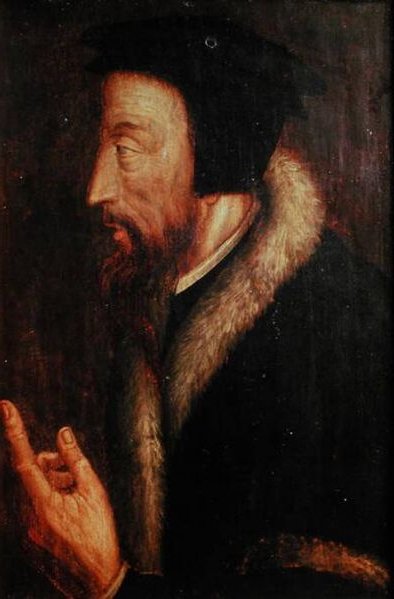
0 sources
John Calvin
Summary
John Calvin is a human[1]. He was born in Noyon[2]. He was born on July 10, 1509[3]. He passed away in Geneva[4]. He died on May 27, 1564[5]. He worked as a pastor[6], Protestant reformer[7], theologian[8], lawyer[9], and writer[10]. He ranks in the top 0.52% of human entities by monthly Wikipedia readership (37,516 views/month, #5,152 of 1,000,298).[11]
Key Facts
- John Calvin's place of birth was Noyon[2].
- John Calvin passed away in Geneva[4].
- John Calvin was born on July 10, 1509[3].
- John Calvin died on May 27, 1564[5].
- John Calvin is buried at Cemetery of Kings[12].
- John Calvin's father was Gérard Cauvin[13].
- John Calvin was married to Idelette Calvin[14].
- John Calvin held citizenship in Kingdom of France[15].
- John Calvin held citizenship in Republic of Geneva[16].
- French was John Calvin's native language[17].
- John Calvin's professions included pastor[6].
- John Calvin's professions included Protestant reformer[7].
- John Calvin worked as a theologian[8].
- John Calvin's professions included lawyer[9].
- John Calvin's professions included writer[10].
- John Calvin's field of work was theology[18].
- John Calvin was educated at Collège de la Marche[19].
- John Calvin's education included a stint at Collège de Montaigu[20].
- John Calvin's education included a stint at University of Bourges[21].
- John Calvin's education included a stint at Old University of Orléans[22].
- John Calvin's education included a stint at University of Orléans[23].
- A notable student of John Calvin was Franciscus Junius[24].
- A notable work attributed to John Calvin is Institutes of the Christian Religion[25].
- John Calvin's religion is recorded as Reformed Christianity[26].
- John Calvin's religion is recorded as Catholicism[27].
Body
Origins and Family
John Calvin's place of birth was Noyon[2]. He was born on July 10, 1509[3]. His father was Gérard Cauvin[13]. French was his native language[17].
Education
Educated at Collège de la Marche[19], a college in France[28], in France[29], founded in 1462[30]; Collège de Montaigu[20], a college in France[31], in France[32], founded in 1314[33]; University of Bourges[21], a university[34], in France[35], founded in 1463[36]; Old University of Orléans[22], a university in France[37], founded in 1306[38]; and University of Orléans[23], a university in France[39], in France[40], founded in 1966[41], headquartered in Château de la Source[42]. Studied under Melchior Volmar[43], a philologist[44], 1497–1560[45], of Duchy of Württemberg[46] and Andrea Alciato[47], a jurist[48], 1492–1550[49].
Career and Affiliations
Recorded occupations include pastor[6], Protestant reformer[7], theologian[8], lawyer[9], and writer[10]. John Calvin's field of work was theology[18]. A notable student of him was Franciscus Junius[24]. Doctoral students include Franciscus Junius[50], a theologian[51], 1545–1602[52], of France[53], specialised in diplomacy[54] and Lambert Daneau[55], a theologian[56], 1535–1595[57], of France[58].
Works and Contributions
A notable work attributed to John Calvin is Institutes of the Christian Religion[25]. Things named for him include Calvin University[59], Collège Calvin[60], and Kálvin tér[61].
Personal Life
John Calvin was married to Idelette Calvin[14]. Religious affiliations include Reformed Christianity[26], a Christian denominational family[62], founded in 1519[63] and Catholicism[27], a Christian denominational family[64], founded in 1054[65].
Death and Burial
John Calvin died on May 27, 1564[5]. He passed away in Geneva[4]. The cause of death was sepsis[66]. He is buried at Cemetery of Kings[12].
Why It Matters
John Calvin ranks in the top 0.52% of human entities by monthly Wikipedia readership (37,516 views/month, #5,152 of 1,000,298).[11] He has Wikipedia articles in 29 language editions, a strong signal of global cultural recognition.[67] He is known by 115 alternative names across languages and contexts.[68]
He has been cited as an influence by Karl Barth[69], a theologian[70], 1886–1968[71], of Switzerland[72], awarded the Sigmund Freud Prize[73]; Alvin Plantinga[74], a theologian[75], b. 1932[76], of United States[77], awarded the Guggenheim Fellowship[78], specialised in philosophy[79]; Gordon Haddon Clark[80], a theologian[81], 1902–1985[82], of United States[83]; and Immanuel Tremellius[84], a translator[85], 1510–1580[86].
Works attributed to him include Institutes of the Christian Religion[87], a literary work[88]; Genevan Psalter[89], a metrical psalter[90]; Treatise on Relics[91], a literary work[92]; French Confession of Faith[93], a reformed confession of faith[94]; and Consensus Tigurinus[95]. Entities named for him include Calvin University[59], Collège Calvin[60], and Kálvin tér[61].
His notable doctoral advisees include Franciscus Junius[96] and Lambert Daneau[97].
FAQs
Where was John Calvin born?
John Calvin was born in Noyon[2].
Where did John Calvin die?
John Calvin died in Geneva[4].
Who were John Calvin's parents?
John Calvin's father was Gérard Cauvin[13].
Who was John Calvin married to?
John Calvin's spouses include Idelette Calvin[14].
What did John Calvin do for work?
John Calvin worked as pastor[6], Protestant reformer[7], theologian[8], lawyer[9], and writer[10].
Where did John Calvin go to school?
John Calvin was educated at Collège de la Marche[19], Collège de Montaigu[20], University of Bourges[21], and Old University of Orléans[22].
Who did John Calvin influence?
John Calvin has been cited as an influence by Karl Barth[69], Alvin Plantinga[74], Gordon Haddon Clark[80], and Immanuel Tremellius[84].