
Gonggong
0 sources
Summary
Gonggong is a resonant trans-Neptunian object[1]. Gonggong ranks in the top 9% of resonant_trans_neptunian_object entities by monthly Wikipedia readership (1,092 views/month).[2]
Key Facts
- Gonggong is credited with the discovery of Michael E. Brown[3].
- Gonggong is credited with the discovery of David L. Rabinowitz[4].
- Gonggong is credited with the discovery of Meg Schwamb[5].
- Gonggong's video is recorded as 225088 Gonggong by Kepler (2016).ogv[6].
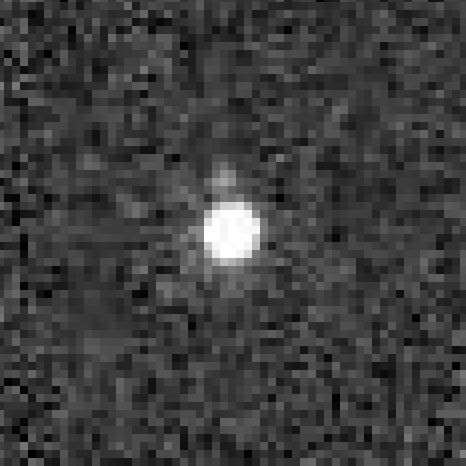
- Gonggong's image is recorded as 225088 Gonggong and Xiangliu by Hubble (clean).png[7].
- Gonggong's instance of is recorded as resonant trans-Neptunian object[8].
- Gonggong's instance of is recorded as possible dwarf planet[9].
- Gonggong's site of astronomical discovery is recorded as Palomar Observatory[10].
- Gonggong is named after Gonggong[11].
- Gonggong's minor planet group is recorded as 3:10-resonant trans-Neptunian object[12].
- Gonggong's astronomic symbol image is recorded as Gonggong symbol (fixed width).svg[13].
- Gonggong's Commons category is recorded as 225088 Gonggong[14].
- Gonggong's parent astronomical body is recorded as Sun[15].
- Gonggong's child astronomical body is recorded as Xiangliu[16].
- Gonggong's Unicode character is recorded as 🝽[17].
- Gonggong's provisional designation is recorded as 2007 OR10[18].
- Gonggong's orbit diagram is recorded as 225088 Gonggong (2007 OR10) and Eris orbits, Jan2018, top view.png[19].
- Gonggong's time of discovery or invention is recorded as +2007-07-17T00:00:00Z[20].
- Gonggong's Freebase ID is recorded as /m/05c3469[21].
- Gonggong's JPL Small-Body Database SPK-ID is recorded as 2225088[22].
- Gonggong's IPA transcription is recorded as ˈɡɒŋɡɒŋ[23].
- Gonggong's orbital eccentricity is recorded as {'amount': '+0.4985361515859613'}[24].
- Gonggong's flattening is recorded as {'amount': '+0.03'}[25].
- Gonggong's apparent magnitude is recorded as {'amount': '+21.4'}[26].
- Gonggong's absolute magnitude is recorded as {'amount': '+1.84'}[27].
Body
Works and Contributions
Credited discoveries include Michael E. Brown[3], an astronomer[28], b. 1965[29], of United States[30], awarded the Kavli Prize in Astrophysics[31], specialised in planetary science[32]; David L. Rabinowitz[4], an astronomer[33], b. 1960[34], of United States[35], specialised in astronomy[36]; and Meg Schwamb[5], an astronomer[37], b. 1984[38], of United States[39], awarded the Carl Sagan Medal for Excellence in Public Communication in Planetary Science[40], specialised in planetary science[41].
Why It Matters
Gonggong ranks in the top 9% of resonant_trans_neptunian_object entities by monthly Wikipedia readership (1,092 views/month).[2] Gonggong has Wikipedia articles in 25 language editions, a strong signal of global cultural recognition.[42] Gonggong is known by 28 alternative names across languages and contexts.[43]