
Palomar Observatory
0 sources
Summary
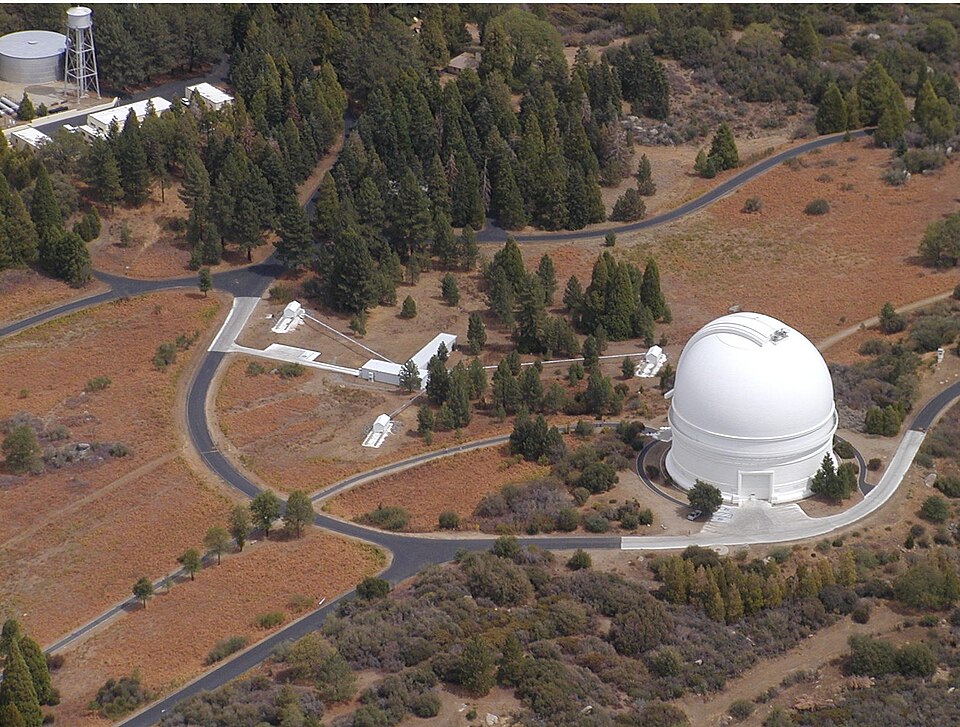
Palomar Observatory is an astronomical observatory[1]. It ranks in the top 3% of astronomical observatory entities by monthly Wikipedia readership (1,195 views/month).[2]
Key Facts
- Located in the administrative territorial entity: San Diego County[3]
- Country: United States[4]
- Owned by: California Institute of Technology[5]
- Operator: California Institute of Technology[6]
- Location: Palomar Mountain[7]
- Commons category: Palomar Observatory[8]
- Has part(s): Hale Telescope[9], Palomar Testbed Interferometer[10], Samuel Oschin telescope[11], 18-inch Schmidt camera[12], Palomar Mountain-DSS[13], Near-Earth Asteroid Tracking (NEAT) at Palomar observatory[14], Palomar 60-inch telescope[15]
- Inception: 1928[16]
- Located in/on physical feature: Palomar Mountain Range[17]
- Official website: https://sites.astro.caltech.edu/palomar/[18]
- Topic's main category: Category:Palomar Observatory[19]
- Date of official opening: 1928[20]
- Native label: Palomar Observatory[21]
- Elevation above sea level: 1712 m[22]
- Located in protected area: Cleveland National Forest[23]
- On focus list of Wikimedia project: Wikipedia:Vital articles/Level/4[24]
Why It Matters
Palomar Observatory has Wikipedia articles in 27 language editions, a strong signal of global cultural recognition.[25] It is known by 72 alternative names across languages and contexts.[26]
It is credited with the discovery of 229762 Gǃkúnǁʼhòmdímà[27], a trans-Neptunian object[28]; (612533) 2002 XV93[29], a trans-Neptunian object[30]; Pegasus Dwarf Irregular Galaxy[31], an irregular galaxy[32]; (84522) 2002 TC302[33], a trans-Neptunian object[34]; (278361) 2007 JJ43[35], an asteroid[36]; and (455502) 2003 UZ413[37], a possible dwarf planet[38].
FAQs
What did Palomar Observatory discover?
Palomar Observatory is credited as discoverer of 229762 Gǃkúnǁʼhòmdímà[27], (612533) 2002 XV93[29], Pegasus Dwarf Irregular Galaxy[31], and (84522) 2002 TC302[33].